
TECHNOLOGICAL INNOVATION
COMPUTATIONAL RULES FOR THE NURSING PROCESS IN ONCOLOGY PALLIATIVE CARE: A TECHNOLOGICAL INNOVATION REPORT
Alex Sandro de Azeredo Siqueira1, Vanessa Gomes da Silva2, Renata Carla Nencetti Pereira Rocha3, Nathalia de Paula Albuquerque Guimarães4, Eliana David da Silva5, Ângela Coe Camargo da Silva6
1 Instituto Nacional de Câncer (INCA), Hospital do Câncer IV (HC IV). Rio de Janeiro, RJ, Brazil. ORCID: 0000-0002-6678-4499. E-mail: assiqueira@inca.gov.br.
2 Instituto Nacional de Câncer (INCA), Hospital do Câncer IV (HC IV). Rio de Janeiro, RJ, Brazil. ORCID: 0000-0003-3438-3401. E-mail: vanessag_2005@yahoo.com.br.
3 Instituto Nacional de Câncer (INCA), Hospital do Câncer IV (HC IV). Rio de Janeiro, RJ, Brazil. ORCID: 0000-0003-1053-6231. E-mail: rcpereira@inca.gov.br.
4 Instituto Nacional de Câncer (INCA), Hospital do Câncer IV (HC IV). Rio de Janeiro, RJ, Brazil. ORCID: 0000-0002-3800-546X. E-mail: depaula_nath@hotmail.com.
5 Instituto Nacional de Câncer (INCA), Hospital do Câncer IV (HC IV). Rio de Janeiro, RJ, Brazil. ORCID: 0000-0003-4665-7545. E-mail: eliana.silva@inca.gov.br.
6 Instituto Nacional de Câncer (INCA), Hospital do Câncer IV (HC IV). Rio de Janeiro, RJ, Brazil. ORCID: 0000-0001-8594-3275. E-mail: asilva@inca.gov.br.
ABSTRACT
Objective: To describe the development, architecture, and construction of the knowledge base of a computational rule-based system for decision support in the Nursing Process in Oncology Palliative Care. Method: A technological innovation report guided by the SQUIRE 2.0 framework, concerning the iterative and participatory development of the PaliPEV platform in a low-code environment (AppSheet®/Google Sheets®). The knowledge base was developed by the Nursing Process Committee across 11 technical-scientific meetings, grounded in Horta's and Kolcaba's theories and a master's thesis. Thirty-one NANDA-I diagnoses were defined and aligned with NOC outcomes, NIC interventions, and nursing prescriptions, alongside the use of the Braden, Morse, and Karnofsky scales and the Edmonton Symptom Assessment System. The study was approved by a Research Ethics Committee. Results: Following an audit, 36,448 valid Nursing Processes distributed across 3,193 medical records (registrations) were identified, featuring 71,969 automatic associations and NANDA-I taxonomy completeness exceeding 99.7% across the three evaluated scenarios. The strategy was complemented by the PaliEducativa platform (35,876 accesses; 2,280 certificates issued), enabling the institution to achieve Gold Certification in a Nursing Process quality program. Conclusion: Grounded in theoretical foundations and empirical data, the iterative development proved feasible for decision support in the Nursing Process in Oncology Palliative Care, demonstrating potential for machine learning application.
Descriptors: Nursing Process; Palliative Care; Nursing Informatics; Clinical Decision Support Systems; Biomedical Technology; Health Information Systems.
|
How to cite: Siqueira ASA, Silva VG, Rocha RCNP, Guimarães NPA, Silva ED, Silva ACC. Computational rules for the nursing process in oncology palliative care: a technological innovation report. Online Braz J Nurs. 2026;25(Suppl 1):e20267082. https://doi.org/10.17665/1676-4285.20267082 |
What is already known
Rule-based clinical decision support systems reduce care variability and assist diagnostic reasoning in nursing.
Low-code platforms expand the development of health technologies in institutions with limited information technology resources.
There is a scarcity of publications on decision support systems applied to the Nursing Process in oncology palliative care within the public health sector.
What this article adds
The integration of NANDA-I, NOC, and NIC taxonomies with the theories of Horta and Kolcaba into a rule engine enables the automated generation of multidimensional nursing plans.
A relational architecture separating the knowledge base from care records allows for continuous updates of clinical knowledge without compromising historical data.
It demonstrates the feasibility of building, within a low-code environment and a real-world care scenario in the Brazilian Unified Health System (SUS), a system that supported 36,448 Nursing Processes for 3,193 patients, achieving NANDA-I completeness exceeding 99.7%.
INTRODUCTION
The growing demand for Oncology Palliative Care and the high complexity of care required by this population highlight the need for technological tools capable of operationalizing the Nursing Process on a large scale. The Nursing Process, grounded in Wanda Horta's Theory of Basic Human Needs(1), constitutes the main scientific method for organizing professional care. It encompasses clinical assessment, diagnosis identification, outcome planning, implementation of interventions, and evaluation of outcomes, being operationalized through standardized classification systems (NANDA-I, NOC, and NIC) and regulated in Brazil by COFEN Resolution No. 736/2024(2,3).
Although computational systems aimed at operationalizing the Nursing Process are already consolidated in various healthcare settings, the absence of these technologies in certain services favors the occurrence of variable and incomplete documentation. This gap overburdens the nurse's cognitive load and compromises the continuity of care(4).
Clinical decision support systems based on computational rules represent a well-established approach to mitigating clinical variability and guiding diagnostic reasoning(5). However, a recent scoping review identified that currently available decision support systems targeting the Nursing Process exhibit limited compliance with international standards recommended for their development. Conversely, the use of low-code platforms for developing health systems has expanded access to technology in institutional settings with Information Technology (IT) resource constraints, enabling the active participation of healthcare professionals in the technological innovation process(6-8).
Studies addressing the design and structuring of knowledge bases for decision support systems in the Nursing Process have prioritized specific diagnoses—such as pediatric hyperthermia and psychiatric nursing care—guiding these bases on clinical guidelines and standardized terminologies; however, they neglect the explicit incorporation of nursing theories as the guiding framework of care(9,10). Similarly, conceptual framework proposals for the architecture of these systems usually do not include nursing theories as a structural foundation(11).
In the domain of palliative care, recent reviews signal the potential of digital technologies to improve symptom assessment, interprofessional communication, and clinical documentation(12-14). Given the absence of a structured system at INCA/HC IV for operationalizing the Nursing Process in Oncology Palliative Care, coupled with the scarcity of publications regarding this topic in public institutions, the PaliPEV platform was developed. This solution is based on the integration of nursing theories, standardized taxonomies, and low-code technology as a strategy to structure and qualify the documentation of care.
Objective
To describe the development, architecture, and construction process of the clinical knowledge base of a computational rule-based system for decision support in the Nursing Process in Oncology Palliative Care.
METHOD
Study design
SQUIRE 2.0 was adopted to guide the structuring and reporting of health quality improvement and innovation initiatives, ensuring transparent communication of the development process and the achieved results(15), in alignment with improvement science principles for establishing healthcare performance measures(16). Because the PaliPEV platform also constitutes a technological product, its development was additionally grounded in the Design Science Research Methodology (DSRM)(17). Its stages guided the study as follows: (1) Problem identification and motivation: identification of the clinical and technological gap represented by the absence of a structured Nursing Process across the three care settings of Hospital do Câncer IV (HC IV); (2) Definition of the objectives for a solution: selection and integration of theoretical frameworks and nursing taxonomies; (3) Design and development: construction of the relational technological architecture and the computational rule engine; (4) Demonstration: implementation and operation in the three care settings; (5) Evaluation: iterative refinement based on usability by nurses in each context; and (6) Communication: preparation of this report.
Institutional context
The study was conducted at the National Cancer Institute (INCA), specifically at Hospital do Câncer IV (HC IV), a national reference unit for Oncology Palliative Care, which encompasses Inpatient Care, Home Care, and Outpatient Care. The motivation for the innovation stemmed from the lack of a structured system for the integrated operationalization of the Nursing Process across these three fronts.
The PaliPEV platform was conceived by the HC IV Nursing Process Committee to act as a clinical decision support system designed for staff nurses, residents, and fellows at the unit. The system guides decision-making by suggesting nursing diagnoses, interventions, and prescriptions—leaving the validation and final decision on their application exclusively to the nurse. Furthermore, it automatically calculates Braden and Morse scale scores from the entered items and automatically generates data spreadsheets, management dashboards, and the final prescription document in PDF format. It should be noted that the master's thesis that served as the foundation for the initial selection of NANDA-I diagnoses(18) consisted of a prior clinical survey, without proposing or testing an computerized system. Therefore, this manuscript constitutes the first scientific report on the PaliPEV platform.
Technological architecture and records
The PaliPEV platform was developed within the AppSheet® environment (Google LLC), integrated with Google Sheets® (Google Workspace®), and registered as an application with Google LLC following confirmation of its implementation. AppSheet® is a no-code/low-code platform that enables the creation of mobile and web applications using spreadsheets as data sources. It offers a visual editor, native expressions for conditional logic and automations, as well as native integration with the Google Workspace® ecosystem(19). These native expressions form the structural basis of the computational rule engine.
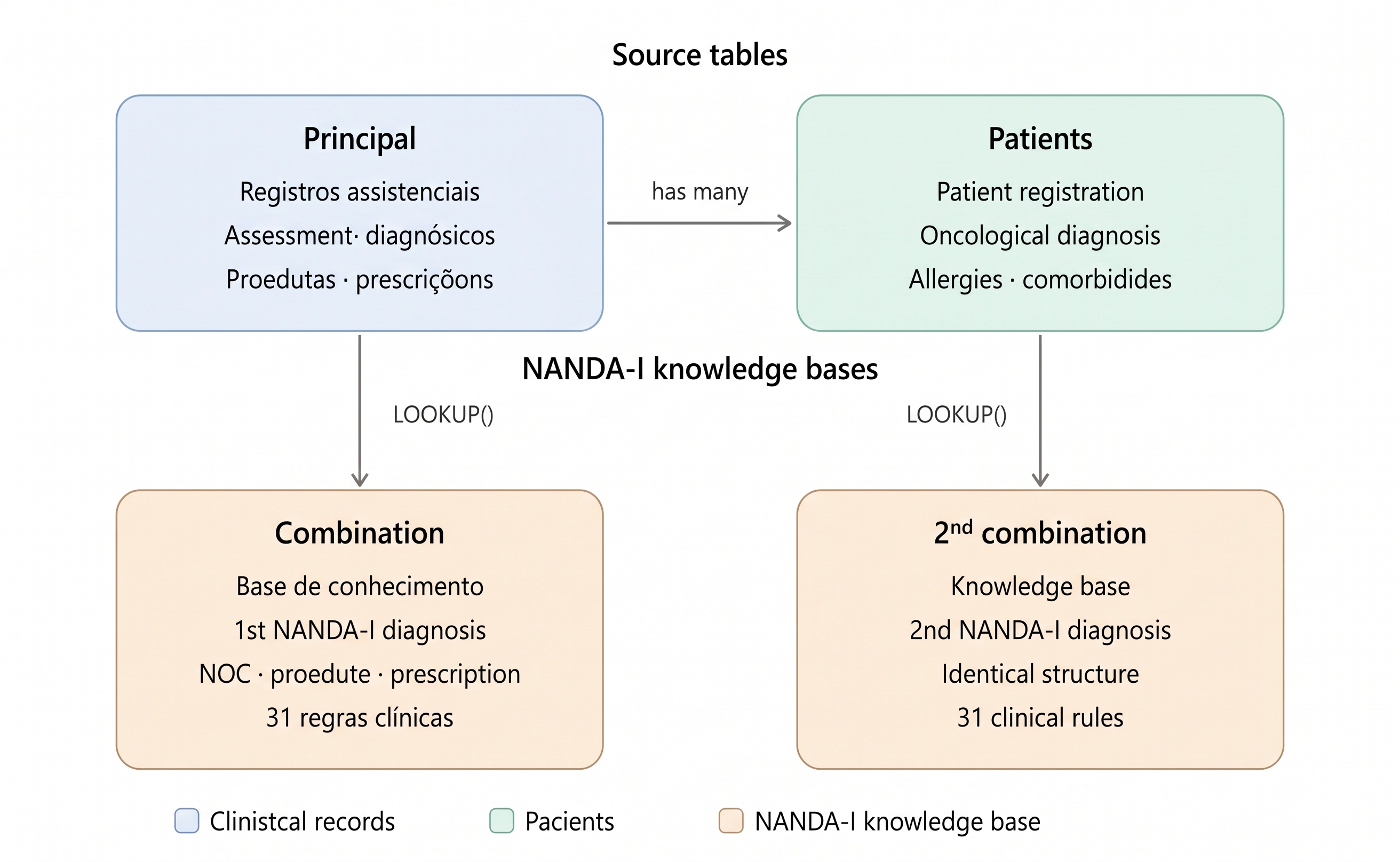
The system database consists of four relational tables (Figure 1): (1) MAIN: stores care records; (2) PATIENTS: registers users; (3) COMBINATION and (4) 2nd COMBINATION: act as knowledge bases for the first and second diagnoses, respectively. The has many relationship between the MAIN and PATIENTS tables, as well as the queries to the knowledge bases performed using the LOOKUP() and SELECT() functions, are illustrated in Figure 1.
The 2nd COMBINATION table, representative of the structure of both knowledge bases, contains five columns: NANDA-I diagnosis, NOC outcome (key field), nurse conduct, nursing prescription, and row number. Conduct and prescription correspond to Nursing Interventions (NIC): conduct refers to the intervention executed by the nurse themselves at the time of care, whereas the prescription is intended for the subsequent nursing team, ensuring continuity of care. The MAIN table has five configured actions: NEW EVOLUTION, Add, Delete, Edit, and View Ref (PATIENT).
Figure 1 – Database architecture of the PaliPEV platform: four relational tables, has many relationship between MAIN and PATIENTS, and knowledge base queries via LOOKUP() and SELECT(). Rio de Janeiro, RJ, Brazil, 2026
Source: Elaborated by the authors, 2026.
Clinical interface
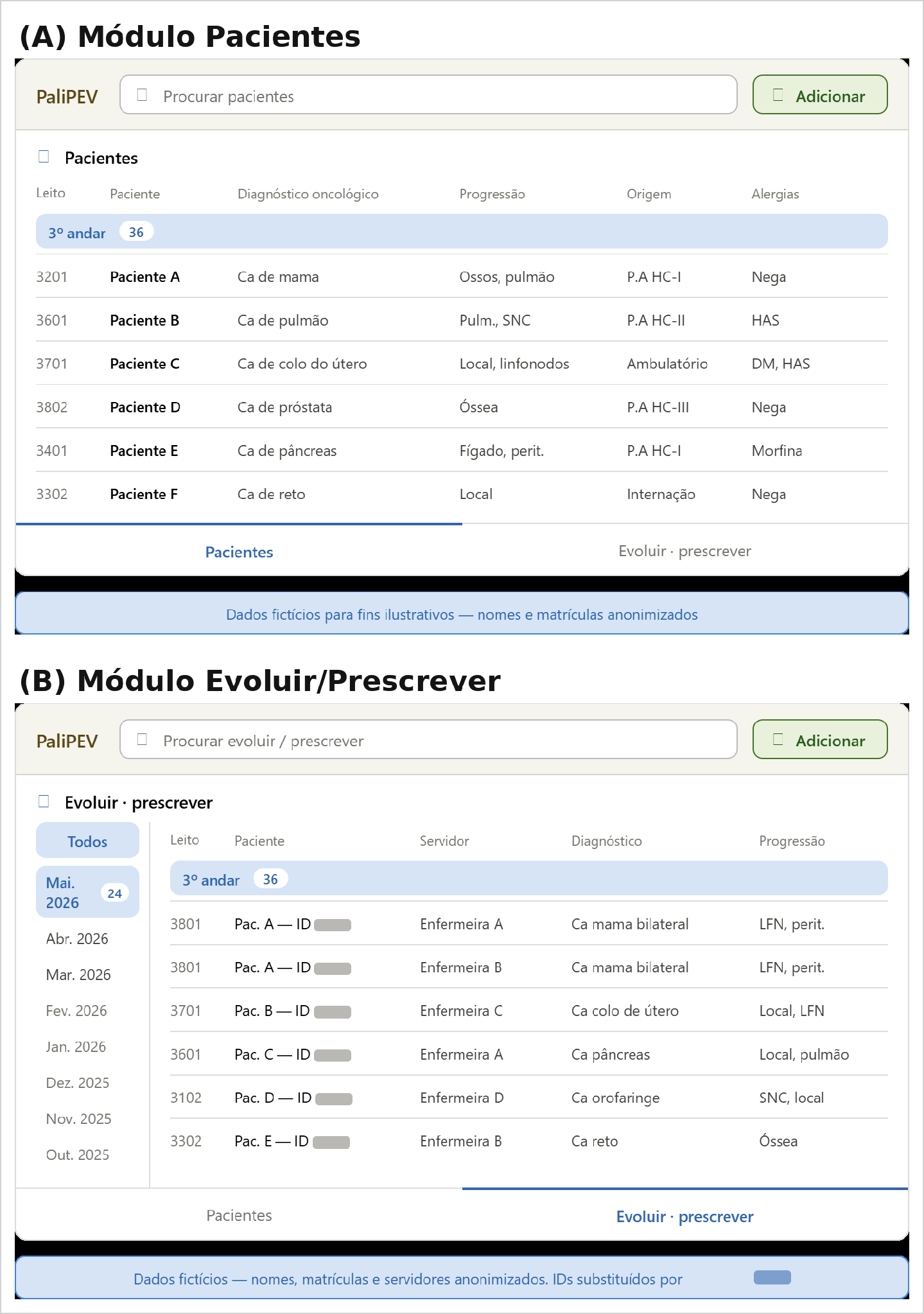
The application interface is organized into two main modules: (1) PATIENTS Module (Figure 2A): displays users distributed by bed and floor, containing information on oncological diagnosis, disease progression, origin of admission, allergies, and comorbidities; and (2) EVOLVE/PRESCRIBE Module (Figure 2B): presents records organized chronologically, featuring a temporal side filter and fields for bed, patient, healthcare professional (employee), oncological diagnosis, and disease progression identification.
Data entry is performed exclusively manually by the nurse, directly within the EVOLVE/PRESCRIBE module, through typing and selection in structured fields (drop-down lists and multiple-selection checkboxes), respecting the sequence of the Nursing Process stages grounded in Horta's Theory of Basic Human Needs.
Figure 2 – Clinical interface of the PaliPEV platform: (A) Patients module and (B) Evolve/Prescribe module. Anonymized mock data for publication purposes. Rio de Janeiro, RJ, Brazil, 2026
Source: Elaborated by the authors, 2026.
Computational rule engine
The rule engine is operationalized through native functions of the AppSheet® platform, categorized into four functional axes (Chart 1). The association rules automatically query the COMBINATION and 2nd COMBINATION tables using the LOOKUP() and SELECT() functions.
Chart 1 – Functional categories of the computational rule engine of the PaliPEV platform. Rio de Janeiro, RJ, Brazil, 2026
|
Category |
Main functions |
Clinical application |
|
Diagnosis–outcome–conduct–prescription association |
LOOKUP(), SELECT(), REF_ROWS() |
Automatic retrieval of NOC outcomes and NIC interventions (executed conduct and prescription for the subsequent nurse) in the COMBINATION / 2nd COMBINATION tables |
|
Clinical threshold alerts |
IF(), IFS(), AND(), OR() |
Alerts for VAS ≥ 7, KPS ≤ 30, anxiety ≥ 5, constipation ≥ 3 days |
|
Automated scale calculation |
SUM(), native form functions |
Braden and Morse calculated automatically from individual items |
|
Automation and document generation |
ADDS_ONLY Bots, Google Docs® Templates |
PDF prescription; email notification for each new MAIN record |
VAS: Visual Analog Scale; KPS: Karnofsky Performance Status.
Source: Elaborated by the authors, 2026.
The platform operates through deterministically programmed native computational rules. With each new association between diagnosis, outcome, conduct, and prescription established by nurses, the knowledge base is fed in a structured and standardized manner, consolidating a robust, highly complete, and clinically curated data repository. This continuous structuring lays the foundation for the future incorporation of artificial intelligence algorithms—a step not implemented in the current version, but whose data preparation is underway, as detailed in the Discussion section.
Construction of the clinical knowledge base
The knowledge base was developed by the Nursing Process Committee (comprising six nurses) during 11 technical-scientific meetings. In these initial meetings, the guiding theoretical frameworks were established: Wanda Horta’s Theory of Basic Human Needs(1), supporting the Nursing Process, and Katharine Kolcaba’s Comfort Theory(20), guiding nursing prescriptions. Associations among diagnoses, outcomes, procedures, and prescriptions were agreed upon and validated through technical consensus among committee members.
Terminology selection was based on a prior study focused on the development and collective validation of an oncological nursing assessment instrument in exclusive palliative care, grounded in the NANDA-I, NOC, and NIC taxonomies(18). From this survey, the 31 priority NANDA-I nursing diagnoses(2) for the palliative care oncology population were identified. For each diagnosis, the committee aligned the expected Nursing Outcome (NOC)(21) and the corresponding Nursing Interventions (NIC)(22), differentiating procedure (performed directly by the nurse) from prescription (intended for continuity of care by the subsequent team), supported by linkages established between the classifications(23) and categorizing prescriptions according to Kolcaba’s comfort dimensions.
Furthermore, standardized clinical assessment scales were incorporated: the Braden Scale for pressure injury risk(24,25); the Morse Fall Scale for fall risk(26,27); the Karnofsky Performance Status (KPS) for evaluating functional capacity(28,29); and the revised Edmonton Symptom Assessment System (ESAS-r) for symptom measurement(30,31).
Implementation and iterative refinement
Following the consolidation of the knowledge base, the platform was implemented and subjected to an iterative refinement process, conducted sector by sector in cycles of approximately one month. In each care setting, specialist nurses utilized the system in their daily practice, and operational adjustments were made based on observed usability and reported demands: (1) Inpatient Unit: adjustments made after one month of monitoring usage by 27 nurses; (2) Home Care: adjustments performed after scaling the system and one month of use by 6 nurses; and (3) Outpatient Clinic: adaptations made after scaling and one month of use by 4 nurses. Upon completing these initial refinement stages, platform access was released to the remaining nurses across the three care units.
Data processing and analysis
Through auditing, all Nursing Processes recorded on the PaliPEV platform between September 2024 and May 2026 were considered valid, with no records excluded during this period. Healthcare data were consolidated and processed in the Google Sheets® application, assisted by the generative artificial intelligence tool Gemini (Google LLC) in structuring formulas for counting, summing, and calculating completeness. Completeness was operationally defined as the percentage of Nursing Processes with duly completed NANDA-I diagnoses relative to the total number of records generated in the MAIN table during the analyzed period. The tool also provided support in preparing preliminary descriptive reports.
All formulas and numerical values generated were individually reviewed and manually audited by the authors, who assume full responsibility for the accuracy of the data presented. Statistical analysis was descriptive, using absolute and relative frequencies.
Ethical considerations
The project was approved by the Research Ethics Committee of the National Cancer Institute (CEP/INCA) under Opinion No. 5.812.349 (CAAE No. 87834025.7.0000.5274), in strict compliance with Resolution No. 466/2012 of the Brazilian National Health Council (CNS) and the General Personal Data Protection Law — LGPD (Law No. 13.709/2018).
The analysis of care records (Nursing Processes on the PaliPEV platform) characterized the secondary use of pre-existing institutional routine data, with no direct contact or intervention with patients. Data were duly anonymized for analysis and publication purposes, in accordance with Article 7, item IV, of the LGPD (data processing for conducting studies by research entities) and meeting the criteria for waiving individual Informed Consent (IC), as provided for by CNS Resolution No. 466/2012 for research involving consolidated databases of minimal risk.
RESULTS
The resulting knowledge base comprises 31 NANDA-I nursing diagnoses distributed across six priority clinical domains (Table 1), mapped to NOC Outcomes and NIC Interventions—differentiating the procedure performed by the healthcare team during care delivery from the prescription intended for the subsequent nurse—categorized into Kolcaba’s four dimensions of comfort.
Following audit, 36,448 valid Nursing Processes were identified, distributed across the three care settings and corresponding to 3,193 medical records (unique patient IDs). The system automatically processed 71,969 associations of the diagnosis → outcome → procedure → prescription type, achieving a NANDA-I taxonomy completeness exceeding 99.7% across all settings (Table 2). The data presented in Table 2 were consolidated as detailed in the Data processing and analysis subsection.
Table 1 – Distribution of the 31 NANDA-I diagnoses by clinical domain. Rio de Janeiro, RJ, Brazil, 2026
|
Clinical domain |
Representative examples |
|
Comfort |
Impaired physical comfort (00380); Chronic pain (00255); Acute pain (00132); End-of-life comfort syndrome (00342) |
|
Safety and protection |
Risk for adult falls (00303); Impaired skin integrity (00046); Risk for impaired skin integrity (00047); Risk for infection (00004); Risk for aspiration (00039); Risk for bleeding (00374) |
|
Activity and functionality |
Impaired physical mobility (00085); Walking ability (00365); Self-care (00331); Sleep (00337); Ineffective breathing pattern (00032) |
|
Elimination |
Impaired bowel elimination (00344); Diarrhea (00424); Urinary elimination (00016); Inadequate fluid volume (00421) |
|
Coping and psychosocial aspects |
Excessive anxiety (00400); Acute confusion (00128); Health self-management (00276); Body image (00497); Spiritual well-being (00454); Resilience (00210); Psychological comfort (00379) |
|
Nutrition, symptoms, and support |
Nausea (00384); Excess fluid volume (00026); Caregiver burden (00366); Support network (00358); Self-esteem (00482) |
Source: Prepared by the authors, 2026.
Table 2 – Automatically generated NANDA-NOC associations according to the main diagnoses. Rio de Janeiro, RJ, Brazil, 2026 (n = 71,969)
|
NANDA-I Diagnosis |
NOC Outcome (automatic) |
Domain |
n associations |
|
Impaired physical comfort (00380) |
Comfort status |
Comfort |
19,765 |
|
Risk for adult falls (00303) |
Safe care environment |
Safety |
6,521 |
|
Impaired skin integrity (00046) |
Tissue integrity |
Safety |
5,918 |
|
Impaired physical mobility (00085) |
Mobility |
Functionality |
4,626 |
|
Ineffective breathing pattern (00032) |
Respiratory status |
Functionality |
4,512 |
|
Excessive anxiety (00400) |
Anxiety level control |
Psychosocial |
3,509 |
|
Impaired bowel elimination (00344) |
Bowel elimination |
Elimination |
3,218 |
|
Remaining 24 diagnoses |
— |
Varied |
23,900 |
|
Total |
— |
— |
71,969 |
Source: Prepared by the authors, 2026.
Reach of the strategy
The care strategy was complemented by the PaliEducativa educational platform, aimed at staff training, which recorded 35,876 visits and issued 2,280 certificates during the analyzed period.
PaliEducativa supported the teaching-learning process of the Nursing Process among the institution’s nurses. Following implementation, care activities began to be guided by the data generated on the PaliPEV platform—both through observed clinical outcomes and the management of analyzed data—demonstrating the full integration of the knowledge base into the teams' daily practice.
DISCUSSION
This study described the development of the PaliPEV platform, a computational clinical rule system designed for decision support in the Nursing Process in Palliative Oncology Care, implemented in a real-world production environment (AppSheet®/Google LLC) and utilized by 37 nurses across three care settings, without constituting a formal validation study.
Regarding documentation completeness, the results achieved with PaliPEV—which reached a NANDA-I taxonomy completeness exceeding 99.7% across 36,448 Nursing Processes—surpass the rates reported in the international literature for electronic nursing documentation systems. A study conducted in three Australian metropolitan hospitals identified an average completion rate of 78.4% for the nursing admission form across 37,512 admissions, ranging from 70.9% to 91.2% depending on the hospital unit(32). This divergence suggests that integrating the computational rule engine directly into the workflow—by suggesting diagnosis, outcome, procedure, and prescription at the moment of documentation—contributes more effectively to documentation completeness than the mere digitization of forms without active decision support.
A core methodological strength of the platform is its explicit theoretical grounding: the operationalized Nursing Process is based on Wanda Horta’s Theory of Basic Human Needs(1), while prescriptions are organized according to the dimensions of Katharine Kolcaba’s Comfort Theory (physical, psychospiritual, environmental, and social)(20). The integration between standardized classification systems (NANDA-I, NOC, and NIC) and nursing theories within the rule engine represents an innovation compared to systems that apply standardized terminologies in isolation, ensuring that automatically generated care plans address the multidimensional needs of patients in palliative care.
In alignment with international experiences, PaliPEV shares with systems such as Psy-KBCDSS and Ped-NKB-Hyperthermia a knowledge base structured on standardized taxonomies and expert knowledge(9-11). However, it stands out in three fundamental aspects: simultaneous grounding in two nursing theoretical frameworks as organizing axes for the entire Nursing Process, rather than for a single specific diagnosis; explicit distinction between procedure (performed during care delivery) and prescription (intended for the subsequent shift), ensuring continuity of care across teams and care settings; and a substantial scale of utilization in a real clinical care setting—totaling 36,448 Nursing Processes applied to 3,193 patients—surpassing typical pilot-study volumes reported in the literature.
As an added advantage, choosing development within a low-code environment enabled expert nurses to build the system without requiring a dedicated IT team, meeting the demand for democratizing and expanding access to these technologies in budget-constrained institutions(6-8). Conversely, as a common limitation of such initiatives, none of these experiences—including PaliPEV—reports formal validation of the mappings between diagnoses and outcomes by an external panel with calculation of the Content Validity Index (CVI).
For clinical practice, the platform connects assessment, diagnosis, planning, and prescription into a continuous workflow, reducing the fragmentation often observed in paper-based or unguided Nursing Process documentation. Regarding patient safety, automated scoring for the Braden and Morse scales(24-27) and clinical threshold alerts (VAS ≥ 7, KPS ≤ 30, anxiety ≥ 5, and constipation ≥ 3 days) facilitate early identification of risks for pressure injuries, falls, and symptom exacerbation, offering potential to anticipate interventions in a palliative oncology population highly vulnerable to these outcomes. Concerning documentation, differentiating between procedure and prescription ensures traceability and continuity of care across nurses and shifts. For professional decision-making, the system preserves nursing autonomy by suggesting rather than imposing diagnoses, procedures, and prescriptions—leaving the final decision to the nurse—thus maintaining clinical judgment as the central element of care, backed by computational support.
The architecture composed of four relational tables, with explicit separation between the knowledge base and clinical care records, allows for independent updating of the theoretical base without compromising historical data—an essential attribute in rule-based systems(5). The symmetric replication across the COMBINATION and 2nd COMBINATION tables reflects the clinical reality of palliative care patients, who frequently present multiple simultaneous human responses.
The PATIENTS module provides oncological diagnosis, disease progression, allergies, and comorbidities prior to initiating consultation, operationalizing the principle of providing contextual information at the point of decision-making(5). The PROGRESS/PRESCRIBE module, organized chronologically by date, facilitates longitudinal tracking indispensable in palliative care. The participatory development model—in which nurses themselves acted as agents in formalizing clinical knowledge and in iterative usability refinement—formed a co-design process aligned with best practices for technological innovation in healthcare(6).
As external recognition of its relevance and the innovative nature of the proposal, the institution progressively advanced through the Bronze, Silver, and Gold levels of the PRO-SAE-PE Quality Certification Program, awarded by the Regional Nursing Council of Rio de Janeiro (Coren-RJ), achieving Gold status in April 2026(33). This certification attests to excellence in operationalizing the Nursing Process within the hospital in compliance with COFEN Resolution No. 736/2024(3), reinforcing the relevance of institutional indicators as complementary evidence of the PaliPEV platform's development.
Limitations of this study include the system's development and validation within a single center (INCA/HC IV), restricting generalizability to other palliative oncology services, particularly those with different IT infrastructure, care profiles, or organizational cultures; the lack of direct comparison with alternative computational systems; and the absence of formal validation of NANDA-I–NOC linkages by an external panel applying the CVI, which stands as a priority for future research.
Additionally, low-code environments present scalability constraints for massive data volumes significantly exceeding those observed. Platform performance remains dependent on the quality and accuracy of nurse documentation, as the system does not replace clinical judgment during data entry. The knowledge base requires periodic updates to align with revisions in NANDA-I, NOC, and NIC taxonomies and evolving evidence in palliative oncology care. Finally, the platform currently lacks interoperability with the institutional electronic health record or other health information systems.
Currently, systematic structuring of baseline assessment data—anamnesis, physical examination, and Braden and Morse scale scores—and free-text records is underway to inform a predictive artificial intelligence model. This model will be capable of suggesting nursing diagnoses, expected outcomes, procedures, and prescriptions, complementing the deterministic rule engine currently in use. Development of this predictive model has already begun alongside the continuous consolidation of the robust, structured, and clinically curated database that underpins it.
CONCLUSION
This report described the iterative development of the PaliPEV platform, a computational clinical rule system for decision support in the Nursing Process in Palliative Oncology Care, implemented in a real-world production environment and initially utilized by 37 nurses across three care settings.
The integration of NANDA-I, NOC, and NIC taxonomies with Kolcaba’s Comfort Theory in structuring the knowledge base, combined with a relational architecture featuring separation of concerns and participatory co-design led by specialist nurses, represents a significant methodological contribution to nursing informatics.
The processing of 71,969 automatic associations—generated by the deterministic rule engine described in the Computational rule engine subsection—and the achievement of NANDA-I taxonomy completeness exceeding 99.7% (calculated as established in the Data processing and analysis subsection) demonstrate the technical feasibility of constructing and operationalizing the system within a real-world context of the Brazilian Unified Health System (SUS)—noting that this did not constitute a formal evaluation of operational feasibility, which would require a specific methodological design with predefined outcome criteria.
Finally, the structured and clinically curated database resulting from this innovation provides the fundamental substrate for the ongoing development of machine learning models and future data mining in nursing.
CONFLICT OF INTEREST
The authors declare that there is no conflict of interest.
USE OF ARTIFICIAL INTELLIGENCE
ChatGPT (OpenAI) and Claude (Anthropic) were used as support tools for language editing and proofreading. Gemini (Google LLC) was used for data processing, including the generation of counting formulas, summation, completeness calculations, as well as the drafting of reports and preliminary descriptive texts. All scientific content, analysis, interpretation of results, and the final version of the manuscript were reviewed and approved by the authors.
DATA AVAILABILITY
Technical documentation is available upon request to the corresponding author. Clinical care data are stored in INCA institutional databases.
REFERENCES
1. Horta WA. Processo de enfermagem. São Paulo: EPU; 1979.
2. Herdman TH, Kamitsuru S, Lopes CT, organizers. NANDA International nursing diagnoses: definitions and classification 2024-2026. 13th ed. New York: Thieme; 2024.
3. Conselho Federal de Enfermagem (BR). Resolução Cofen nº 736, de 17 de janeiro de 2024. Dispõe sobre a implementação do Processo de Enfermagem em todo contexto socioambiental onde ocorre o cuidado de enfermagem. Brasília (DF): Cofen; 2024 [cited 2026 Jun 29]. Available from: https://www.cofen.gov.br/resolucao-cofen-no-736-de-17-de-janeiro-de-2024/
4. Lee RY, Knaplund C, Withall J, Bokhari SM, Cato KD, Rossetti SC. Variability in Nursing Documentation Patterns across Patients' Hospital Stays. AMIA Annu Symp Proc. 2024;2023:1037-1046. PMID: 38222368; PMCID: PMC10785899.
5. Khalil CA, Saab A, Rahme J, Bouaud J, Seroussi B. Capabilities of computerized decision support systems supporting the nursing process in hospital settings: a scoping review. BMC Nurs. 2025;24:677. https://doi.org/10.1186/s12912-025-03272-w. PMID: 40598308.
6. Rafner J, Dellermann D, Hjorth A, Verasztó D, Kampf CE, Mackay WE, et al. Deskilling, upskilling, and reskilling: a case for hybrid intelligence. Morals Mach. 2021;1(2):24-39. https://doi.org/10.5771/2747-5174-2021-2-24
7. Schlicht L, Wendsche J, Melzer M, Tschetsche L, Rösler U. Digital technologies in nursing: an umbrella review. Int J Nurs Stud. 2025;161:104950. https://doi.org/10.1016/j.ijnurstu.2024.104950. PMID: 39603090.
8. Walzer S, Armbruster C, Mahler S, Farin-Glattacker E, Kunze C. Factors Influencing the Implementation and Adoption of Digital Nursing Technologies: Systematic Umbrella Review. J Med Internet Res. 2025;27:e64616. https://doi.org/10.2196/64616. PMID: 40743516.
9. Zhao Y, Hu J, Gu Y, Wan Y, Liu F, Ye C, Zhang X. Development and implementation of a pediatric nursing-clinical decision support system for hyperthermia: a pre- and post-test. CIN Comput Inform Nurs. 2021;40(2):131-137. https://doi.org/10.1097/CIN.0000000000000812. PMID: 34347639.
10. Ho KF, Chou PH, Chao JCJ, Hsu CY, Chung MH. Design and evaluation of a knowledge-based clinical decision support system for the psychiatric nursing process. Comput Methods Programs Biomed. 2021;207:106128. https://doi.org/10.1016/j.cmpb.2021.106128. PMID: 34015737.
11. Lu SC, Brown RJ, Michalowski M. A Clinical Decision Support System Design Framework for Nursing Practice. ACI Open. 2021;5(2):e84-e93. https://doi.org/10.1055/s-0041-1736470
12. Guo J, Dai Y, Chen F, Liu C, Jiang S, Hu Y, et al. Role of Digital Health on Palliative Care: Umbrella Review. J Med Internet Res. 2025;27:e72104. https://doi.org/10.2196/72104. PMID: 41151049.
13. Zhang Y, Zhou C, Xing Y, Liu Y, Sun J, Luan W. Application of digital technology intervention in palliative care: a scoping review. BMC Palliat Care. 2025;24:31. https://doi.org/10.1186/s12904-025-01963-4. PMID: 41345868.
14. Tan YH, Xue L, Wei M, HuiMin X, Yang W, Yan G. A scoping review of digital technology applications in palliative care. BMC Palliat Care. 2024;23:290. https://doi.org/10.1186/s12904-024-01626-w. PMID: 39707313.
15. Ogrinc G, Davies L, Goodman D, Batalden P, Davidoff F, Stevens D. SQUIRE 2.0: revised publication guidelines from a detailed consensus process. BMJ Qual Saf. 2016;25(12):986-92. https://doi.org/10.1136/bmjqs-2015-004411. PMID: 26369893.
16. Institute for Healthcare Improvement. Science of Improvement: Establishing Measures [Internet]. Boston (MA): Institute for Healthcare Improvement; 2023 [cited 2026 Jun 29]. Available from: https://www.ihi.org/resources/Pages/HowtoImprove/ScienceofImprovementEstablishingMeasures.aspx
17. Peffers K, Tuunanen T, Rothenberger MA, Chatterjee S. A Design Science Research Methodology for Information Systems Research. J Manag Inf Syst. 2007;24(3):45-77. https://doi.org/10.2753/MIS0742-1222240302
18. Guimarães NPA. Avaliação inicial de enfermagem do paciente com câncer avançado: uma produção em prol dos princípios dos cuidados paliativos [dissertation]. Rio de Janeiro: Universidade Federal do Estado do Rio de Janeiro; 2024.
19. Google LLC. AppSheet: build apps with no code [Internet]. Mountain View (CA): Google LLC; 2026 [cited 2026 Aug 18]. Available from: https://about.appsheet.com/home/
20. Kolcaba K. Comfort theory and practice: a vision for holistic health care and research. New York: Springer Publishing; 2003.
21. Moorhead S, Swanson E, Johnson M, Maas ML, eds. Classificação dos Resultados de Enfermagem (NOC). 7. ed. Rio de Janeiro: Elsevier; 2023.
22. Wagner CM, Butcher HK, Clarke MF, eds. Classificação das Intervenções de Enfermagem (NIC). 8. ed. Rio de Janeiro: Elsevier; 2024.
23. Johnson M, Moorhead S, Bulechek G, Butcher H, Maas M, Swanson E. NOC and NIC linkages to NANDA-I and clinical conditions. 3rd ed. Maryland Heights: Mosby/Elsevier; 2012.
24. Bergstrom N, Braden BJ, Laguzza A, Holman V. The Braden Scale for Predicting Pressure Sore Risk. Nurs Res. 1987;36(4):205-10. https://doi.org/10.1097/00006199-198707000-00002
25. Guo Y, Pattavana F, Siangco C, Ngo-Huang A, Fu J, Hui D, et al. Overall Survival among Patients with Cancer and Pressure Injury and Its Association with Braden Scale Score. J Palliat Med. 2022;25(8):1254-7. https://doi.org/10.1089/jpm.2021.0645. PMID: 35394852.
26. Morse JM, Morse RM, Tylko SJ. Development of a scale to identify the fall-prone patient. Can J Aging. 1989;8(4):366-77. https://doi.org/10.1017/S0714980800008576
27. Jiang H, Liu H, Wu H, Yang Y, Li X. A real-world study on the Morse Fall Scale and clinical judgment method for fall risk in adult inpatients. Int Nurs Rev. 2025;72(4):e70110. https://doi.org/10.1111/inr.70110. PMID: 41084899.
28. Karnofsky DA, Burchenal JH. The clinical evaluation of chemotherapeutic agents in cancer. In: MacLeod CM, editor. Evaluation of chemotherapeutic agents. New York: Columbia University Press; 1949. p. 191-205.
29. Ferreira PCS, Moreira MN, Lourenço RA. Cross-cultural adaptation of the Karnofsky Performance Status instrument to Brazilian Portuguese. Rev Col Bras Cir. 2024;51:e20243771. https://doi.org/10.1590/0100-6991e-20243771-en. PMID: 39630756.
30. Bruera E, Kuehn N, Miller MJ, Selmser P, Macmillan K. The Edmonton Symptom Assessment System (ESAS): a simple method for the assessment of palliative care patients. J Palliat Care. 1991;7(2):6-9. https://doi.org/10.1177/082585979100700202
31. Alsuliman HR, Alsaigh SA, Habib FA, Alshehery MZ. Exploring the Influence of the Edmonton Symptom Assessment System Implementation in Palliative Care Patients: A Systematic Review. Cureus. 2024;16(10):e70914. https://doi.org/10.7759/cureus.70914. PMID: 39502990.
32. Shala DR, Jones A, Fairbrother G, Tran DT. Completion of electronic nursing documentation of inpatient admission assessment: insights from Australian metropolitan hospitals. Int J Med Inform. 2021;156:104614. https://doi.org/10.1016/j.ijmedinf.2021.104614. PMID: 34662820.
33. Conselho Regional de Enfermagem do Rio de Janeiro. Programa de Apoio à Implantação do Processo de Enfermagem no Estado do Rio de Janeiro (PRO_SAE_PE) [Internet]. Rio de Janeiro: Coren-RJ; 2026 [cited 2026 Jun 29]. Available from: https://www.coren-rj.org.br/pro-sae-pe/
Submission: 30-Jun-2026
Approved: 19-Aug-2026
Editors:
Rosimere Ferreira Santana (ORCID: 0000-0002-4593-3715)
Geilsa Soraia Cavalcanti Valente (ORCID: 0000-0003-4488-4912)
Patricia dos Santos Claro Fuly (ORCID: 0000-0002-0644-6447)
Corresponding author: Alex Sandro de Azeredo Siqueira (assiqueira@inca.gov.br)
Publisher:
Escola de Enfermagem Aurora de Afonso Costa – UFF
Rua Dr. Celestino, 74 – Centro, CEP: 24020-091 – Niterói, RJ, Brazil
Journal email: objn.cme@id.uff.br
|
AUTHOR CONTRIBUTIONS |
|
Study conception: Siqueira ASA, Silva VG, Rocha RCNP, Guimarães NPA, Silva ED, Silva ACC. Data collection: Siqueira ASA, Silva VG. Data analysis: Siqueira ASA, Silva VG, Rocha RCNP, Guimarães NPA, Silva ED, Silva ACC. Data interpretation: Siqueira ASA, Silva VG, Rocha RCNP, Guimarães NPA, Silva ED, Silva ACC. All authors are responsible for drafting the manuscript and critically revising its intellectual content, approving the final version for publication, and ensuring responsibility for all ethical, legal, and scientific aspects related to the accuracy and integrity of the study. |
