
TECHNOLOGICAL DEVELOPMENT
CONSTRUCTION OF A SERIOUS GAME ON CHRONIC WOUNDS SUPPORTED BY ARTIFICIAL INTELLIGENCE: A METHODOLOGICAL STUDY*
Raphael Monteiro de Oliveira1, Júlia Queiroz de Morais2, Pedro Miguel Santos Dinis Parreira3, Verónica Rita Dias Coutinho4, Bruna Maiara Ferreira Barreto Pires5
1 Universidade Federal Fluminense, Escola de Enfermagem Aurora de Afonso Costa. Niterói, Rio de Janeiro, Brazil; Universidade de Coimbra, Escola Superior de Enfermagem da Universidade de Coimbra. Coimbra, Portugal. ORCID: 0000-0002-4321-2316. E-mail: raphaelmonteiro@id.uff.br
2 Universidade Federal Fluminense, Escola de Enfermagem Aurora de Afonso Costa. Niterói, Rio de Janeiro, Brazil. ORCID: 0009-0007-0742-2512. E-mail: juqueiroz@id.uff.br
3 Universidade de Coimbra, Escola Superior de Enfermagem da Universidade de Coimbra. Coimbra, Portugal. ORCID: 0000-0002-3880-6590. E-mail: parreira@ese.uc.pt
4 Universidade de Coimbra, Escola Superior de Enfermagem da Universidade de Coimbra. Coimbra, Portugal. ORCID: 0000-0001-8073-4562. E-mail: vcoutinho@ese.uc.pt
5 Universidade Federal Fluminense, Escola de Enfermagem Aurora de Afonso Costa. Niterói, Rio de Janeiro, Brazil. ORCID: 0000-0002-5584-8194. E-mail: bruna_barreto@id.uff.br
ABSTRACT
Objective: To describe the construction of a serious game aimed at nursing education in the care of people with chronic wounds, developed with the support of generative artificial intelligence, under the supervision and scientific responsibility of the authors. Method: A methodological study focusing on the technological construction phase, grounded in the Analysis, Design, and Development stages of the ADDIE model and Design Thinking. Code engineering in React.js was performed by the research team with the support of generative artificial intelligence in the CodeSandbox environment, with storage on Firebase. The design included ethical approval in Brazil and Portugal for the subsequent validation stage by expert judges and evaluation by nursing students. Results: The simulator was consolidated into a single-screen architecture structured into four operational modules. The system integrates interactive keys for cross-cultural adaptation between Brazil and Portugal, management of chromatic stimuli (in Dark/Light modes) and sound stimuli, scenario randomization mechanics, and immediate evidence-based feedback for each correct or incorrect action. Conclusion: The study demonstrates that nurses can lead the production of digital technologies, delivering a practical, autonomous, and cross-cultural tool aimed at nursing education.
Descriptors: Gamification; Nursing Informatics; Artificial Intelligence; Wounds and Injuries; Educational Technology.
|
How to cite: Oliveira RM, Morais JQ, Parreira PMSD, Coutinho VRD, Pires BMFB. |
What is already known:
The development of digital educational technologies in nursing traditionally demands high financial costs and the hiring of extensive programming teams.
Interactive games based on clinical simulation, combined with immediate feedback, constitute effective tools for student training.
What this article adds:
The use of generative artificial intelligence, guided by guidelines and prompts from the nurse, democratizes the construction of educational applications and reduces operational costs.
The simulator establishes itself as a cross-cultural pedagogical tool capable of standardizing clinical learning about chronic wounds among students in Brazil and Portugal.
INTRODUCTION
The integration of Artificial Intelligence (AI) into healthcare represents a new phase in nursing education and redefines its use as an extension of the pedagogical creativity inherent to human beings. Far from being limited to the automation of repetitive tasks, AI emerges as a resource with transformative potential, capable of optimizing, in an integrated manner, both the complex workflows and the practices and educational processes that characterize the profession(1).
Within this panorama, which part of the literature refers to as the Fourth Industrial Revolution, studies indicate that the dissemination of AI has been reconstructing structures and healthcare delivery itself, which requires nurses to adopt a critical, proactive stance and commit to constant improvement regarding their technological literacy(2).
This digital transition has driven a shift in the teaching-learning process, moving the pedagogical axis—historically grounded in traditional, passive models centered on the instructor—toward active learning approaches. It is in this scenario that serious games gain prominence: structured applications that use interactivity with the purpose of educating, training technical skills, and developing clinical judgment, moving away from mere entertainment(3).
These tools operate strategically through immediate feedback mechanisms, reward systems, and challenges of progressive complexity, which increase student engagement time with the educational material and, consequently, expand the retention of clinical knowledge(1,4).
Within nursing, an area requiring priority attention is chronic wound management. The literature characterizes these lesions as a "silent epidemic" that exerts a significant financial and care burden on health systems(5). This scenario makes the development of innovative educational strategies urgent to prepare future professionals for prompt and assertive decision-making in the care of these individuals.
Given this need, by combining clinical guidelines and manuals with the flexibility of interactive virtual scenarios, it becomes possible to convert passive study into dynamic, real-time decision-making experiences, since simulations offer significant benefits in knowledge acquisition and the preservation of patient safety(1).
This methodological approach allows students to evaluate the consequences of their choices and adjust their conduct in a strictly controlled environment, which mitigates academic anxiety and builds the self-confidence indispensable for future bedside care(1,3).
Despite broad scientific recognition regarding the efficacy of games in higher education, the implementation and development of these tools encounter severe operational barriers in the daily routine of institutions. Frequently, the creation of these solutions demands high financial investments, extensive execution deadlines, and the mandatory mediation of multidisciplinary programming teams (3,6).
Faced with these challenges, AI consolidates itself as a driving force, allowing nurses themselves to take charge of software architecture management and translate their pedagogical premises into logical code. Although the incorporation of AI in academia still represents an evolving methodological challenge(6), its use as direct support for educators fills a critical gap, ensuring scientific rigor and pedagogical fidelity from the genesis of construction.
Thus, the development of gamified decision-making simulators—the result of the convergence between human clinical expertise and algorithmic agility—materializes a relevant methodological advancement. Such a strategy not only personalizes the learning journey but also fosters the secure mastery of complex protocols through a grounded trajectory with real risk mitigation(6).
It is emphasized, however, that the use of artificial intelligence tools in the creative process does not transfer authorship, creativity, or scientific responsibility for the developed product to these systems. Technology acts in translating human instructions into code and structured content, but the pedagogical design, validation of clinical relevance, and full responsibility for the material remain under the governance of the nurse, who holds the technical and scientific knowledge of the field.
In view of the above, this study aims to describe the construction of a serious game aimed at nursing education in the care of people with chronic wounds, developed with the support of generative artificial intelligence, under the supervision and scientific responsibility of the authors.
METHODS
Study design and theoretical foundation
This investigation comprises the stages of a methodological study focused on the construction and validation of a serious game, entitled "Studyferida", aimed at improving the clinical judgment of nursing students in the care of people with chronic wounds.
Methodologically, it was defined that the technology's dynamics would take the form of an interactive quiz, in which each clinical situation presented to the student would contain four alternative answer choices, with only one being correct. The existence of different methodological frameworks intended for the development and validation of health technologies is recognized; however, the association between Design Thinking and the ADDIE model (Analysis, Design, Development) was chosen as the structuring framework due to its adequacy for the conception, design, and development stages described in this study.
The construction process was grounded in the integration between structured theoretical knowledge and participatory support models for the design of interventions and technological tools in the healthcare field(7). As outlined, the initial conception and idealization phase of the technology was guided by the Design Thinking approach, an interactive, human-centered problem-solving model whose purpose lies in empathetic, creative, and analytical decision-making for managing complex challenges(8). This methodology provides the necessary support to identify the needs and requirements of nursing students, refining the direction of the first three phases of the ADDIE instructional design model, adopted for structuring the simulator(9).
AI and humans in code optimization within the sandbox
The practical development process dispensed with the traditional model of hiring technology teams, occurring through a collaborative creation cycle among the authors, with the support of the Gemini 1.5 Pro multimodal language model (Google), employed in the generation and optimization of the platform's code.
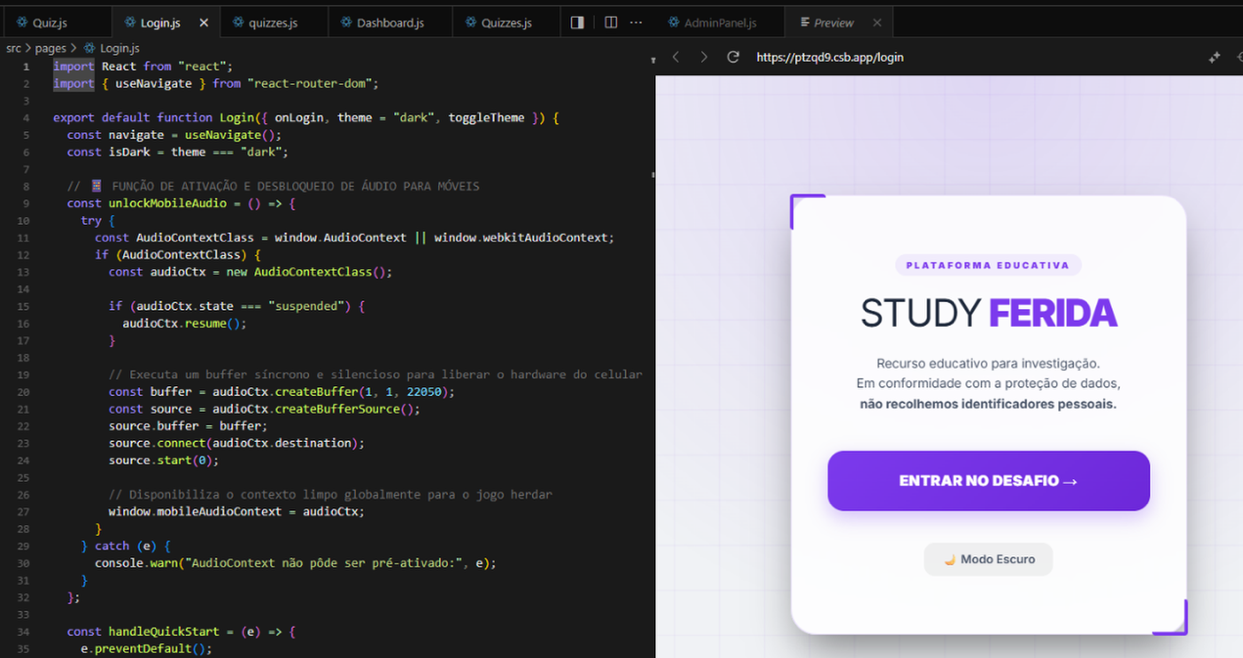
For the materialization of these lines of code, the CodeSandbox virtual environment was used. The workflow consisted of submitting structured design and pedagogical logic requests to the AI and then transferring the generated code in React.js and JavaScript to the sandbox editing panel. CodeSandbox acted as a real-time technical simulation laboratory: as the AI optimized and adjusted the components guided by the researcher, the graphical interface was rendered instantly alongside the code (Figure 1).
Figure 1 – Development screen and sandboxing environment in CodeSandbox: analytical intersection between React.js code engineering and the immediate rendering of the StudyFerida platform interface. Coimbra, Portugal, 2026.
Source: prepared by the authors, 2026.
To ensure transparency in the code production process, the interaction between the researcher and the artificial intelligence occurred through a dialogical process, rather than isolated, standardized prompts. Each functionality was built progressively, through successive exchanges in which the researcher presented the pedagogical context of the screen to be developed, refined the technical specifications of layout, behavior, and integration with Firebase, and continuously evaluated the generated output until it met the established acceptance criteria.
The responses generated by the AI were accepted when they fully met the defined technical and pedagogical requirements; adjusted through new dialogical refinement exchanges when they presented occasional inconsistencies in logic or style; and fully rejected and reformulated if they compromised the pedagogical accuracy of the content.
The research team performed continuous cycles of functional testing and technical screening, acting as the primary quality filter to internally validate the behavior of the serious game and neutralize potential algorithm "hallucinations”, maintaining absolute control over the tool's realism.
It should be noted that the emphasis of this study lies on demonstrating the nurse's ability to autonomously lead the technological construction of an educational tool through dialogical interaction with generative artificial intelligence—and not on producing unprecedented clinical knowledge about chronic wound care, a topic that served as the application domain for this methodological demonstration.
Even so, the rigor of the incorporated clinical content was ensured through double-checking, performed by at least two research team members with a background in nursing, of all textual, clinical, and generated code content before its definitive incorporation into the simulator, based on international care guidelines and scientific literature on chronic wound care.
The hyper-realistic images used in the simulation scenarios were produced by the Google Imagen AI image generation model (Google DeepMind), integrated into the Google Gemini ecosystem, based on requests and clinical parameters formulated and optimized by the research team.
The React format and page division
The simulator structure was developed using React.js technology, chosen because it enables the creation of modularized digital components that facilitate visual organization and game interactivity. To optimize student engagement time and ensure fluid learning, the system was planned in a linear architecture, dividing the journey into four main modules integrated by navigation mechanisms that control interface behavior and responsiveness with each user interaction.
To support this structure, the technology was integrated with the Firebase (Google) system. This real-time database acts as a dynamic repository, responsible for securely and anonymously storing the questions and structured data of the simulator.
Ethical aspects and legal compliance
As this is a phase focused on technological development and software base architecture, the stage described in this manuscript did not involve the direct participation of human beings. However, aiming to ensure scientific integrity and the advancement of the methodological study, the research is formally approved by research ethics committees: in Brazil, under CAAE opinion no. 90795825.8.0000.5243; and in Portugal, by Opinion no. P1270_02_2026. These approvals guarantee full ethical and legal support for the execution of subsequent validation stages by expert judges and evaluation by nursing students in both countries.
It should be noted that empirical data collection with experts and students was not conducted in this phase of the study, and its results will be the subject of subsequent publication, in which participants, eligibility criteria, instruments, informed consent procedures, and analytical approaches will be detailed.
RESULTS
System architecture, page structure, and instructional layout
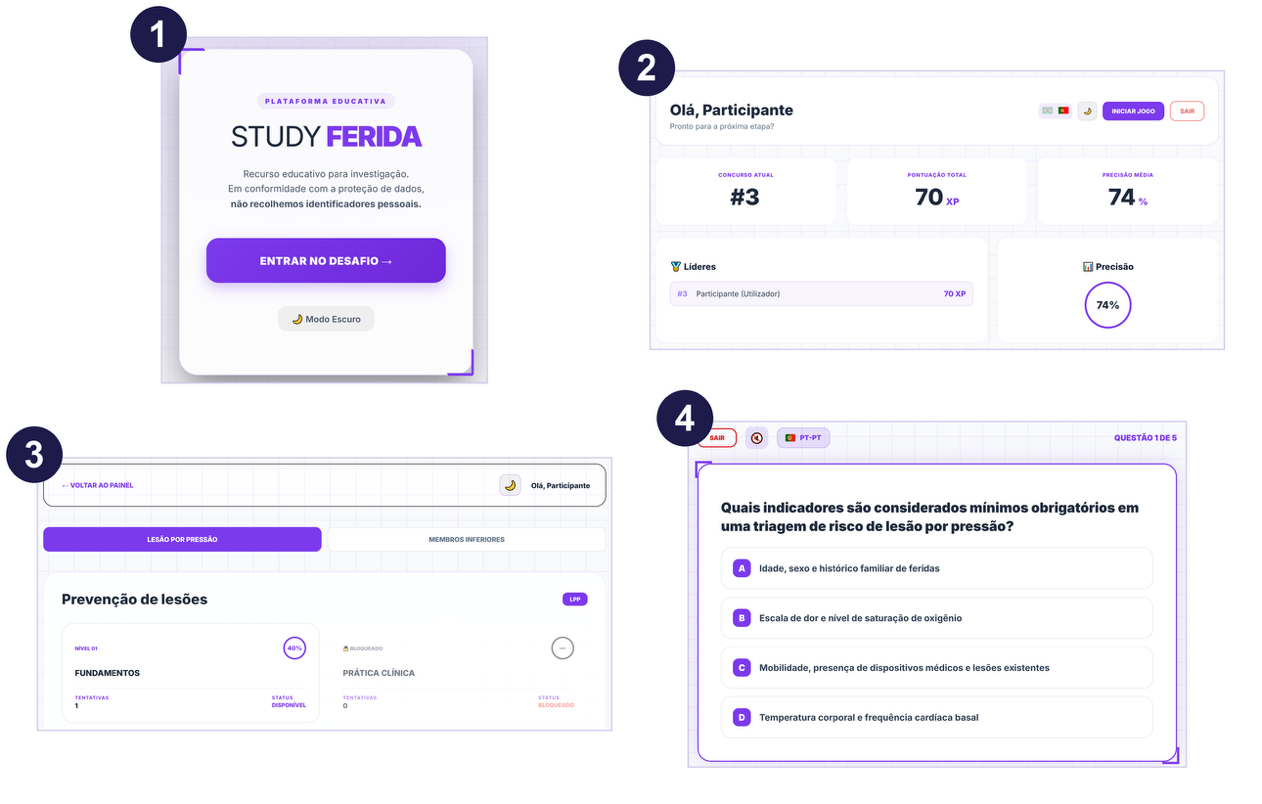
The pedagogical strategy was materialized into a functional, navigable, and modular digital simulator, coded in React.js and integrated into the Firebase real-time database infrastructure. The layout was designed to function as an extension of the student's learning process, organizing the simulator linearly across four main screens (Figure 2).
Figure 2 – Interface architecture and user navigation flow in the StudyFerida simulator: (1) Welcome Screen; (2) Central Self-Management Panel (Dashboard); (3) Thematic Selection and Level Progression Module; (4) Clinical Simulation Cell in quiz format, highlighting at the top the graphic language selectors (flags) and the active internationalization switch (PT-PT). Coimbra, Portugal, 2026.
Source: prepared by the authors, 2026.
The first window was named the welcome screen, serving as the user's initial immersion portal. It directly presents the simulation scenario, the start button, and notices of compliance with data protection. There is no collection, storage, or processing of users' personal data, since access to the simulator requires no registration, authentication, or individual identification, in compliance with the General Data Protection Law (LGPD), ensuring that the platform operates under rigorous ethical and anonymity precepts.
Upon starting, the user accesses the central self-management panel, called the dashboard. Designed as the participant's core identity and monitoring hub, it displays the position indicator in the current competition, the accumulated experience points (XP), and the dynamically calculated overall average accuracy rate, allowing the student to analyze their global performance before starting the activity.
The third component is the thematic selection and progression module, which acts as the game's choice and pedagogical control center. In it, the user navigates between topics structured as "Pressure Injury" and "Lower Limbs" and visualizes the percentage progress in Level 1 (Fundamentals), while Level 2 (Clinical Practice) remains with a visual algorithmic lock until the 80% performance target is reached.
Finally, the clinical simulation cell constitutes the operational core of decision-making. The layout organizes, on a single screen, the question progress marker (e.g., "Question 1 of 5"), the prompt area with the clinical situation grounded in international guidelines, and the interactive interface with four multiple-choice options.
Stimulus management: chromatic duality and sound design
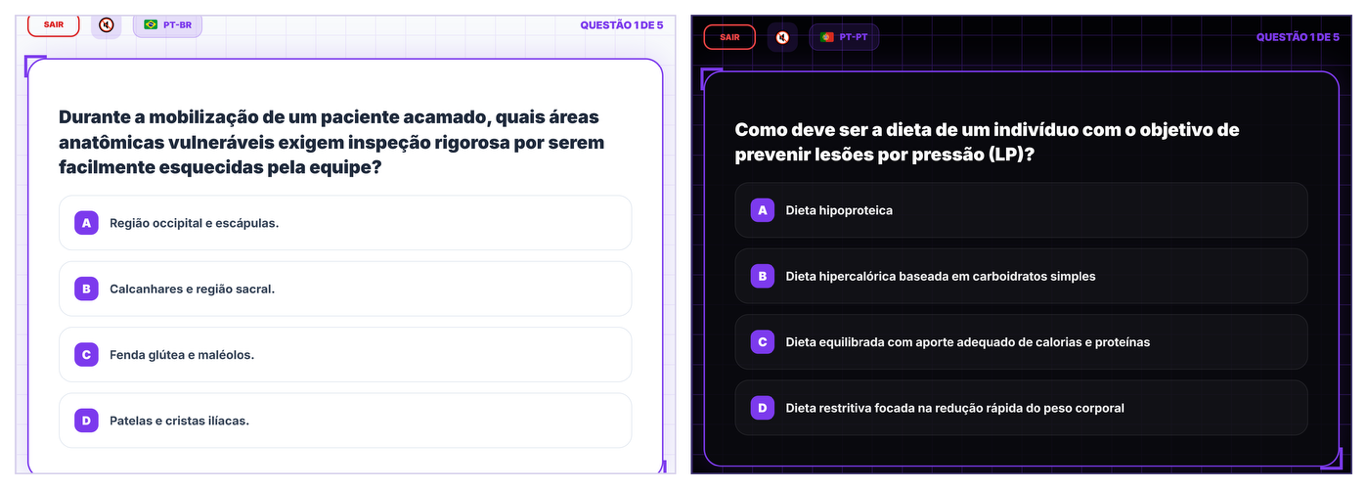
The implementation of toggling between Dark and Light modes was incorporated into the interface to act directly on the management of mental effort and visual fatigue of the user. Dark mode applies a chromatic duality aimed at reducing visual fatigue and increasing the contrast of critical elements, facilitating selective attention during prolonged periods of study. In turn, Light mode ensures optimal legibility under high ambient lighting conditions (Figure 3).
Figure 3 – Operational interface of the clinical simulation cell: demonstration of chromatic duality (Light and Dark modes), sound resources, and the cross-cultural linguistic internationalization system (PT-BR / PT-PT). Coimbra, Portugal, 2026.
Source: prepared by the authors, 2026.
Complementarily, the audio architecture of the simulator integrated discrete sound stimuli for correct and incorrect answers, operating as positive reinforcement and immediate alert for the correction of clinical reasoning, in addition to a soft background soundtrack aimed at promoting multisensory engagement. Respecting the student's autonomy, the activation or silencing control of all sound and chromatic resources was made available through quick-click preference commands in the graphical interface.
Internationalization and cross-cultural adaptation (PT-BR and PT-PT)
A significant result of pedagogical impact consists of the effort toward the consolidation of a unified Luso-Brazilian tool. The simulator was programmed to operate flexibly in both Brazilian and European Portuguese through a process of technical and terminological adaptation, aiming to bring the simulator closer to the care realities of both countries.
To this end, software engineering sought to minimize the use of literal translations and initiated the mapping of equivalent terms from clinical nursing practice, organized in a modular string dictionary file (locales). It is recognized that this linguistic matrix is neither static nor definitive; it is a progressive alignment based on the main terms recommended by the care guidelines of both countries, structured precisely to eliminate comprehension barriers and enable future interinstitutional and international cooperation (Table 1).
Table 1 – Matrix of selected terminological, clinical, and orthographic equivalences for cross-cultural adaptation of the simulator. Coimbra, Portugal, 2026.
|
Adaptation category |
Reference term (Brazil – PT-BR) |
Equivalent term (Portugal – PT-PT) |
|
Scenario participants |
Paciente(s) Equipe(s) |
Utente(s) Equipa(s) |
|
Clinical terminology and procedures |
Curativo(s) Mudança de decúbito Banho no leito Hiperemiada/o Gaze(s) |
Penso(s) Alternância de posicionamento Higiene no leito Com eritema Compressa(s) |
|
System actions and pathologies |
Cadastrar Infecção(ões) Infarto |
Registar Infeção(ões) Enfarte |
|
Orthographic variations |
Gênero / Fêmur / Fenômeno Anatômico(a) Crônico(a) Isquêmico(a)/ Isquemia |
Género / Fémur / Fenómeno Anatómico(a) Crónico(a) Isquémico(a) / Isquémia |
Source: Prepared by the authors, 2026.
Gamification mechanics: level progression and randomization
The system incorporated Game Thinking elements structured to sustain intrinsic motivation during decision-making(10). The pedagogical engineering of the simulator was divided into two progressive levels of complexity (Level 1: Fundamentals and Level 2: Clinical Practice), establishing an algorithmic pass rate lock of a minimum of 80% for the student to receive system authorization to advance to the next phase. This value was established by the research team as a minimum proficiency parameter, aligned with the logic of mastery learning, and may be recalibrated in future validation studies.
To break away from the mechanical memorization model, each level was coupled with a dynamic database containing approximately 15 questions, from which a subset of 5 questions is selected and presented to the user completely at random by the algorithm with each new game. This randomization dynamic ensures that each attempt in the simulator constitutes an unprecedented cognitive challenge, sustaining a state of flow where error ceases to be punitive and becomes configured as an invitation to the continuous improvement of clinical judgment(11).
Immediate feedback as an active metacognition strategy
The critical differential of the simulator lies in its evidence-based immediate feedback system, triggered responsively with each student decision-making act, regardless of whether the answer in the simulation cell was correct or incorrect. Upon processing the user's choice, the system immediately displays on the screen a clear technical rationale, direct scientific backing grounded in international guidelines, and targeted links to bibliographic sources.
Visual innovation vs. limitations in clinical development
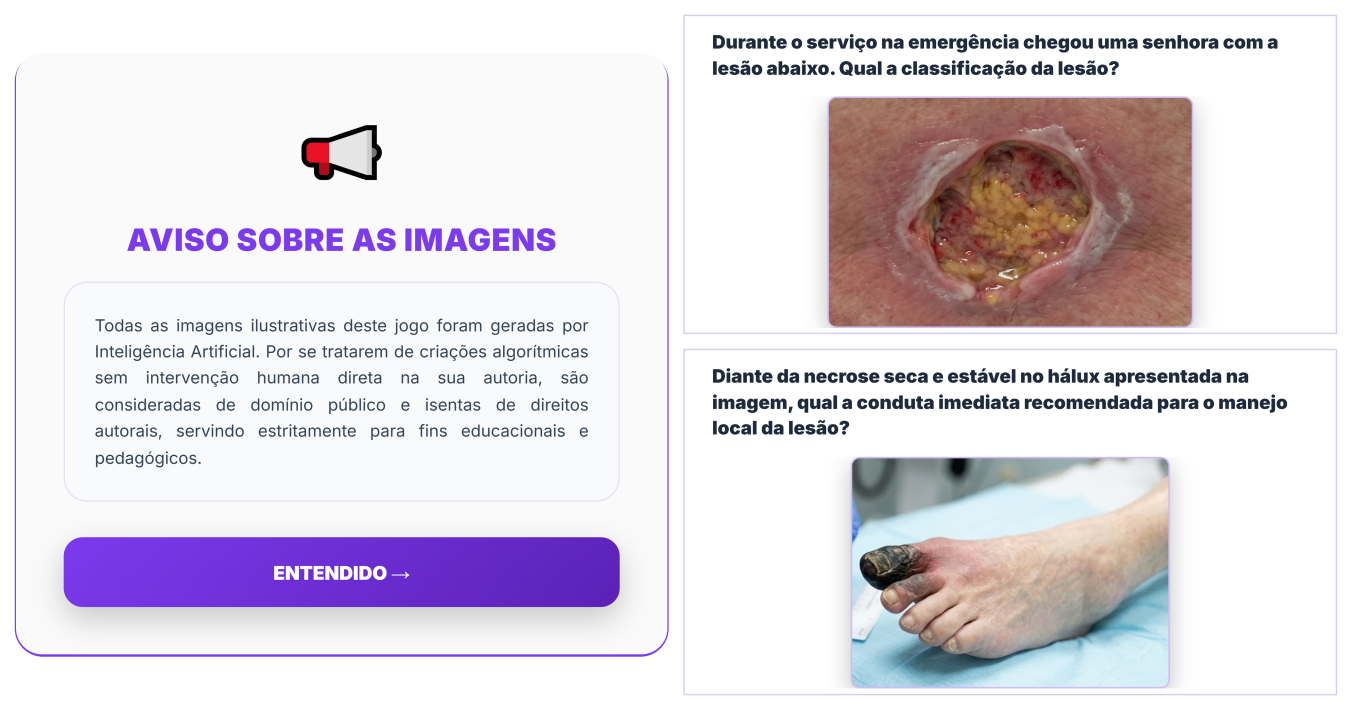
Regarding the aesthetic dimension and diagnostic fidelity of the simulator, the use of generative AI tools enabled the creation of hyper-realistic images for the simulation scenarios (Figure 4). The warning screen displayed to the user informs that these images were generated by artificial intelligence and clarifies that the authors do not claim copyright over this content, based on the terms of use of the employed tool.
It should be noted that the legal status of content generated by generative artificial intelligence remains a subject of debate in the literature and in intellectual property legislation, which recommends caution regarding the assertion of full copyright exemption.
Figure 4 – Aesthetic, ethical, and diagnostic fidelity dimension of the simulator: evidence of the copyright disclaimer warning screen (left) and clinical case scenarios with hyper-realistic images of chronic wounds generated by generative AI (right). Coimbra, Portugal, 2026.
Source: prepared by the authors, 2026.
DISCUSSION
The pedagogical architecture of the simulator created in this study, structured into progressive levels and algorithmic advancement barriers, is grounded in classical game design guidelines, which dictate that the challenges of a gamified system must be modularized to ensure an exact balance between user skill and software complexity(10). This need for methodological structuring corroborates recent global evidence defending the use of gamification in nursing education as a crucial strategy for long-term engagement(3).
Within the context of nursing education, this progression aligns with the dynamics of experience points (XP) accumulated within the simulation cell. This instructional design choice associates gamified dynamics with increased intrinsic motivation and knowledge retention in health and care professions(4).
Additionally, the increased frequency of use of educational material generated by scoring dynamics induces pedagogical repetition, one of the most powerful factors for memory consolidation and knowledge retention(4). However, as the literature warns, reward mechanisms must be designed with caution so that the focus on competition does not eclipse the internalization of knowledge—a scenario that StudyFerida's design sought to mitigate, where the accumulation of XP assumes a formative and emancipatory function substantially distinct from conventional grades and punitive rankings(11).
This convergence between technology and human sensitivity directly responds to contemporary global movements. The literature points out that the Design Thinking approach has consolidated itself as an international evolutionary trend, advancing from isolated experiences to a pedagogical maturation capable of reshaping curricula and creating innovative, collaborative learning environments focused on empathy and creative problem-solving(8).
However, current evidence on this topic remains predominantly descriptive and restricted to specific contexts, lacking greater methodological consistency or longitudinal evaluations(8). It is precisely in the face of this need for structural consolidation that the StudyFerida simulator proposes an advance: instead of being limited to an informal application, the study is guided by user-centricity grounded in Design Thinking and the rigid, systematic stages of the ADDIE instructional model, delivering a tool with high software engineering rigor and a cross-cultural adaptation matrix designed to bridge clinical learning between Brazil and Portugal.
Beyond following a structured instructional model, the main differential of this work lies in breaking away from the traditional model of technological production in healthcare, bringing nurses to the center of digital creation through the direct use of artificial intelligence tools in the development process. In practice, prompt engineering did not merely constitute the act of triggering mechanical commands, but functioned as a true dialogical bridge, in which the researchers' clinical knowledge and pedagogical experience translated the needs of nursing education into logical lines of code in React.js and JavaScript.
In StudyFerida, the machine's computational agility remained subordinate to human judgment, suggesting that it is possible to democratize the development of high-performance simulators and reduce prohibitive institutional costs(6). Above all, this subordination ensures that technology develops in alignment with ethical rigor and the core values of the science of caring(2).
In addition to game mechanics, the interface engineering of the serious game sought support in instructional neuroarchitecture. The structuring of the clinical simulation cell in a single-screen arrangement strictly aligns with the precepts of Cognitive Load Theory(12). By concentrating the clinical case, alternatives, and interactive resources into a single visual field, the system deliberately reduces extraneous cognitive load. This decision preserves the student's working memory capacity, ensuring that their focus remains fully directed toward clinical judgment and the diagnostic reasoning necessary for caring for people with chronic wounds.
The flexibility granted to the user to toggle between chromatic polarities (Dark and Light) directly responds to experimental studies. These studies associate visual fatigue and long-term reading performance with the calibration between screen brightness and ambient illumination, demonstrating that contrast and polarity adjustment is crucial to reduce eye strain(13). Added to this perspective, the introduction of informative sound stimuli acts as a signaling element, directing user attention and facilitating the understanding of commands during interaction(14).
Finally, the visual realism and methodological rigor of the simulator drive the debate on the limits and potentialities of using artificial intelligence in health education. The use of generative AI tools represents a contemporary educational innovation by enabling immersive clinical simulations in nursing(15).
In the development of technologies for wound care, this approach allows for the realization of detailed visual representations of different stages of chronic wounds and tissue types, such as granulation, slough, and necrosis. This resource overcomes the ethical and privacy barriers associated with the use of real patient photographs and mitigates the high costs of commercial image banks. However, the diagnostic fidelity of these images has not yet been formally validated, which represents a potential risk for teaching clinical judgment if there are inaccuracies in tissue representation; therefore, this aspect was treated as a limitation of this study.
This strategy directly responds to one of the major concerns of nursing education institutions today: the prohibitive cost for acquiring advanced AI-based simulation commercial tools(6). By producing highly customized images within a proprietary ecosystem with the support of generative AI, the educator overcomes financial and methodological barriers, delivering an authentic environment indispensable for the development of clinical judgment(1).
However, high complexity in the curation and algorithmic construction of problem situations emerges as a counterpoint and limitation to this model. Although AI offers speed in logical code structuring and textual refinements, international literature warns that generative tools are subject to biases, conceptual simplifications, or data "hallucinations"(16).
Thus, the elaboration of rigorous clinical cases and the calibration of multiple-choice alternatives demanded exhaustive analytical human effort through double-checking. This faculty validation stage reaffirms that, despite technological support, learning safety and the pedagogical fidelity indispensable to nursing education remain inseparable from human intellectual judgment.
This need for rigorous faculty validation gains prominence in view of the concerns of the nursing educator community itself, which frequently reports insecurity in calibrating AI tools within curricula and fears the impact of algorithmic biases on professional training(6). Therefore, human supervision and refinement of the simulations operate as indispensable filters to ensure that artificial intelligence-generated artifacts perfectly meet the scientific standards of evidence-based practice(1).
Limitations
As this is a descriptive methodological study, data on usability, acceptability, or student learning outcomes are not yet available—which is consistent with the scope delimited here, focused on the construction of the technology. The development of the simulator was conducted by a single team, which may restrict the diversity of perspectives incorporated into the interface.
From a technical standpoint, the diagnostic fidelity of the hyper-realistic images generated by artificial intelligence has not yet been formally validated by experts, posing a potential risk to the teaching of clinical judgment in the event of inaccuracies in tissue representation. Likewise, the full reproducibility of the dialogical co-production process with AI is limited by the level of detail possible in documenting the exchanges performed. The content generated by the system also remains subject to biases and inaccuracies which, although mitigated by the team's double-checking, cannot be entirely ruled out.
Future studies should address these gaps, especially through the formal validation of images by enterostomal therapy experts, investigations into usability and educational effectiveness with students, and the use of structured documentation protocols for the dialogical production process.
CONCLUSION
The results of this study demonstrate that the transfer of nurses' clinical knowledge to the digital environment can constitute a viable and autonomous process, bypassing the need for large, costly informatics development centers. The use of AI as a technological support tool, under the governance and intellectual direction of the nurse-researcher—who retains authorship, creativity, and scientific responsibility for the product—proved to be a promising and accessible methodological pathway, capable of inspiring other health professionals to take the lead in creating their own educational tools.
The simulator was consolidated into a single-screen architecture, conceived in light of Cognitive Load Theory to mitigate user fatigue and favor the management of mental load. By integrating game thinking mechanics, it enabled cross-cultural navigation adapted to the care realities of both Brazil and Portugal.
One of the central aspects of the technology lies in the delivery of evidence-based immediate feedback, because by intercepting error at the exact moment it occurs, the system provides technical justification anchored in international guidelines, transforming failure into a trigger for the refinement of clinical judgment.
As a direction for the next stages of research, the need for content and appearance validation studies by expert judges, the evaluation of usability and user experience, the analysis of accessibility, and, subsequently, the investigation of educational effectiveness and impact on student learning stand out.
In summary, the main contribution of this study lies in the democratization of technological production in nursing, breaking away from the paradigm that nurses must be merely passive consumers of software. By demonstrating that digital development leadership can emanate from the care and teaching category itself, this research delivers to educational institutions a practical and innovative tool designed to strengthen the construction of active methodologies.
*Article extracted from the Doctoral Dissertation entitled "Studyferida: construction and validation of a digital game on chronic wounds focusing on teaching”, presented to the Graduate Program in Health Care Sciences at Fluminense Federal University (Niterói, RJ, Brazil), with defense scheduled for December 2026. The work in question integrated the activities of PDSE (Sandwich Doctorate Program Abroad).
CONFLICT OF INTEREST
The authors declare no conflict of interest.
FUNDING
This work was carried out during the Sandwich Doctorate Program Abroad (PDSE) at the Nursing School of the University of Coimbra, with financial support from the Coordination for the Improvement of Higher Education Personnel (CAPES), through process no. 88881.220287/2025-01.
USE OF ARTIFICIAL INTELLIGENCE
The practical development process of the technology dispensed with the traditional model of hiring technology teams, occurring through a co-creation cycle between the authors and the generative artificial intelligence Gemini 1.5 Pro. The machinery of this work was based on prompt engineering, in which the researcher organized the pedagogical knowledge and the AI converted it into structured commands to feed the technology.
REFERENCES
1. Lifshits I, Rosenberg D. Artificial intelligence in nursing education: A scoping review. Nurse Educ Pract. 2024;80:104148. https://doi.org/10.1016/j.nepr.2024.104148. PMID: 39405792.
2. Raposo DRA, Alves Júnior JS, Silva DTO, Alves RA, Santos DCM, Alves TM, et al. Avanços na assistência de enfermagem: uma revisão de escopo sobre o uso da Inteligência Artificial na ciência do cuidar. Contrib Cienc Soc. 2024;17(7):e8854. https://doi.org/10.55905/revconv.17n.7-417
3. Nylén-Eriksen M, Stojiljkovic M, Lillekroken D, Lindeflaten K, Hessevaagbakke E, Flølo TN, et al. Game-thinking; utilizing serious games and gamification in nursing education – a systematic review and meta-analysis. BMC Med Educ. 2025;25(1):140. https://doi.org/10.1186/s12909-024-06531-7. PMID: 39881301.
4. van Gaalen AEJ, Brouwer J, Schönrock-Adema J, Bouwkamp-Timmer T, Jaarsma ADC, Georgiadis JR. Gamification of health professions education: a systematic review. Adv Health Sci Educ Theory Pract. 2021;26(2):683-711. https://doi.org/10.1007/s10459-020-10000-3. PMID: 33128662.
5. Díaz-Herrera MÁ, González-Durán M, Rodríguez-Martínez FJ, Tujillo-Flores G, Tuset-Mateu N, Verdú-Soriano J, et al. The financial burden of chronic wounds in primary care: A real-world data analysis on cost and prevalence. Int J Nurs Stud Adv. 2025;8:100313. https://doi.org/10.1016/j.ijnsa.2025.100313. PMID: 40535786.
6. Rony MKK, Ahmad S, Tanha SM, Das DC, Akter MR, Khatun MA, et al. Nursing Educators’ Perspectives on the Integration of Artificial Intelligence Into Academic Settings. SAGE Open Nurs. 2025;11:23779608251342931. https://doi.org/10.1177/23779608251342931. PMID: 40386172.
7. Harrison R, Ní Shé É, Debono D, Chauhan A, Newman B. Creating space for theory when codesigning healthcare interventions. J Eval Clin Pract. 2023;29(4):572-575. https://doi.org/10.1111/jep.13720. PMID: 35700040.
8. Wang D, Deng Y, Zeng L, Dong L, Payo RM, Zhang F. Design thinking in nursing education: A scoping review. Nurse Educ Pract. 2026;90:104666. https://doi.org/10.1016/j.nepr.2025.104666. PMID: 41365057.
9. Chang SL. The Systematic Design of Instruction. Educ Technol Res Dev. 2006;54(4):417-420. https://doi.org/10.1007/s11423-006-9606-0
10. Silva GF, Silva TSC, Perrone Filho M. Game Design. Porto Alegre: SAGAH; 2021.
11. Delage PEGA, Mendes ES, Paula JGF, Mendes ISB, Almeida MS, Costa FNA. Creation and application of a gamified strategy in nursing undergraduate education. Cogitare Enferm. 2021;26:e70221. https://doi.org/10.5380/ce.v26i0.70221
12. Sweller J, Ayres P, Kalyuga S. Cognitive Load Theory. New York: Springer; 2011.
13. Fan Q, Xie J, Dong Z, Wang Y. The effect of ambient illumination and text color on visual fatigue under negative polarity. Sensors (Basel). 2024;24(11):3516. https://doi.org/10.3390/s24113516. PMID: 38894307.
14. Mayer RE, Fiorella L, editors. The Cambridge Handbook of Multimedia Learning. 3rd ed. New York: Cambridge University Press; 2022.
15. Park GE, Kim H, Go UR. Generative artificial intelligence in nursing: A scoping review. Collegian. 2024;31(6):428-436. https://doi.org/10.1016/j.colegn.2024.10.004
16. Topaz M, Peltonen LM, Michalowski M, Stiglic G, Ronquillo C, Pruinelli L, et al. The ChatGPT Effect: Nursing Education and Generative Artificial Intelligence. J Nurs Educ. 2025;64(6):e40-e43. https://doi.org/10.3928/01484834-20240126-01. PMID: 38302101.
Submission: 19-Jun-2026
Approved: 19-Aug-2026
Editors:
Rosimere Ferreira Santana (ORCID: 0000-0002-4593-3715)
Geilsa Soraia Cavalcanti Valente (ORCID: 0000-0003-4488-4912)
Corresponding author: Raphael Monteiro de Oliveira (raphaelmonteiro@id.uff.br)
Publisher:
Escola de Enfermagem Aurora de Afonso Costa – UFF
Rua Dr. Celestino, 74 – Centro, CEP: 24020-091 – Niterói, RJ, Brazil
Journal email: objn.cme@id.uff.br
|
AUTHORSHIP CONTRIBUTIONS |
|
Study conception: Oliveira RM, Parreira PMSD, Coutinho VRD, Pires BMFB. Data collection: Oliveira RM, Morais JQ, Parreira PMSD, Coutinho VRD, Pires BMFB. Data analysis: Oliveira RM, Morais JQ, Parreira PMSD, Coutinho VRD, Pires BMFB. Data interpretation: Oliveira RM, Morais JQ, Parreira PMSD, Coutinho VRD, Pires BMFB. All authors take responsibility for the textual drafting and critical revision of the intellectual content, the final published version, and all ethical, legal, and scientific aspects related to the accuracy and integrity of the study. |
 © 2026 Authors. The authors retain copyright and grant the Online Brazilian Journal of Nursing the right of first publication. This article is licensed under the Creative Commons Attribution 4.0 International License (CC BY 4.0).