
ORIGINAL ARTICLE
HEALTH-PROMOTING UNIVERSITY AND CONSTRUCTION OF A CONCEPTUAL FRAMEWORK: A QUALITATIVE DOCUMENTARY STUDY*
Antônio Carlos Pereira Junior1, Ivonete Teresinha Schülter Buss Heidemann2, Priscila Verônica Smolen Monteiro3
1 Federal University of Santa Catarina, Graduate Program in Nursing. Florianópolis, Santa Catarina, Brazil. ORCID: 0000-0002-4111-7438. E-mail: acpjunior5@hotmail.com.
2 Federal University of Santa Catarina, Graduate Program in Nursing. Florianópolis, Santa Catarina, Brazil. ORCID: 0000-0001-6216-1633. E-mail: ivoneteheideman@gmail.com.
3 Federal University of Santa Catarina, Graduate Program in Nursing. Florianópolis, Santa Catarina, Brazil. ORCID: 0009-0004-3728-8674. E-mail: priscila.smolen@yahoo.com.br.
ABSTRACT
Objective: To analyze the letters, declarations, and structuring documents produced within the scope of the Ibero-American Network of Health-Promoting Universities and, based on this analysis, construct a conceptual framework for the Health-Promoting University. Method: A qualitative, documentary, and theoretical-analytical study guided by reflexive thematic analysis. The corpus comprised 12 documents produced between 2003 and 2025, selected for their centrality in the consolidation of the movement and their role in defining institutional guidelines. Results: The documents showed that the field of Health-Promoting Universities constitutes a historical and progressive construction, marked by the transition from institutional legitimization initiatives to an integrated model. The analysis identified five structuring and interrelated dimensions: institutional, political, pedagogical, socio-community, and transversal-systemic. The articulation among these dimensions underpinned the proposed conceptual framework. An asymmetry in the development of the field was observed, with greater consolidation of the institutional and political dimensions and less detail in the pedagogical dimension. Conclusion: The study theoretically systematizes the field of Health-Promoting Universities, proposes a conceptual framework, and highlights the centrality of strengthening the pedagogical dimension for the consolidation of the model in higher education.
Descriptors: Health Promotion; Higher Education Policy; Universities; Professional Training; Health Policy.
|
How to cite: Pereira Junior AC, Heidemann ITSB, Monteiro PVS. Health-promoting university and construction of a conceptual framework: a qualitative documentary study. Online Braz J Nurs. 2026;25(1):e20267021. https://doi.org/10.17665/1676-4285.20267021 |
What is already known:
The Health-Promoting University has been consolidating as a strategic approach to integrate health promotion, social responsibility, and sustainability into higher education.
The production of the Ibero-American Network evidences conceptual and political advances, expressed in letters and declarations over more than two decades.
Gaps persist in the theoretical systematization of the field, especially in the articulation between the institutional, pedagogical, and territorial dimensions.
What this article adds:
Proposes a structured conceptual framework for the Health-Promoting University, grounded in the analysis of documents from the Ibero-American Network.
Identifies five interrelated dimensions that organize the field and expand the understanding of its institutional, political, and pedagogical complexity.
Evidences asymmetry in the development of the field, highlighting the fragility of the pedagogical dimension and the need for its curricular operationalization.
INTRODUCTION
Over recent decades, health promotion has undergone an important theoretical and political shift, moving from being understood as a set of preventive actions centered on individual behavior to becoming established as a strategic approach aimed at addressing social determinants, promoting equity, and strengthening social participation. This movement contributed to the emergence of the health-promoting environments approach, expanding the role of social institutions in the production of well-being and quality of life, including schools, cities, workplaces, and universities(1-2).
In higher education, this inflection materializes in the proposal of Health-Promoting Universities, which conceives the university as a complex environment capable of influencing lifestyles, social relations, knowledge production, and commitment to sustainable development. From this perspective, health promotion is no longer a peripheral dimension and becomes part of institutional culture, organizational policies, and academic practices, forming a systemic and transversal approach(3-4).
The Okanagan Charter represents a central milestone in this process by proposing the integration of health promotion into all aspects of university life and by calling upon higher education institutions to assume local and global leadership in this field. Although produced outside the formal scope of the Ibero-American Network of Health-Promoting Universities (RIUPS), the charter was widely incorporated into the Ibero-American movement, becoming part of its conceptual and political repertoire and being made available, disseminated, and referenced by the network itself in its cooperation and institutional development strategies. Its principles directly influenced subsequent RIUPS documents, particularly regarding the systemic approach, the institutional integration of health promotion, participatory governance, sustainability, social responsibility, and the articulation between the university and the territory. A similar process occurred, albeit to a lesser extent, with the Edmonton Charter, whose principles regarding healthy environments and institutional commitment contributed to the initial consolidation of the field. Since then, an expansion in the use of these benchmarks has been observed for the reorganization of institutional policies, the strengthening of integrated approaches, and the incorporation of principles such as equity, sustainability, and social responsibility. However, the literature also points out that translating these principles into concrete institutional practices, especially within the scope of academic training, remains uneven and incomplete(5-6).
In the Ibero-American context, the Ibero-American Network of Health-Promoting Universities has played a central role in the political and conceptual consolidation of the field, articulating congresses, declarations, and guiding documents that express collective commitments and institutional guidelines. Over more than two decades, this document corpus has come to constitute a relevant normative corpus for understanding the evolution of the Health-Promoting University, highlighting conceptual shifts, scope expansion, and the strengthening of the movement's institutionalization(7-8).
Despite this accumulation, studies that theoretically systematize this corpus as a basis for constructing an integrated conceptual framework remain limited. Recent reviews indicate that the field of Health-Promoting Universities is supported by multiple benchmarks, but lacks an analytical structure capable of articulating principles, institutional dimensions, and educational implications. Convergingly, implementation studies show that universities exhibit unequal levels of incorporation of these guidelines, with weaknesses in institutionalization, evaluation, and, above all, the curricular integration of health promotion(4,9).
This gap becomes particularly relevant in the field of academic training, where challenges related to curricular fragmentation, low interprofessional integration, and the difficulty of articulating academic knowledge with social demands persist. Recent evidence points to the insufficiency of pedagogical models capable of supporting critical, transversal, and territory-oriented training, indicating the need for greater conceptual and operational density in this field(10-11).
In this scenario, the letters and declarations of the Ibero-American Network of Health-Promoting Universities can be understood not only as historical records, but as a strategic documentary corpus for analyzing the meanings, commitments, and limits of the movement. Produced in the context of Ibero-American congresses and collective processes of institutional consensus-building, these documents express, in a cumulative way, the conceptual and political evolution of the field, constituting a privileged space for synthesizing and directing health promotion agendas in higher education.
A preliminary reading of this textual corpus reveals that the documents do not constitute a homogeneous set, but express a progressive trajectory of consolidation of the Health-Promoting Universities movement. A transition is observed from an initial phase of mobilization and conceptual definition to a moment of institutionalization and systemic integration, culminating more recently in an expanded agenda that incorporates dimensions such as equity, sustainability, mental health, and social responsibility. This historical dynamic reinforces the need for an articulation that considers not only the content of the documents, but also their shifts over time.
Despite their relevance, these documents have generally been used in a fragmented way in the literature, without an integrated analysis capable of capturing their historical articulation and implications for the organization of the field. In this sense, the systematic and contextualized analysis of this document set represents an as-yet underexplored approach, allowing us to understand what these texts enunciate when considered together and how they implicitly and progressively structure a framework for the Health-Promoting University.
By proposing an articulated reading, this study advances by systematizing this corpus as a basis for constructing an interpretive conceptual framework, contributing to the theoretical organization of the field and to addressing its gaps, especially regarding its translation into institutional and educational practices in higher education. Therefore, this study aimed to analyze letters, declarations, and structuring documents of the Ibero-American Network of Health-Promoting Universities and international frameworks incorporated into the movement, with a view to constructing a conceptual framework for the Health-Promoting University.
METHOD
This is a qualitative, documentary, and theoretical-analytical study guided by the reflexive thematic analysis proposed by Braun and Clarke(12), understood as an interpretive, iterative, and recursive process of meaning-making, in which analytical movements develop dynamically and reflexively throughout the investigation. This approach allows for the identification and interpretation of patterns of meaning, convergences, shifts, and gaps within a corpus of a normative-political nature, in which documents are understood as institutional and political artifacts expressing the field's directions.
The corpus comprised documents produced within the scope of the Ibero-American Network of Health-Promoting Universities and international frameworks subsequently incorporated and appropriated by the Ibero-American Health-Promoting Universities movement, drafted between 2003 and 2025 and selected for their centrality in the field's consolidation trajectory and their role in defining institutional guidelines.
Foundation documents, congressional declarations, and guiding charters expressing successive milestones of field organization were included, namely: Guía para Universidades Saludables y otras Instituciones de Educación Superior of 2003(13), Edmonton Charter of 2006(14), RIUPS constitutive act of 2007(8), Pamplona Declaration of 2009(15), Costa Rica Declaration of 2011, Declaración conmemorativa de los diez años del Movimiento de Universidades Promotoras de la Salud en la Región de las Américas of 2013(16), Okanagan Charter of 2015(17), Alicante Declaration of 2017(18), Monterrey Declaration of 2019(19), Coimbra Declaration of 2022(20), Niterói Charter of 2024(21), and the Limerick Framework for Action of 2025(22).
It is noteworthy that the analysis of the Costa Rica Declaration utilized analytical material reconstructed from institutional records and secondary references originating from the network itself, due to the unavailability of an official full-text version of the document.
The constitution of the corpus and the interpretive process were conducted in light of methodological rigor criteria recognized for qualitative documentary research, encompassing the documents' authenticity, institutional credibility, representativeness for the movement's trajectory, and analytical significance within the investigated context(23,24). These criteria guided both document selection and the interpretation of findings, contributing to the consistency and robustness of the analysis.
The selection considered documents with a guiding nature, international scope, and institutional recognition in the field of Health-Promoting Universities, made available by the Ibero-American Network of Health-Promoting Universities and related instances of the movement.
In line with the iterative and recursive nature of Reflexive Thematic Analysis, the analysis was developed in four articulated analytical movements(12). The first consisted of the constitution and chronological ordering of the corpus, allowing the apprehension of the movement's historical trajectory. The second involved comprehensive, repeated, and comparative reading of the documents, aiming at familiarization with their core statements, explicit commitments, and inflection points. The third corresponded to the thematic coding of recurring nuclei of meaning, with attention to dimensions related to the institutionalization of health promotion, the role of the university, academic training, the participation of the university community, and the transversality of actions. Themes were derived inductively from the corpus, without prior definition of analytical categories, in accordance with the reflexive approach. The fourth movement consisted of the interpretive synthesis of the themes, grouped into broader analytical dimensions and constructing relationships among them, resulting in the proposal of a conceptual framework for the Health-Promoting University. This stage was conducted reflexively, considering the context of document production, their convergences and tensions, as well as the conceptual shifts identified over time, enabling the construction of an analytical reading guided by the historicity of the corpus.
The analytical process was conducted iteratively and reflexively, with continuous return to the documents throughout the coding and synthesis stages, ensuring internal coherence and interpretive depth. In accordance with the assumptions of Reflexive Thematic Analysis, the interpretations produced were continually discussed, refined, and problematized within the context of doctoral research supervision and monitoring activities, including moments of analytical discussion with the advisor and academic spaces for monitoring and evaluating the investigation, serving as a strategy for analytical debriefing, interpretive refinement, and expansion of the reflexivity of the analysis process.
Methodological rigor was sustained by repeated reading of the corpus, constant comparison between documents, continuous review of interpretations, and adherence to the criteria of authenticity, credibility, representativeness, and meaning, recognized as quality benchmarks for qualitative documentary research.
The analysis was subsequently contextualized in light of recent scientific literature on Health-Promoting Universities, aiming to situate the findings within the academic field and expand their interpretation.
The analysis adopted a critical interpretive perspective, recognizing the documents as situated sociopolitical productions.
This study is part of a doctoral research project in Nursing, whose scope corresponds to the theoretical-analytical stage of documentary analysis and the construction of a conceptual framework.
RESULTS
The analyzed corpus consisted of 12 institutional documents published between 2003 and 2025. Regarding the nature of the materials, the profile is characterized by a predominance of Charters and Declarations originating from international congresses of the Ibero-American Network of Health-Promoting Universities, in addition to strategic action frameworks and institutional guidance technical guides. The documents have international scope, with original publications in Spanish, English, and Portuguese, reflecting the plurality and cooperation among the institutions of the Ibero-American network. Regarding the target audience, the texts set forth guidelines aimed at university managers, public policy makers, and the broader academic community, establishing political and normative commitments for the institutionalization of health promotion in higher education.
The document analysis showed that the field of Health-Promoting Universities constitutes a historical and progressive construction, marked by shifts in the understanding of the university's role, the institutionalization of health promotion, and its articulation with academic training.
Throughout the analyzed period, a transition is observed from initiatives focused on legitimizing the university as a health-promoting space to the consolidation of an integrated institutional model, with broader political, pedagogical, and socio-community implications. This trajectory does not develop linearly, but through successive overlaps and deepening, in which new documents revisit, expand, and resignify previously established guidelines, evidencing a cumulative process of conceptual and operational densification(8,13,16-17).
Chart 1 presents a synthesis of the analyzed documents and their main contributions to the field's evolution. It is noteworthy that the analysis of the Costa Rica Declaration (2011) was carried out based on institutional records and secondary references produced, disseminated, or recognized within the scope of RIUPS and the Health-Promoting Universities movement, due to the unavailability of its official full-text version.
Chart 1 – Analyzed documents and analytical synthesis of the evolution of the field of Health-Promoting Universities. Florianópolis, SC, Brazil, 2026
|
Document |
Year |
Predominant analytical focus |
Contribution to the field |
|
Guía para Universidades Saludables |
2003 |
Recognition of the university as a health-promoting setting |
Introduces initial guidelines and broadens the notion of health promotion to institutional culture and educational processes |
|
Edmonton Charter |
2006 |
Healthy environments and institutional commitment |
Consolidates conceptual principles and defines the university's role in health promotion |
|
RIUPS Constitutive Act |
2007 |
Network articulation |
Institutionalizes the movement and establishes an international cooperation structure |
|
Pamplona Declaration |
2009 |
Expansion and cooperation |
Expands the university's role in training, innovation, and social impact |
|
Costa Rica Declaration |
2011 |
Community and social transformation |
Strengthens the socio-community dimension and critical training |
|
Commemorative Declaration of the movement's ten years |
2013 |
Institutionalization |
Defines the incorporation of health promotion into the mission, vision, and institutional planning |
|
Okanagan Charter |
2015 |
Systemic integration |
Establishes a transversal approach and institution-wide integration |
|
Alicante Declaration |
2017 |
Governance and participation |
Reinforces institutional policies, democratic participation, and sustainability |
|
Monterrey Declaration |
2019 |
Articulation with public policies |
Expands the university's political role and social insertion |
|
Coimbra Declaration |
2022 |
Equity and sustainability |
Integrates health promotion into the SDGs and the global agenda |
|
Niterói Charter |
2024 |
Advanced institutionalization |
Consolidates institutional policies and emphasizes training and governance |
|
Limerick Framework for Action |
2025 |
Implementation and evaluation |
Proposes an operational framework and consolidates the contemporary agenda |
Source: prepared by the authors, 2026.
Historical evolution of the field
The initial documents focus on legitimizing the university as a strategic space for health promotion and on building its conceptual and organizational foundations. The 2003 Guide(13) indicates the need to overcome approaches centered on individual behavior by introducing the university as a health-promoting setting, articulating institutional culture, environment, and educational processes. This formulation establishes a shift of health promotion beyond the individual dimension, embedding it into institutional logic.
This perspective is deepened by the Edmonton Charter, which explicitly states that the university functions of teaching, research, and community outreach position the university as an active agent in the production of health and well-being(14). The RIUPS Constitutive Act, by institutionalizing the network movement, organizes this emerging agenda and establishes cooperation, training, and dissemination mechanisms that enable the transition from isolated experiences to a structured field(8).
In this initial set of documents, a coexistence is observed between the conceptual definition of the field and the creation of political and organizational conditions for its expansion.
From 2009 onwards, the documents consistently expand the social and political role of the university. The Pamplona Declaration shifts the focus from institutional organization to the university's performance as an agent of social transformation, articulating comprehensive training, innovation, and commitment to society(15). This inflection is deepened by the Costa Rica Declaration, which more explicitly introduces the centrality of the university community as a collective subject and reinforces the relationship between health promotion, territory, and critical training.
This movement culminates in the 2013 Commemorative Declaration, which revisits and systematizes the advances of preceding documents by establishing the need to incorporate health promotion into the mission, vision, and institutional strategic plans(16).
Throughout this trajectory, a progressive convergence is observed among the documents, which move from more open formulations to more structured guidelines, consolidating health promotion as the organizing axis of the university.
From 2015 onwards, the field begins to present greater conceptual density and a higher degree of integration among its dimensions. The Okanagan Charter proposes the incorporation of health promotion into all aspects of university life, articulating institutional culture, policies, academic practices, and social responsibility(17). This formulation is revisited and deepened by the Alicante Declaration, which emphasizes participatory governance, sustainability, and collective commitment(18).
In the most recent documents, the incorporation of contemporary agendas and the deepening of the model's operationalization are observed. The Monterrey Declaration expands the articulation with public policies and reinforces the university's role as a political actor(19), while the Coimbra Declaration integrates health promotion into the Sustainable Development Goals agenda(20).
The Niterói Charter consolidates the centrality of institutional policies and makes explicit the importance of academic training in health promotion(21), and the Limerick Framework for Action translates the accumulated principles into operational guidelines focused on implementation and evaluation(22).
Structuring analytical dimensions
The thematic analysis identified five structuring dimensions that run through the corpus and articulate throughout the trajectory of the movement.
The institutional dimension emerges incipiently in the initial documents and consolidates progressively from 2013 onwards, when it becomes explicitly associated with institutional mission, governance, and strategic plans. This dimension is continuously reinforced in subsequent documents, especially in Okanagan, Alicante, and Niterói, which expand its scope by including institutional policies and organizational culture(16-18,21).
The political dimension runs through the corpus by redefining the university's role as a social actor committed to equity and the transformation of reality. Already present in Edmonton, this dimension gains greater density in Pamplona and Costa Rica, being subsequently expanded by documents such as Monterrey's(14-15,19).
The pedagogical dimension appears recurrently throughout the corpus, associated with the training of professionals and critical subjects capable of acting in health promotion. However, it is observed that this dimension presents lower operational development when compared to the others, remaining less detailed even in more recent documents.
The socio-community dimension is strengthened above all from Costa Rica onwards and deepened in Alicante and Niterói(18,21), which emphasize democratic participation, articulation with the territory, and social commitment.
The transversal-systemic dimension synthesizes the maturation of the field by stating that health promotion must cut across all university functions, being formulated more explicitly in Okanagan(17) and reinforced in subsequent documents.
Conceptual framework of the health-promoting university
The articulation among the identified dimensions allows us to understand the Health-Promoting University as a conceptual construction resulting from a historical process of accumulation, convergence, and refinement of institutional guidelines.
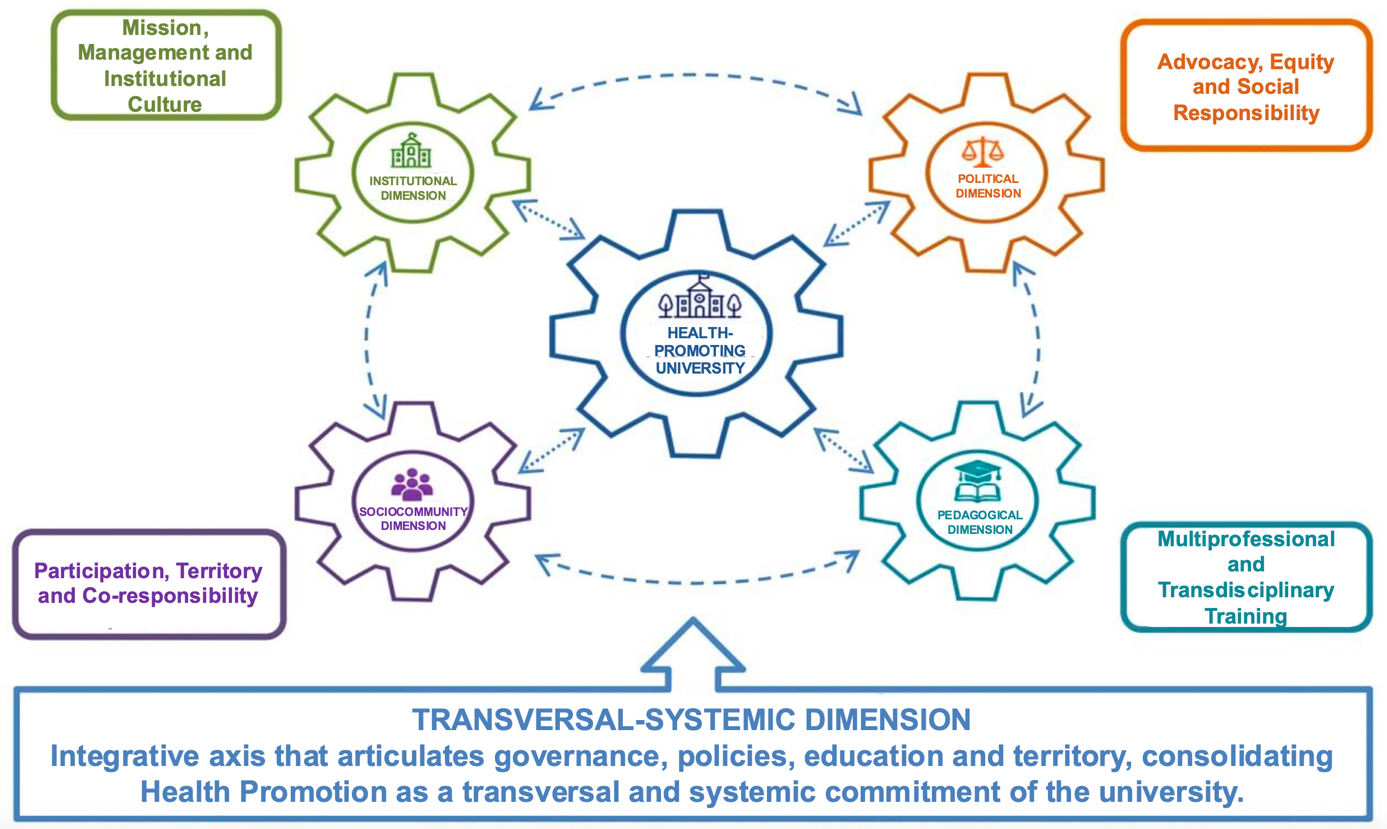
The Health-Promoting University is understood as an institution that incorporates health promotion into its identity and governance, assumes expanded social responsibility, recognizes academic training as a constitutive axis, values community participation and the relationship with the territory, and operates in an integrated manner through a transversal and systemic logic, as synthesized in the conceptual model proposed in Figure 1.
Figure 1 – Conceptual framework of the Health-Promoting University structured into five interrelated dimensions. Florianópolis, SC, Brazil, 2026
Source: prepared by the authors, 2026.
As illustrated in Figure 1, the institutional, political, pedagogical, and socio-community dimensions articulate dynamically and interdependently, whereas the transversal-systemic dimension acts as an integrating axis responsible for the coherence and articulation of the proposed conceptual model.
This model shows that health promotion is not configured as a set of isolated actions, but as an organizing principle of the university that guides its policies, practices, and relations.
The analysis also reveals an asymmetry in the development of the field, insofar as the institutional and political dimensions show a higher degree of consolidation, whereas the pedagogical dimension presents a lower level of detail, especially regarding its translation into structured educational models(16-18).
DISCUSSION
The findings of this study converge with recent scientific literature by showing that the field of Health-Promoting Universities has advanced in formulating institutional principles and guidelines, but remains characterized by conceptual heterogeneity and implementation inequality among institutions. The most recent scoping review demonstrates that the field still lacks greater theoretical systematization, being supported by multiple frameworks and approaches that do not always articulate in an integrated manner. In this context, the conceptual model proposed here contributes by organizing, into a single analytical structure, dimensions that frequently appear in a dispersed manner in the literature(9).
The historical analysis developed in this study represents an important differential. While recent literature tends to favor implementation studies and the analysis of institutional experiences, the results presented here demonstrate that the field was constituted through progressive shifts between initial legitimization, institutionalization, and systemic integration. This trajectory, marked by successive overlaps, re-engagements, and deepenings, evidences a movement of conceptual convergence over time, while revealing different levels of institutional maturity. This finding converges with studies pointing to variations in universities' organizational capacity to sustain health promotion policies and practices, even though the literature emphasizes implementation stages more than the historical processes of field construction(25-26).
Regarding the dimensions of the model, recent literature consistently supports the institutional and political dimensions, indicating convergence with the findings of this study. Factors such as leadership, institutional recognition, funding, coordination, and a whole-system approach are described as determinants for the effective implementation of Health-Promoting Universities, requiring the participation of different institutional actors and health professions in strategic management and governance positions. These elements also appear in a progressively more structured way in the analyzed documents, evidencing alignment between the Ibero-American movement and the international debate on the institutionalization and sustainability of initiatives(25,27).
The socio-community dimension also finds support in the literature, which recognizes participation as a central principle of health promotion. However, a partial divergence is observed between the centrality attributed to participation in the documents and its effective operationalization. Studies indicate fragility in translating this principle into concrete institutional practices, which is corroborated by the results of this study by highlighting the absence of greater detail regarding participation mechanisms. This tension between discursive centrality and practical operationalization constitutes a critical point in the development of the field(28-29).
The main contribution of this study focuses on the pedagogical dimension. The results demonstrated that, although this dimension is recurrently present in the documents, it presents a lower degree of detail and operationalization when compared to the institutional and political dimensions. Recent literature supports this asymmetry by indicating that health promotion is still poorly integrated into curricula and frequently addressed in a fragmented manner, without consistent articulation with interdisciplinary approaches. This finding is particularly relevant in the Latin American context, where structural challenges persist for the consolidation of more integrated educational proposals(9,30).
By highlighting this asymmetry, the study establishes an analytical convergence that deepens and systematizes a debate already present in the literature, situating the pedagogical gap not only as an operational limitation, but as a structuring element for the consolidation of the field. Although the literature recognizes training as one of the components of Health-Promoting Universities, the results presented here suggest that the fragility of this dimension can compromise the realization of the proposal as a whole.
The transversal-systemic dimension reinforces this interpretation by positioning health promotion as an organizing principle of the university. The literature points out that the effectiveness of Health-Promoting Universities depends on the integration between teaching, research, community outreach, and management, requiring coherence between institutional values and concrete practices. The results of this study converge with this perspective by evidencing the progressive incorporation of transversality in the analyzed documents(9,29).
Among the limitations of the study, the use of a specific document corpus, composed of institutional frameworks and international declarations, stands out, which may not encompass the totality of experiences and academic productions on the subject. Furthermore, although the analysis was conducted by a single researcher, a characteristic inherent to the adopted theoretical-analytical design, the possibility of interpretive biases is recognized. To mitigate them, strategies of systematization, reflexivity, and analytical rigor were adopted. In this sense, the interpretations produced were continually discussed and refined within the scope of doctoral research supervision and monitoring, functioning as a debriefing and analytical refinement strategy and contributing to broadening interpretive consistency and reducing potential biases inherent in the analysis process. It is also noteworthy that the qualitative and theoretical-analytical nature of the study does not allow empirical generalizations, but rather the construction of conceptual interpretations anchored in the analyzed corpus.
The implications of this study are relevant for the advancement of the health and nursing fields, especially in the field of professional training. By highlighting the pedagogical gap in the operationalization of Health-Promoting Universities, the study points to the need for the development of structured educational strategies, with curricular integration, an interdisciplinary approach, and articulation with the territory.
For Nursing, this discussion assumes particular relevance due to the strategic position historically occupied by the profession in articulating care, education, management, and community action. In the context of Health-Promoting Universities, nurses can play a central role in the leadership and operationalization of the pedagogical and transversal-systemic dimensions of the proposed model, acting in the formulation and coordination of institutional policies, academic management, the reconfiguration of pedagogical projects, and the construction of educational processes guided by health promotion, interprofessionality, social responsibility, and action on the social determinants of health.
Furthermore, nursing's tradition in health education, the coordination of intersectoral actions, occupational health, and service management positions the profession as a strategic actor to promote the integration between teaching, research, community outreach, and territory, contributing to the training of professionals capable of acting on the social determinants of health and developing transformative practices in different contexts of action.
Thus, the main contribution of the article lies in the conceptual organization of a field still in consolidation, in the proposition of an analytical model structured into five interrelated dimensions, and in the elucidation of a structural asymmetry between institutional advancement and pedagogical fragility. This is a theoretical contribution that qualifies the debate and provides a basis for more consistent analyses regarding the implementation of Health-Promoting Universities.
Finally, the findings indicate the need to advance in the pedagogical operationalization of the model. The development of curricular strategies, the incorporation of interdisciplinary approaches, and the creation of impact evaluation mechanisms are central elements for strengthening the field. In this sense, the proposed model does not close the debate, but guides a research and intervention agenda aimed at consolidating health promotion in higher education(25-26,29).
CONCLUSION
The analysis of the letters, declarations, and structuring documents of the Ibero-American Network of Health-Promoting Universities allowed for an understanding of the Health-Promoting University as a historical and progressive construction, marked by the expansion of its scope, institutional consolidation, and the integration of organizational, social, and educational dimensions.
The systematization of this trajectory made it possible to identify five structuring dimensions: institutional, political, pedagogical, socio-community, and transversal-systemic, whose articulation underpins the proposed conceptual framework. As a contribution, the study offers an analytical basis for the theoretical organization of a field still characterized by conceptual dispersion and the fragmented use of its benchmarks.
The results revealed an asymmetry in the development of these dimensions. While the institutional and political dimensions show a higher degree of consolidation, the pedagogical dimension remains less developed, especially regarding its translation into educational practices and curricular arrangements.
It is concluded that strengthening the pedagogical dimension constitutes a central condition for the consolidation of the Health-Promoting University as an institutional model. In this sense, the conceptual framework developed in this study contributes to guiding curricular strategies, future analyses, and institutional processes aimed at integrating health promotion into higher education.
*Article derived from the Doctoral Thesis titled “Health-Promoting University: Multiprofessional and Transdisciplinary Training in Higher Education”, submitted to the Graduate Program in Nursing at the Universidade Federal de Santa Catarina, Florianópolis, Santa Catarina, Brazil, scheduled for a qualification defense in 2026.
CONFLICT OF INTEREST
The authors declare no conflict of interest.
REFERENCES
1. World Health Organization. Regional Office for Europe. Ottawa Charter for Health Promotion, 1986 [Internet]. Geneva: WHO; 1986 [cited 2026 Mar 20]. Available from: https://iris.who.int/handle/10665/349652
2. World Health Organization. Achieving well-being: a global framework for integrating well-being into public health utilizing a health promotion approach [Internet]. Geneva: WHO; 2023 [cited 2026 Mar 20]. Available from: https://iris.who.int/handle/10665/376200
3. Dooris M, Doherty S. Healthy universities: current activity and future directions: findings and reflections from a national-level qualitative research study. Glob Health Promot. 2010;17(3):6-16. https://doi.org/10.1177/1757975910375165. PMID: 21495435.
4. Suárez-Reyes M, Muñoz Serrano M, Van den Broucke S. How do universities implement the Health Promoting University concept? Health Promot Int. 2019;34(5):1014-1024. https://doi.org/10.1093/heapro/day055. PMID: 30052965.
5. International Conference on Health Promoting Universities and Colleges. Carta de Okanagan: una carta internacional para la promoción de la salud en universidades e instituciones de educación superior [Internet]. Kelowna: University of British Columbia; 2015 [cited 2026 Mar 20]. Available from: https://riups.org/wp-content/uploads/2025/01/carta-de-okanagan-para-unas-universidades-e-ies-promotoras-de-salud-2015.pdf
6. Ginter PM, Kennedy R, Erwin PC, Reed W. The Okanagan Charter to improve wellbeing in higher education: shifting the paradigm. Front Educ. 2024;9:1443937. https://doi.org/10.3389/feduc.2024.1443937
7. Arroyo-Acevedo H, Durán Landazabal G, Gallardo Pino C. Diez años del Movimiento de Universidades Promotoras de la Salud en Iberoamérica y la contribución de la Red Iberoamericana de Universidades Promotoras de la Salud (RIUPS). Glob Health Promot. 2015;22(4):64-68. https://doi.org/10.1177/1757975914547548. PMID: 25319375.
8. Red Iberoamericana de Universidades Promotoras de la Salud. Acta constitutiva de la Red Iberoamericana de Universidades Promotoras de la Salud [Internet]. 2007 [cited 2026 Mar 20]. Available from: https://riups.org/wp-content/uploads/2025/01/2007-actaconstitutivariups-1.pdf
9. Sáenz C, Boldú E, Canal J. Health promoting universities: a scoping review. Health Promot J Austr. 2025;36(2):e939. https://doi.org/10.1002/hpja.939. PMID: 39912192.
10. Prevedello AS, Góes FSN, Cyrino EG. Educação interprofissional na formação em saúde no Brasil: scoping review. Rev Bras Educ Med. 2022;46(3):e110. https://doi.org/10.1590/1981-5271v46.3-20210006
11. Soares P, Costa AR da, Medeiros LMPO, Santos G, Carlomagno G, Batista NA, et al. Interprofessional education in undergraduate courses in health in Brazil: integrative review. J Interprof Care. 2024;38(3):499-506. https://doi.org/10.1080/13561820.2023.2273862. PMID: 37955981.
12. Braun V, Clarke V. Thematic Analysis: A Practical Guide. London: SAGE Publications; 2022.
13. Lange I, Vio F. Guía para universidades saludables y otras instituciones de educación superior [Internet]. Santiago: Universidad de Chile; 2003 [cited 2026 Mar 20]. Available from: https://uchile.cl/dam/jcr%3Aff0dd31d-4539-40d9-be5c-3c2bcbaaf675/guiausal.pdf
14. Edmonton International Conference for Health Promoting Universities and Institutions of Higher Education. The Edmonton Charter for Health Promoting Universities and Institutions of Higher Education [Internet]. Edmonton: University of Alberta; 2006 [cited 2026 Mar 20]. Available from: https://riups.org/wp-content/uploads/2025/01/2006_edmonton_charter_hpu.pdf
15. Declaración de Pamplona/Iruña. Las universidades y la promoción de la salud [Internet]. IV Congreso Internacional de Universidades Promotoras de la Salud. Pamplona: Universidad Pública de Navarra; 2009 [cited 2026 Mar 20]. Available from: https://www.uah.es/export/sites/uah/es/conoce-la-uah/compromiso-social/sostenibilidad-medioambiental/ecocampus/.galleries/documentos/Ecocampus/declaracion-Pamplona.pdf
16. Red Iberoamericana de Universidades Promotoras de la Salud. Asamblea General. Diez años para la década en el Movimiento de Universidades Promotoras de la Salud (2003-2013) [Internet]. San Juan: Universidad de Puerto Rico; 2013 [cited 2026 Mar 20]. Available from: https://riups.org/wp-content/uploads/2025/01/decada-movimiento-de-ups-2013.pdf
17. International Conference on Health Promoting Universities and Colleges. Okanagan Charter: An International Charter for Health Promoting Universities and Colleges [Internet]. Kelowna: University of British Columbia; 2015 [cited 2025 Nov 12]. Available from: https://bpb-us-w2.wpmucdn.com/wp.ovptl.uci.edu/dist/8/90/files/2023/11/Okanagan-Charter-2015.pdf
18. Red Iberoamericana de Universidades Promotoras de la Salud. Declaración de Alicante sobre la Promoción de la Salud y Universidad: construyendo entornos sociales y educativos saludables [Internet]. Alicante: Universidad de Alicante; 2017 [cited 2026 Mar 20]. Available from: https://riups.org/wp-content/uploads/2025/01/declaracionalicante2017.pdf
19. Red Iberoamericana de Universidades Promotoras de la Salud. Declaración de Monterrey: concertación política, social y universitaria por la salud y la equidad [Internet]. Monterrey: RIUPS; 2019 [cited 2026 Mar 20]. Available from: https://riups.org/wp-content/uploads/2025/01/declaracion-de-monterrey-2019.pdf
20. Red Iberoamericana de Universidades Promotoras de la Salud. Declaración de Coimbra: educación superior, promoción de la salud y desarrollo sostenible [Internet]. Coimbra: Instituto Politécnico de Coimbra; 2022 [cited 2026 Mar 20]. Available from: https://riups.org/wp-content/uploads/2025/01/declaracion-de-coimbra_esp-2022.pdf
21. Red Iberoamericana de Universidades Promotoras de la Salud. Declaración del XI Congreso Iberoamericano de Universidades Promotoras de la Salud: políticas institucionales promotoras de la salud que valoricen la vida [Internet]. Niterói: RIUPS/UFF; 2024 [cited 2026 Mar 20]. Available from: https://riups.org/wp-content/uploads/2025/08/carta-de-niteroi-final.pdf
22. International Union for Health Promotion and Education. Limerick Framework for Action for Health Promoting Universities and Colleges [Internet]. Limerick: IUHPE; 2025 [cited 2026 Mar 21]. Available from: https://riups.org/wp-content/uploads/2026/03/carta-de-limerick-versao-potugues-patricia-leme.pdf
23. Scott J. A matter of record: documentary sources in social research. Cambridge: Polity Press; 1990.
24. Bowen GA. Document analysis as a qualitative research method. Qual Res J. 2009;9(2):27-40. https://doi.org/10.3316/QRJ0902027
25. Suárez-Reyes M, Muñoz Serrano M, Van den Broucke S. Factors influencing the implementation of the Health Promoting University initiative: experiences of Ibero-American universities. Health Promot Int. 2021;36(5):1346-1356. https://doi.org/10.1093/heapro/daaa154. PMID: 33515026.
26. Tafireyi CGS, Grace JM. Status of the Health Promoting University (HPU) globally and its relevance for emerging African HPUs: an integrative review and bibliometric analysis. Glob Health Promot. 2024;31(3):42-59. https://doi.org/10.1177/17579759241235109. PMID: 38520053.
27. Comellas-Sáenz P, Juvinyà-Canal D, Esqué-Boldú S. Analyzing the implementation of the Health Promoting University framework in different contexts: a cluster analysis. Rev Bras Enferm. 2025;78(5):e20240130. https://doi.org/10.1590/0034-7167-2024-0130. PMID: 41370449.
28. Suárez-Reyes M, Van den Broucke S. Participation of university community members in Health Promoting University (HPU) initiatives. Front Public Health. 2023;11:1217177. https://doi.org/10.3389/fpubh.2023.1217177. PMID: 37693703.
29. Paduano S, Amicizia D, Mancuso D, La Torre M, Minet C, Paglino F, et al. Health promotion in the university setting: a scoping review. Am J Health Promot. 2025;40(7):886-897. https://doi.org/10.1177/08901171251412956. PMID: 41439445.
30. Faria MGA, Mello AS, Silva CSSL, Gallasch CH, David HMSL, Martinez-Riera JR. Health promoting universities and the salutogenic theory: contemporary challenges in the Latin American reality. Glob Health Promot. 2024;31(4):20-26. https://doi.org/10.1177/17579759241242113. PMID: 38801023.
Submission: 06-May-2026
Approved: 15-Jul-2026
Editors:
Rosimere Ferreira Santana (ORCID: 0000-0002-4593-3715)
Geilsa Soraia Cavalcanti Valente (ORCID: 0000-0003-4488-4912)
Elaine Antunes Cortez (ORCID: 0000-0003-3912-9648)
Corresponding author: Antônio Carlos Pereira Junior (acpjunior5@hotmail.com)
Publisher:
Escola de Enfermagem Aurora de Afonso Costa – UFF
Rua Dr. Celestino, 74 – Centro, CEP: 24020-091 – Niterói, RJ, Brazil
Journal email: objn.cme@id.uff.br
|
AUTHOR CONTRIBUTIONS |
|
Study design: Pereira Junior AC, Heidemann ITSB. Data collection: Pereira Junior AC, Monteiro PVS. Data analysis: Pereira Junior AC, Heidemann ITSB, Monteiro PVS. Data interpretation: Pereira Junior AC, Heidemann ITSB, Monteiro PVS. All authors are responsible for the textual writing and critical review of the intellectual content, the final version published, and all ethical, legal, and scientific aspects related to the accuracy and integrity of the study. |
