
ORIGINAL ARTICLE
SOCIAL NETWORKS AND ORGANIZATIONAL CLIMATE IN HOSPITAL NURSING CARE
Aline Brito Nunes1, Lucilane Maria Sales da Silva2, Tarciso Feijó da Silva3, Cristina Albuquerque Douberin4, Helena Maria Scherlowski Leal David5, Hugo Pinto de Almeida6
1 Universidade Estadual do Ceará, Faculdade de Enfermagem. Fortaleza, CE, Brazil. ORCID: 0000-0003-2188-6405.E-mail: enfermagemalinebrito@gmail.com.
2 Universidade Estadual do Ceará, Faculdade de Enfermagem. Fortaleza, CE, Brazil. ORCID: 0000-0002-3850-8753. E-mail: lucilane.sales@uece.br.
3 Universidade do Estado do Rio de Janeiro, Faculdade de Enfermagem. Rio de Janeiro, RJ, Brazil. ORCID: 0000-0002-5623-7475. E-mail: tarcisofeijo@yahoo.com.br.
4 Universidade Estadual do Ceará, Faculdade de Enfermagem. Fortaleza, CE, Brazil. ORCID: 0000-0003-0023-0036. E-mail: albuquerque.dourebin@aluno.uece.br.
5 Universidade do Estado do Rio de Janeiro, Faculdade de Enfermagem. Rio de Janeiro, RJ, Brazil. ORCID: 0000-0001-8002-6830. E-mail: helenalealdavid@gmail.com.
6 Universidade do Estado do Rio de Janeiro, Faculdade de Enfermagem. Rio de Janeiro, RJ, Brazil. ORCID: 0000-0002-7531-793X. E-mail: hugopa_rj@yahoo.com.br.
ABSTRACT
Objective: to analyze, from the perspective of Social Network Analysis, the configuration of interactions among healthcare workers in the context of hospital nursing care. Method: cross-sectional, descriptive, and exploratory study conducted at a philanthropic hospital in Ceará, Brazil. Data collection occurred in July 2022 using a sociodemographic questionnaire and an egocentric relational matrix applied to 25 nurses working across three care sectors. Interactions were classified as favorable or unfavorable to the organizational climate based on participants' evaluations and graphically represented using UCINET® and NetDraw® software. Results: two distinct relational patterns were identified. Favorable interactions were concentrated among core care professionals, particularly between nurses and physicians, associated with functional proximity and communication in care. Unfavorable interactions mainly involved support sectors, such as pharmacy, nutrition, and transport, highlighting difficulties at interprofessional interfaces. Furthermore, lower participation of managers was observed in favorable interactions. Conclusion: the identified interaction patterns indicate that the evaluation of the organizational climate among nurses is related to daily interaction experiences in care practice and is influenced by proximity, frequency, and the quality of relationships established in the work environment.
Descriptors: Organizational Culture; Patient Care Team; Integrality in Health; Social Networking; Nursing Service, Hospital.
|
How to cite: Nunes AB, Silva LMS, Silva TF, Douberin CA, David HMSL, Almeida HP. Social networks and organizational climate in hospital nursing care. Online Braz J Nurs. 2026;25(1):e20266998. http://doi.org/10.17665/1676-4285.20266998 |
What is already known:
Organizational climate in nursing is associated with the quality of interpersonal relationships in the workplace.
The coordination between care teams and support sectors influences the dynamics of hospital care.
Gaps remain in understanding professional interactions from the perspective of Social Network Analysis.
What this article adds:
Interactions favorable to the organizational climate are concentrated within the core care team (nursing and medicine), highlighting the centrality of relationships directly involved in care production.
Unfavorable interactions occur primarily with support sectors, revealing weaknesses in interprofessional coordination.
Organizational climate is configured as a relational phenomenon, structured by workplace interactions and mediated by nursing in care coordination.
INTRODUCTION
The hospital environment is a highly complex space in which the production of nursing care occurs through interdependent practices that link multiple healthcare workers, including direct care professionals, technical-logistical support sectors, and managers involved in hospital organizational dynamics(1). In this scenario, the organizational climate has been analyzed as a phenomenon that expresses shared evaluations among workers regarding working conditions, interpersonal relationships, and management styles, directly influencing team performance, professional well-being, and the quality of care provided(2-4).
However, despite being widely discussed, the organizational climate is still frequently treated as a construct centered on individual subjective dimensions, often measured by standardized instruments that capture individual evaluations of workers(5). Although relevant, this approach can limit the understanding of its relational nature, especially in contexts such as hospitals, where care is produced collectively and depends on the quality of interactions established among different institutional actors. Thus, analyzing the organizational climate requires shifting the analytical focus away from an exclusively individual perspective toward one that considers the interaction processes that structure health work.
From this analytical shift, relationships among healthcare workers can be understood as social networks, constituted by actors and the ties they establish in daily work(6). These networks organize not only communication and cooperation flows but also influence information circulation, decision-making, and care coordination. Evidence indicates that organizational contexts characterized by more integrated and collaborative interactions tend to favor teamwork and patient safety, whereas fragmented relationships or those marked by communication barriers can compromise care continuity and increase clinical risks(7,8).
In nursing, this discussion assumes central importance, given that nurses occupy a strategic position in coordinating care and mediating among different professional categories. Nursing constitutes the organizational core of care practices, serving as the entity responsible for integrating clinical information, coordinating care actions, and interfacing with other institutional sectors. Consequently, the interactions established by these professionals not only reflect work organization but also actively participate in building collaborative environments, which reinforces the need to analyze them in greater depth.
Despite this recognition, a significant portion of studies addressing organizational climate and work relations in health still presents important limitations, particularly regarding the analysis of the interactional dynamics that underpin such phenomena. Many investigations describe associations between organizational climate and outcomes such as satisfaction, performance, or patient safety, without examining in depth how relationships among healthcare workers are structured and which interaction patterns are implicated in these processes(9).
Additionally, even in studies incorporating a relational perspective, a tendency toward the simplification of interactions is sometimes observed, reducing them to normative categories of collaboration or conflict without considering the complexity of the ties established in daily institutional life. This gap is particularly relevant in hospital services, where distinct work logics, professional hierarchies, and organizational conditions coexist, influencing how professionals interact and producing distinct effects on the work environment. In the Brazilian context, such challenges are exacerbated by structural conditions often marked by resource constraints, high workloads, and interprofessional tensions, especially in public and philanthropic institutions(10). These factors can directly affect the quality of interactions among healthcare workers and, consequently, how organizational climate is evaluated and experienced in daily work(11).
Given this scenario, there is a clear need for investigations that deepen the analysis of relationships among healthcare workers, considering not only their individual evaluations but also the interaction patterns that structure collective work. By analyzing these interactions, it becomes possible to identify dynamics that foster or hinder care coordination, contributing to the identification of relational factors associated with organizational climate in hospital contexts. In this sense, the use of Social Network Analysis can contribute to a deeper understanding of professional interactions, allowing the identification of relational patterns that interfere with organizational dynamics, interprofessional coordination, and care orientation, particularly within the nursing context(12).
Thus, this study assumes that organizational climate in hospital nursing care is intrinsically linked to how healthcare workers connect and interact in daily work, requiring these relationships to be analyzed as a constitutive part of care processes. Therefore, this study aims to analyze, from the perspective of Social Network Analysis, the configuration of interactions among healthcare workers in the context of hospital nursing care.
METHODS
This is a cross-sectional, descriptive, and exploratory study based on Social Network Analysis (SNA), a methodological approach that allows the description of structural patterns of interaction among actors using metrics such as density, centrality, and network positioning, without, however, assuming causal relationships among the analyzed elements(13,14). The study was conducted and reported in accordance with the Strengthening the Reporting of Observational Studies in Epidemiology (STROBE) guidelines(15).
The study was conducted at a philanthropic hospital located in the city of Fortaleza, Ceará, Brazil, which provides medium- and high-complexity healthcare. Three care sectors were selected—medical clinic, intensive care unit, and surgical center—because they present distinct levels of care complexity and a high need for interprofessional coordination, favoring the analysis of interactions in the context of nursing care.
The study population comprised 32 nurses working in the selected sectors. The following inclusion criteria were adopted: being a nurse with an active employment link with the institution, being assigned to one of the selected sectors, and having a minimum of one year of work experience at the hospital, considering the need for prior integration into the organizational context for study participation. Professionals with occasional performance, such as on-call nurses without fixed employment links or those whose work was restricted to weekends, were excluded.
The final sample consisted of 25 nurses, representing most eligible professionals in the investigated sectors. There was a loss of seven participants due to refusal to participate in the research or unavailability during the data collection period. Data collection was carried out in July 2022 through individual approaches in a private environment, using a structured instrument composed of two parts: (1) sociodemographic and professional variables; and (2) an egocentric relational matrix. The choice of the egocentric approach was based on the possibility of capturing networks from the participants' perspective, considering their direct interactions in the work context(6).
In the relational matrix, each participant (ego) was asked to indicate healthcare workers with whom they maintained interactions in the care context. Participants were allowed to freely name workers from different professional categories and institutional sectors involved in this context, with no upper limit on nominations. For each indicated actor (alter), the participant classified the interaction based on their evaluation of how that relationship influenced the organizational climate, categorizing it as "favorable" or "unfavorable."
The classification of interactions was based exclusively on the participant's evaluation, considering three dimensions previously presented in the instrument: (1) perceived contribution to care flow; (2) ease or difficulty in communication; and (3) perceived impact on daily work organization. Interactions classified as "favorable" were those evaluated as facilitators of care and communication, whereas those classified as "unfavorable" were considered barriers to these processes. It is emphasized that this classification does not correspond to an objective evaluation of the performance of the nominated healthcare workers, but rather to the relational perception of the participant, thus constituting a subjective measure.
The nominated actors were subsequently coded according to professional category and work sector, ensuring individual and institutional anonymity. Relationships were organized into directed binary matrices, in which the presence of a tie was represented by the value 1 and the absence by the value 0. Two separate matrices were constructed: one for interactions evaluated as favorable and another for interactions evaluated as unfavorable.
Network analysis was performed using UCINET® software (version 6.643) to process the matrices and calculate structural indicators, and NetDraw® (version 2.161) to graphically represent the networks. The following indicators were analyzed: network density, defined as the proportion of existing ties relative to the total possible ties; degree centrality, which expresses the number of direct connections of each actor; and structural positioning, distinguishing central and peripheral actors(13).
The interpretation of SNA data was conducted descriptively, aiming to identify interaction patterns among actors in the constructed networks. No inferential analyses were performed, nor were causal relationships established between network structure and organizational climate, considering that data are based on individual evaluations and an egocentric approach, which limits the generalization of results and the inference of cause-and-effect relationships(14).
Sociodemographic and professional variables were analyzed using simple descriptive statistics, with absolute and relative frequencies. The results of the network analysis were presented through sociograms and descriptions of structural indicators, without attributing value judgments to the mentioned actors or sectors.
The study complied with the ethical guidelines established by Resolution No. 466/2012 of the Brazilian National Health Council(16). The project was approved by a Research Ethics Committee (CAAE No. 14088419.7.0000.5534), and all participants signed an Informed Consent Form. Anonymity, confidentiality, and the right to withdraw were guaranteed.
RESULTS
The socioprofessional characterization of the participants (Table 1) revealed a female predominance (76%), while men represented 24% of the sample, indicating the majority participation of women in the analyzed workforce. Most participants (60%) were aged between 26 and 35 years, characterizing a predominantly young group. A high level of professional qualification was observed, with 80% of the nurses holding a postgraduate degree.
Regarding institutional distribution, 56% of participants worked in the medical clinic, 24% in the surgical center, and 20% in the intensive care unit. Professional experience ranged from 1 to 22 years, with a predominance of the interval between 4 and 8 years (76%). Length of service at the institution ranged from 1 to 17 years, with a higher concentration between 5 and 7 years (56%). Regarding work shifts, 72% worked day shifts as day workers, while 28% worked night shifts on a duty rotation. A relatively balanced distribution was also observed between professionals with a single job link and those with multiple employment links, with a slight predominance of the latter (52%).
Table 1 - Socioprofessional characteristics of the study participants. Fortaleza, CE, Brazil, 2026 (n=25)
|
Variable |
n |
% |
|
Sex |
|
|
|
Female |
19 |
76 |
|
Male |
6 |
24 |
|
Age group (years) |
|
|
|
26–35 |
15 |
60 |
|
36–51 |
10 |
40 |
|
Graduate education |
|
|
|
Yes |
20 |
80 |
|
No |
5 |
20 |
|
Hospital unit |
|
|
|
Medical ward |
14 |
56 |
|
Intensive Care Unit |
5 |
20 |
|
Surgical Center |
6 |
24 |
|
Years of professional experience |
|
|
|
1–3 years |
2 |
8 |
|
4–8 years |
19 |
76 |
|
9–22 years |
4 |
16 |
|
Years working at this hospital |
|
|
|
1–4 years |
7 |
28 |
|
5–7 years |
14 |
56 |
|
8–17 years |
4 |
16 |
|
Work shift |
|
|
|
Day shift |
18 |
72 |
|
Night shift |
7 |
28 |
|
Work schedule |
|
|
|
Regular daytime schedule |
18 |
72 |
|
Rotating/on-call shifts |
7 |
28 |
|
Employment at another institution |
|
|
|
Yes |
13 |
52 |
|
No |
12 |
48 |
|
Total |
25 |
100 |
Source: prepared by the authors, 2026.
Social network analysis was conducted from an egocentric perspective, considering nurses as central actors (ego) and the healthcare workers they nominated as part of their work-related interactions (alters). Based on the matrices built and processed using UCINET® and NetDraw® software, two distinct representations were generated: one referring to interactions evaluated as favorable to the organizational climate and another to interactions evaluated as unfavorable.
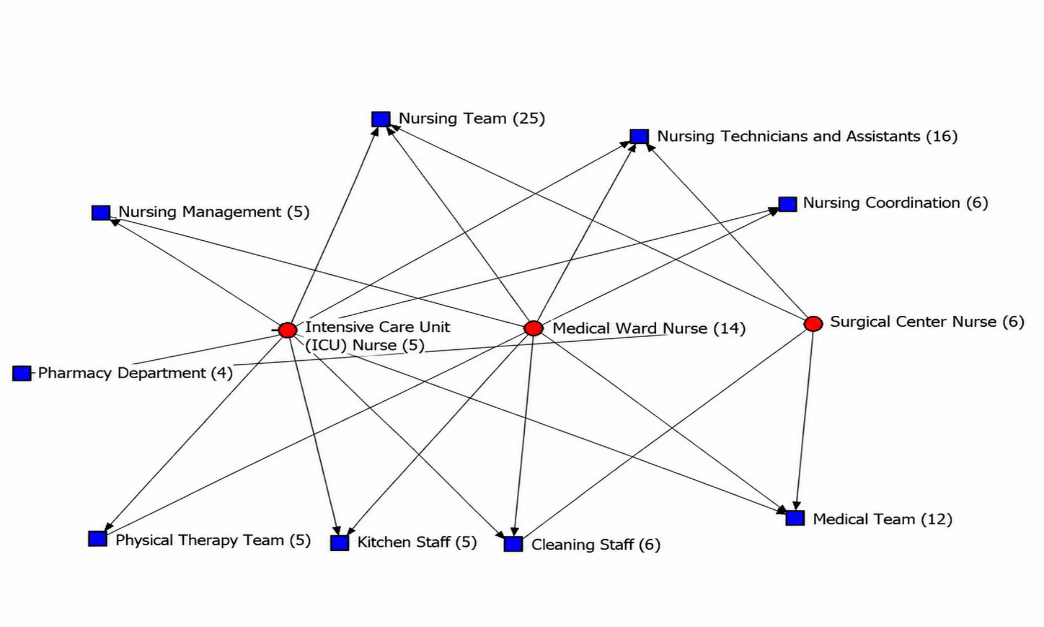
In the network of interactions classified as favorable (Figure 1), a higher concentration of ties was observed among professionals within the nursing team itself—including nurses, nursing technicians, and nursing assistants—alongside frequent mentions of physicians. The graphical representation of this network revealed a higher number of connections among the nominated actors, highlighting the ties established among professionals in the core care team.
Source: prepared by the authors, 2026.
Figure 1 - Social network of nurses with a favorable organizational climate. Fortaleza, CE, Brazil, 2026
In this network, nursing team professionals presented a higher number of direct connections, characterizing more central positions within the represented structure. A lower frequency of nominations was observed for professionals occupying management positions, such as coordinators and supervisors, among interactions classified as favorable.
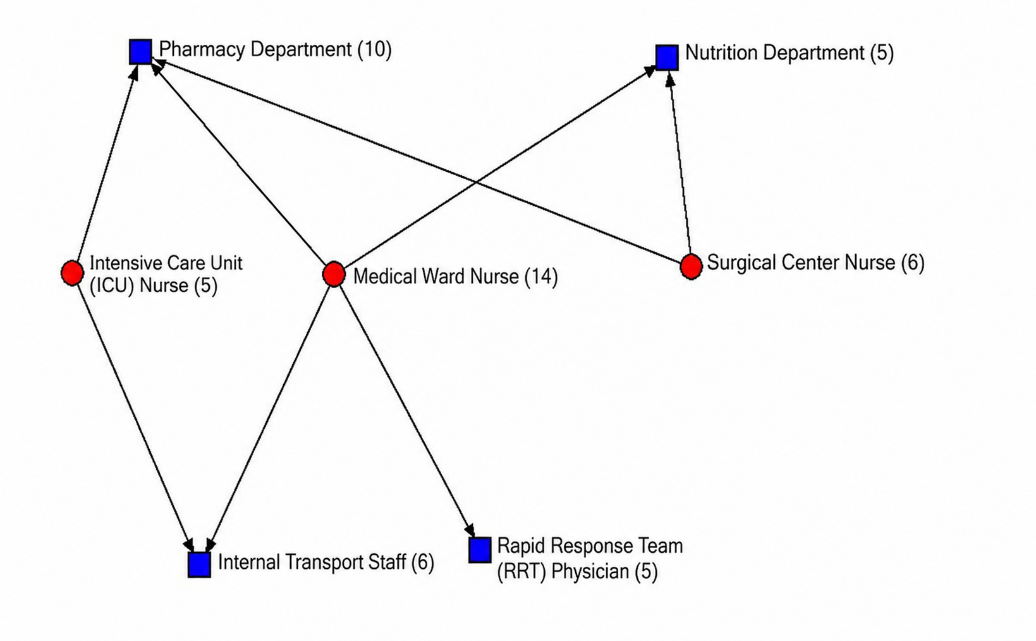
The network of interactions classified as unfavorable (Figure 2) presented a lower number of connections and greater dispersion among the nominated actors. The most frequently mentioned professionals were linked to support sectors, such as hospital pharmacy, internal transport, and nutrition, as well as physicians belonging to the Rapid Response Team (RRT). These actors were cited by participants from different care sectors.
Source: prepared by the authors, 2026.
Figure 2 - Social network of nurses with an unfavorable organizational climate. Fortaleza, CE, Brazil, 2026
In the graphical representation of this network, the nominated actors tended to occupy positions with a lower number of direct connections relative to the participating nurses, reflecting a structure of lower relative density. A lower presence of reciprocal ties among the nominated actors was also observed.
Overall, the network of interactions evaluated as favorable displayed a higher concentration of connections among professionals in the core care team, whereas the network of interactions evaluated as unfavorable showed a more dispersed distribution of ties and a lower number of direct connections among actors. These patterns reflect structural differences between the networks constructed from the participants' categorization of interactions, without implying causal inferences or judgments regarding the performance of the mentioned professionals.
DISCUSSION
The socioprofessional composition of the investigated group suggests a work context marked by relative institutional stability, intermediate professional experience, and relevant qualification—elements that tend to favor the construction of more consistent relationships in daily care.
In hospital environments, teams with greater continuity of activity and consolidated integration into the institution show greater potential to develop shared routines, strengthen interpersonal ties, and establish more stable communication patterns, aspects directly related to the evaluation of the organizational climate(8). Furthermore, work organization predominantly on day shifts and daily schedules can contribute to greater frequency and predictability of interactions among healthcare workers, favoring processes of cooperation and nursing care coordination. On the other hand, the presence of multiple employment links among some participants may introduce elements of fragmentation into the work experience, with potential repercussions on institutional involvement and the continuity of professional relationships(7,17).
In this sense, the combination of these characteristics configures a scenario that can both favor and strain the construction of the organizational climate, in that it combines integration factors, such as stability and experience, with potentially disruptive elements, such as multiple employment links, requiring an analysis articulated with the relational dynamics observed in the graphs.
The analysis of the results, based on Table 1 and the graphical representations of the networks, shows that the interactions established by nurses are not homogeneously distributed among the different institutional actors, allowing the organizational climate to be understood as a relational phenomenon built in the daily routine of work practices.
The predominance of a young, predominantly female workforce with high professional qualification suggests a favorable context for the development of collaborative practices, in line with evidence indicating that environments characterized by higher qualification and professional stability tend to present more positive evaluations of organizational climate and greater work engagement(18). In the context of nursing, these elements assume practical relevance, since nurses act directly in care coordination, workflow organization, and mediation of interactions among different healthcare workers, thereby influencing hospital care dynamics.
The reading of the graph regarding interactions evaluated as favorable indicates greater relational proximity among core care professionals, particularly between members of the nursing team and physicians. This pattern suggests that the most frequent and positively recognized interactions among participants are associated with activities directly related to care, reinforcing the understanding that organizational climate is strongly influenced by relationships established at the operational level of work. Environments characterized by collaborative interactions and effective communication are associated with better organizational climate evaluations, higher professional satisfaction, and better care quality(19). The findings also reinforce the centrality of nursing in sustaining hospital care, considering that nurses continuously articulate clinical information, care demands, and interprofessional needs throughout the care process.
The recurrent mention of professionals from the nursing team itself and physicians among favorable interactions indicates that functional proximity and the interdependence inherent to care tend to favor relationships perceived as collaborative. Literature on organizational climate in nursing highlights that relationships based on trust, mutual support, and continuous communication contribute directly to building positive and safe work environments(20). In this context, the results of this study, although derived from data collection conducted in 2022, reinforce the relevance of collaborative interactions in hospital care, especially given the expansion of interprofessional practices in health services(7,8), with greater integration among nurses, physicians, physical therapists, nutritionists, and pharmacists, particularly in higher-complexity units such as intensive care units. Thus, the findings should be interpreted considering the relational dynamics specific to different care contexts and the observed transformations in interprofessional practice within the hospital environment.
On the other hand, the lower presence of professionals in management positions among interactions evaluated as favorable, as observed in the graph, may indicate that these relationships are less frequent or less recognized in the daily care routines of nurses. This finding can be understood considering studies demonstrating that organizational climate evaluation is strongly influenced by immediate interactions and leadership exercised at the closest level, with the visible and accessible presence of management being a relevant factor in strengthening this climate(21-23). For nursing practice, this aspect highlights the importance of bringing managers closer to care teams, especially in supporting decision-making, work organization, and the qualification of care processes.
Conversely, the reading of the graph of interactions evaluated as unfavorable reveals the presence of actors linked to support sectors, such as pharmacy, nutrition, and transport, as well as physicians associated with the Rapid Response Team (RRT). These actors appear less connected to nurses, suggesting relationships that are less frequent or less integrated into daily work routines. This pattern may be related to organizational fragmentation and the technical division of labor, elements identified in the literature as potentially associated with difficulties in building a cohesive organizational climate(23). In nursing care, such weaknesses can directly impact care continuity, care management, and the coordination of clinical and operational demands required for hospital care, compromising care coordination carried out by nurses.
Studies on organizational climate in health services indicate that difficulties in intersectoral communication and coordination between different areas constitute relevant factors in the perception of less favorable work environments, especially when they compromise care flow and care continuity. Environments characterized by communication breakdowns and low integration tend to exhibit higher levels of occupational stress and lower professional satisfaction(24). However, in the present study, these relationships must be interpreted as participant perceptions of their interaction experiences; thus, structural or performance characteristics cannot be attributed to the mentioned sectors based on the analyzed data.
The presence of RRT professionals among interactions evaluated as unfavorable may also be associated with the episodic and highly complex nature of these interactions, which are frequently marked by critical situations. Literature indicates that high-pressure environments and critical clinical events influence healthcare workers' perceptions of work and interpersonal relationships, potentially impacting organizational climate evaluations negatively when associated with stress and work overload(25).
When considering both graphs together, it is observed that interactions evaluated as favorable are more strongly associated with functional proximity and the frequency of relationships established in daily care practice, whereas interactions evaluated as unfavorable tend to involve intersectoral interfaces and specific work process situations. This distinction reinforces the understanding of organizational climate as a dynamic phenomenon, influenced by relational experiences, work organization, and institutional conditions that mediate interactions among healthcare workers(18).
Thus, the results indicate that the evaluation of organizational climate among nurses is directly related to daily interaction experiences in care practice, especially those mediated by communication, cooperation, and coordination among healthcare workers. Concurrently, they demonstrate that difficulties at sector interfaces and less frequent interactions can contribute to less favorable evaluations of the work environment, highlighting the importance of institutional strategies aimed at strengthening interprofessional communication, integration among sectors, and the enhancement of workplace relationships in hospitals. For nursing, these findings reinforce the need for investments in collaborative work processes, the strengthening of nursing leadership, and the qualification of communication practices, considering their central role in care coordination and team integration within the hospital environment.
CONCLUSION
The analysis of interactions among professionals showed that the organizational climate in hospital nursing care is directly related to relational experiences lived in daily work. It was observed that closer, more frequent interactions established among professionals in the core care team were evaluated as favorable, whereas those involving support sectors and less integrated interprofessional interfaces were associated with unfavorable evaluations, especially when marked by communication difficulties and care coordination challenges.
The findings indicate that the way work is organized and how healthcare workers connect in daily care practice influences the evaluation of the work environment, potentially facilitating or hindering collaborative practices. In this context, limitations in intersectoral integration and interprofessional communication emerge as relevant aspects for understanding the organizational climate in hospital services.
It is recommended that health services invest in strengthening interprofessional relationships, with an emphasis on improving communication, coordination between sectors, and team integration in the care process. Continuing education strategies, spaces for dialogue among healthcare workers, and actions aimed at organizing care workflows can contribute to qualifying interactions and promoting more collaborative work environments.
Furthermore, the importance of management in promoting conditions that foster proximity between different areas and strengthen institutional relationships is highlighted, contributing to a more favorable organizational climate. Investments in infrastructure, work process organization, and professional qualification are also essential to sustain integrated care practices aligned with care needs.
CONFLICT OF INTEREST
The authors declare that there is no conflict of interest.
REFERENCES
1. Wei H, Horns P, Sears SF, Huang K, Smith CM, Wei TL. A systematic meta-review of systematic reviews about interprofessional collaboration: facilitators, barriers, and outcomes. J Interprof Care. 2022;36(5):735–49. https://doi.org/10.1080/13561820.2021.1973975. PMID: 35129041.
2. Schneider B, González-Romá V, Ostroff C, West MA. Organizational climate and culture: Reflections on the history of the constructs in the Journal of Applied Psychology. J Appl Psychol. 2017;102(3):468–82. https://doi.org/10.1037/apl0000090. PMID: 28125256.
3. Cantos Nieto V, Lucero Sánchez M, Nausin RJ. Clima Organizacional y Satisfacción Laboral del Profesional de Enfermería. ReSoFro. 2026;6(2). https://doi.org/10.59814/resofro.2026.6(2)1107.
4. Villagracia HN, Alanezi AJ, Alshammri RZ, Alblwei KH, Harbi FFA, Alanezi FM, et al. Intensive Care Unit Nurses’ Organizational Climate and Clinical Competency in Saudi Government Hospitals: Cross‐Sectional and Multicenter Study. J Nurs Manag. 2025;2025(1):5041633. https://doi.org/10.1155/jonm/5041633.
5. Tueros Jurado RM, Salazar Marzal AM. Impacto del clima organizacional en la satisfacción laboral del personal de una empresa de mensajería en Lima. BIJ. 2025;4(2):5–23. https://doi.org/10.62943/bij.v4n2.2025.304.
6. Fonseca J dos SA, David HMSL, Silva TF da, Ramos TC da S, Neves ACL, Miranda RB de. Redes sociais, acesso e regulação dos serviços de saúde em um município de pequeno porte do Rio de Janeiro, Brasil. Ciênc saúde coletiva. 2018;23(10):3211–22. https://doi.org/10.1590/1413-812320182310.15492018.
7. Peduzzi M, Agreli HLF, Silva JAM da, Souza HS de. Trabalho em equipe: uma revisita ao conceito e a seus desdobramentos no trabalho interprofissional. Trab educ saúde. 2020;18(suppl 1):e0024678. https://doi.org/10.1590/1981-7746-sol00246.
8. Reeves S, Pelone F, Harrison R, Goldman J, Zwarenstein M. Interprofessional collaboration to improve professional practice and healthcare outcomes. Cochrane Database Syst Rev. 2017;6(6):CD000072. https://doi.org/10.1002/14651858.CD000072.pub3. PMID: 28639262.
9. Berberoglu A. Impact of organizational climate on organizational commitment and perceived organizational performance: empirical evidence from public hospitals. BMC Health Serv Res. 2018;18(1):399. https://doi.org/10.1186/s12913-018-3149-z. PMID: 29859066.
10. Ferreira AG, Lopes MRC, Borba AK de OT, Marques AP de O, Alves FAP, Lima BC de C. Factors associated with absenteeism in elderly nursing workers. Rev Gaucha Enferm. 2022;43:e20210063. https://doi.org/10.1590/1983-1447.2022.20210063.en. PMID: 36383815.
11. Araújo-dos-Santos T, Nunes DO, Pereira RB, Góes MM da CSR, Ferreira IQBP, Santos SD dos, et al. Associação entre variáveis relacionadas à precarização e afastamento do trabalho no campo da enfermagem. Ciênc saúde coletiva. 2020;25(1):123–33. https://doi.org/10.1590/1413-81232020251.28242019.
12. Silva TF da, David HMSL. Acolhimento, Redes sociais e produção do cuidado na Atenção Básica em Saúde no Município do Rio de Janeiro, Brasil. redes. 2021;32(1):67–81. https://doi.org/10.5565/rev/redes.879.
13. Borgatti SP, Everett MG, Johnson JC. Analyzing social networks. 2nd ed. Thousand Oaks: Sage Publications; 2018.
14. Andrade DC, David HMSL. Análise de redes sociais: uma proposta metodológica para a pesquisa em saúde e na enfermagem. Rev enferm UERJ. 2016;23(6). https://doi.org/10.12957/reuerj.2015.14861.
15. von Elm E, Altman DG, Egger M, Pocock SJ, Gøtzsche PC, Vandenbroucke JP. The Strengthening the Reporting of Observational Studies in Epidemiology (STROBE) Statement: guidelines for reporting observational studies. Int J Surg. 2014;12(12):1495–9. https://doi.org/10.1016/j.ijsu.2014.07.013. PMID: 25046131.
16. Conselho Nacional de Saúde (BR). Resolução nº 466, de 12 de dezembro de 2012. Aprovar diretrizes e normas regulamentadoras de pesquisas envolvendo seres humanos [Internet]. Brasília: Conselho Nacional de Saúde; 2012 [cited 2026 mar 15]. Available from: https://www.gov.br/conselho-nacional-de-saude/pt-br/atos-normativos/resolucoes/2012/resolucao-no-466.pdf/view
17. Ljungholm L, Edin-Liljegren A, Ekstedt M, Klinga C. What is needed for continuity of care and how can we achieve it? – Perceptions among multiprofessionals on the chronic care trajectory. BMC Health Serv Res. 2022:22(686). https://doi.org/10.1186/s12913-022-08023-0. PMID: 35606787.
18. Oliveira LB de, Cordeiro C de L. What do Young Adults Want? A Study About Their Job Preferences. BBR, Braz Bus Rev. 2025;22:e20231341. https://doi.org/10.15728/bbr.2023.1341.en
19. Meneses-La-Riva ME, Fernández-Bedoya VH, Suyo-Vega JA, Ocupa-Cabrera HG, Grijalva-Salazar RV, Ocupa-Meneses G di D. Enhancing Healthcare Efficiency: The Relationship Between Effective Communication and Teamwork Among Nurses in Peru. Nurs Rep. 2025;15(2):59. https://doi.org/10.3390/nursrep15020059. PMID: 39997795.
20. Larsman P, Pousette A, Törner M. Nurses' organizational climate of perceived organizational support and its relationships with psychosocial working conditions and psychological contracts: A longitudinal questionnaire study. Scand J Psychol. 2024;65(4):683–92. https://doi.org/10.1111/sjop.13017. PMID: 38482993.
21. Amiri F, Baghbani M, Hannani S, Azadi NA. Impact of organizational climate on the self-efficacy of operating room personnel. Ann Med Surg (Lond). 2023;85(6):2414–9. https://doi.org/10.1097/MS9.0000000000000368. PMID: 37363572.
22. Shen Y, Li Y, Ju C, Ashraf H, Hu Z, He C, et al. Foundational Effects of Organizational Climate on Perceived Safety Climate: A Multiple Mediation Model. Sustainability. 2023;15(22):15759. https://doi.org/10.3390/su152215759.
23. Tsoni E, Lazanaki V, Katsaros K. The Influence of Organizational Climate on Work Engagement: Evidence from the Greek Industrial Sector. Adm Sci. 2025;15(11):413. https://doi.org/10.3390/admsci15110413.
24. Conceoção A, Palma-Moreira A. The Relationship Between Occupational Stress, Burnout, and Perceived Performance: The Moderating Role of Work Regime. Adm Sci. 2025;15(10):377. https://doi.org/10.3390/admsci15100377.
25. Ullah H, Arbab S, Khan SA, Liu CQ, Fayaz M, Tian Y, et al. Work-Related Stress, Professional Respect, and Psychological Counseling Among Nurses: A Cross-Sectional Study. J Nurs Manag. 2025;2025(1):2413658. https://doi.org/10.1155/jonm/2413658. PMID: 40709105.
Submission: 15-Apr-2026
Approved: 26-May-2026
Editors:
Rosimere Ferreira Santana (ORCID: 0000-0002-4593-3715)
Geilsa Soraia Cavalcanti Valente (ORCID: 0000-0003-4488-4912)
Fabio André Miranda de Oliveira (ORCID: 0000-0002-4290-7247)
Corresponding author: Hugo Pinto de Almeida (hugopa_rj@yahoo.com.br)
Publisher:
Escola de Enfermagem Aurora de Afonso Costa – UFF
Rua Dr. Celestino, 74 – Centro, CEP: 24020-091 – Niterói, RJ, Brazil
Journal email: objn.cme@id.uff.br
|
AUTHORSHIP CONTRIBUTIONS |
|
Study design: Nunes AB, Silva LMS, Douberin CA. Data collection: Nunes AB, Silva LMS, Douberin CA. Data analysis: Nunes AB, Silva LMS, Silva TF, Douberin CA, David HMSL, Almeida HP. Data interpretation: Nunes AB, Silva LMS, Silva TF, Douberin CA, David HMSL, Almeida HP. All authors are responsible for the textual writing and critical review of the intellectual content, the final version published, and all ethical, legal, and scientific aspects related to the accuracy and integrity of the study. |
