
ORIGINAL ARTICLE
USER-FRIENDLINESS AND RECEPTION AT THE HUMAN MILK BANK: PARTICIPATORY CONSTRUCTION OF EDUCATIONAL TECHNOLOGY BASED ON THE MAGUEREZ ARCH*
Bianca Maria Innocencio da Silveira Lobo1, Elaine Antunes Cortez2, Cláudia Maria Messias3, Melissa Rangel Paulista4, Camilly Cardoso da Silva5, Rebeca Grassini Gomes de Carvalho6
1 Universidade Federal Fluminense, Escola de Enfermagem Aurora de Afonso Costa. Niterói, Rio de Janeiro, Brazil. ORCID: 0000-0002-0140-4491. E-mail: biainnocencio@gmail.com
2 Universidade Federal Fluminense, Escola de Enfermagem Aurora de Afonso Costa. Niterói, Rio de Janeiro, Brazil. ORCID: 0000-0003-3912-9648. E-mail: elainecortez@id.uff.br
3 Universidade Federal Fluminense, Escola de Enfermagem Aurora de Afonso Costa. Niterói, Rio de Janeiro, Brazil. ORCID: 0000-0002-1323-0214. E-mail: cmessias@id.uff.br
4 Universidade Federal Fluminense, Escola de Enfermagem Aurora de Afonso Costa. Niterói, Rio de Janeiro, Brazil. ORCID: 0000-0002-6019-8923. E-mail: melissarang@gmail.com
5 Universidade Federal Fluminense, Escola de Enfermagem Aurora de Afonso Costa. Niterói, Rio de Janeiro, Brazil. ORCID: 0000-0001-9069-2706. E-mail: camillycardoso96@gmail.com
6 Universidade Federal Fluminense, Escola de Enfermagem Aurora de Afonso Costa. Niterói, Rio de Janeiro, Brazil. ORCID: 0009-0000-2248-4825. E-mail: rebeca_ggc@id.uff.br
ABSTRACT
Objective: To analyze the reception at the Human Milk Bank (HMB) and develop a participatory and educational technology focused on Permanent Education in Health (PEH), to favor the reception of lactating women. Method: Participatory qualitative research, based on the Maguerez Arch, conducted with 22 participants (11 lactating women and 11 health professionals) at a university hospital in Niterói, RJ. The methodological path followed five stages: 1) Observation of reality (participant observation and questionnaires for lactating women); 2) Identification of key points; 3) Theorization (based on Merhy's framework and PEH policy); 4) Solution hypotheses (development and collective validation of an educational video); and 5) Application to reality (dissemination and registration of the technology). Results: Immersion revealed quality of care and technical excellence, but also emotional vulnerabilities (27.27% at risk of postpartum depression) and gaps. These data served as reflective triggers in the workshops, resulting in thematic categories regarding reception challenges. The synthesis culminated in the creation of an educational video to sensitize the team regarding subjective and integral support for women. Conclusion: The study fulfilled its objective by producing the video as a PEH technology. The tool proved capable of mediating reflections on "living work in act," enhancing reception and the humanization of practices at the Milk Bank.
Descriptors: Breastfeeding; Human Milk Banks; Education, Continuing; Lactating Women; Educational Technology.
|
How to cite: Lobo BMIS, Cortez EA, Messias CM, Paulista MR, Silva CC, Carvalho RGG. User-friendliness and reception at the Human Milk Bank: participatory construction of educational technology based on the Maguerez Arch. Online Braz J Nurs. 2026;25(1):e20266945. http://doi.org/10.17665/1676-4285.20266945 |
What is already known:
Human Milk Banks are multiprofessional services aimed at the promotion, protection, and support of breastfeeding and maternal-child health.
Humanized reception is fundamental for the success of breastfeeding, although gaps persist in the support provided to lactating women, especially regarding the emotional demands of the postpartum period.
PEH favors the transformation of professional practices, but its application in Human Milk Banks is still incipient.
What this article adds:
The use of the Maguerez Arch proved to be an effective PEH strategy to sensitize professionals regarding the reception of lactating women in Human Milk Banks.
The participatory construction of an educational video with a multiprofessional team constitutes a powerful technology for reflection and qualification of reception practices.
The identification of the probability of postpartum depression (according to a validated instrument) among the lactating women attended highlights the need for integral reception that addresses the technical, physical, and emotional dimensions of the postpartum period.
Breastfeeding (BF) is a high-impact strategy in reducing infant mortality, providing benefits for the mother and the baby, such as disease prevention and the strengthening of the bond(1). This process should begin during prenatal care and extend throughout the postpartum period, requiring health professionals to play a foundational role in the lines of care by integrating the technical management of breastfeeding, reception strategies, and sensitive listening(2).
It is noteworthy that Brazil has public policies aimed at supporting, protecting, and promoting BF, such as the Baby-Friendly Hospital Initiative, Human Milk Banks (HMBs), and the Brazilian Standard for the Commercialization of Foods for Infants and Young Children(3). HMBs are considered centers that work towards the promotion, protection, and support of BF, in addition to constituting a multiprofessional workspace in maternal-child health(4).
This article is the result of research linked to the Professional Master's in Health Teaching (MPES) at the Fluminense Federal University (UFF) and is part of the research line of Permanent Education in Health (PEH) within the Unified Health System (SUS). It is understood that HMBs should act as facilitators of the mother-baby bond, sustained by "soft" technologies of support and reception(5).
The HMB, as a multiprofessional setting, presents itself as a powerful field for the implementation of PEH, since it aims to transform professional practices through critical thinking. The challenge of PEH is to stimulate the co-responsibility of the actors involved in the permanent improvement of care, aiming to produce more resolute and humanized health practices(6).
To welcome means to recognize the health demands brought by users as legitimate. Reception must sustain the relationship between teams and users(7), and it is essential that health professionals be available for attentive and sensitive listening to doubts and afflictions, performing, whenever necessary, an individualized evaluation of each case.
In this perspective, PEH allows for the discussion of care demands and the verification of possible practical actions in daily work. PEH is understood as a method of transformation that expands knowledge through the problematization of reality in the daily labor routine(8). In the scientific literature, it is observed that the political and theoretical deepening of the PEH proposal with professionals working in the SUS(9) constitutes an aggregating strategy for the qualification of services.
The justification for this study lies in the premise that the development of an educational technology can serve as support for SUS professionals to promote physical, emotional, and technological support for lactating women. It is believed that such a tool can favor integral reception, helping the team to deal with the subjective complexities of the postpartum period that transcend biological management.
Therefore, the general objective is to analyze the reception at the HMB to develop, in a participatory manner, an educational technology focused on PEH, aiming to favor the reception of lactating women.
METHOD
Study design
This is a descriptive, exploratory, and qualitative study of the participatory action-research type. The report follows the Consolidated Criteria for Reporting Qualitative Research (COREQ) guidelines. The research was approved by the Research Ethics Committee of UFF under number CAAE: 14346719.8.0000.5243, in November 2020.
Research team and reflexivity
The research was conducted by the lead researcher, who at the time was a master's student in the MPES at UFF. The researcher is a nutritionist with a professional background in women's health and previous experience in HMBs, which provided the necessary sensitivity to understand the care nuances of the setting. In compliance with ethical rigor and reflexivity, it is emphasized that there was no employment bond or subordination relationship between the researcher and the HMB professionals at the time of the study.
Integration into the field was guided by technical neutrality for data collection, yet mediated by an empathetic and dialogical stance during the workshops, utilizing the researcher's professional experience as a tool to facilitate the PEH process. The risk of measurement bias was mitigated by critical distancing in data analysis, performed in conjunction with the supervisor and members of her research core, and by adopting an open-ended question script that prioritized the participants' free voice.
Setting and context
The setting for this research was the HMB of the Antônio Pedro University Hospital (HUAP), a public teaching hospital located in the city of Niterói, state of Rio de Janeiro. The HUAP HMB is the only one in Metropolitan Region II, which has an estimated total population of 2,021,681 inhabitants. The service operates with appointments scheduled by telephone or internal hospital demand (postpartum women hospitalized and mothers with hospitalized babies).
Participants
Study participants were divided into two groups: lactating women attended at the HMB and the sector's health team (professionals and students). The recruitment of lactating women occurred individually at the HMB through verbal invitations during the participant observation stage. Professionals were also recruited during this period for participation in the workshops.
For lactating women, inclusion criteria were: being registered and receiving care at the HMB during the data collection period, regardless of the postpartum time. As an exclusion criterion, any cognitive difficulty preventing comprehension of the research questions was considered. For professionals and students, inclusion criteria were: at least three months of activity in the sector and providing direct assistance to lactating women. Those who were away from their duties due to leave or vacation during the workshops were excluded.
The sample totaled 22 participants. The first group consisted of 11 lactating women attended at the HMB, corresponding to 36.6% of the users served in the sector during that period. The second group included 11 members of the HMB team: one nutritionist, one nutrition resident, two nurses, two nursing technicians, one psychologist, one nutrition technician, and three nutrition undergraduates. All were female, aged between 23 and 58 years. At the time of collection, the nutritionist (resident) worked on a daily routine care basis, while the other professionals followed a shift-based care schedule.
In compliance with the ethical precepts of Resolution 466/12, all participants signed the Informed Consent Form (ICF) and the Image and Voice Use Authorization Term (IVUAT). The final video was validated by the participants regarding content and form before its public availability on EduCapes and YouTube.
Data collection
Data collection occurred in a procedural and integrated manner, in two stages, structured from a situational diagnosis followed by the educational path in the workshops.
The first stage corresponded to the situational diagnosis, with a survey of the reality of the sector and the women. It began with participant observation at the HMB over one month, totaling eight hours distributed across three visits. Data were recorded in a field diary, allowing for an understanding of the service dynamics. As the researcher integrated into the field and interacted with the lactating women, she presented the research objectives; for those who agreed to participate, the TCLE was signed, and a contact phone number was requested to send the online questionnaire via Google Forms, forwarded by a link through the WhatsApp application.
This questionnaire was divided into two parts: the first contained characterization questions and open-ended questions about the perception of reception; the second consisted of the application of the Edinburgh Postnatal Depression Scale (EPDS), in its version validated for Brazil by Santos, Martins, and Pasquali(10), a self-administered scale. The objective of the scale was to identify the emotional vulnerability profile of the users, serving as a sensitizer and instrument for collective reflection, without individual clinical diagnostic purposes. It is important to note that the online questionnaire aimed to ensure the participant's privacy, allowing her to respond in a private environment of her choice via smartphone.
In the second stage, three workshops were held with the health team, based on the Problematization Methodology and structured by the five stages of the Maguerez Arch: 1) Observation of Reality; 2) Key points of the problem; 3) Theorization; 4) Hypothesis and solution proposals; and 5) Application to reality (11).
The workshops lasted 60 to 90 minutes each, in a reserved room at the hospital. The meetings were audio-recorded, upon authorization and signature of the ICF and IVUAT.
Workshop 1 corresponded to the first two stages of the Arch (Observation of Reality and Key Points), in which the researcher presented the situational diagnosis, composed of the synthesis of participant observation, EPDS data, and analysis of the online questionnaire with the lactating women. From this presentation, the group identified "critical nodes" (Key Points) and developed two learning questions about PEH strategies for reception. Through a conversation circle, each professional answered the questions, which were then subjected to Bardin's content analysis(12). At the end of this workshop, scientific readings were suggested to support the theorization phase—the theoretical response to the developed questions.
In Workshop 2, two more stages of the Arch were covered (Theorization and Solution Hypotheses). The researcher began the workshop by presenting Bardin's content analysis(12) of the previous responses to the learning questions, in the form of a chart with categories and subcategories, functioning as a trigger to revisit the developed questions, now theoretically grounded through group discussion. The group debated the framework of humanization and PEH regarding the identified problems and learning questions and, as a solution hypothesis, proposed the construction of an educational video.
The group defined the content, and a script was drafted. Content and script validation occurred both by the participants in the workshop itself and, subsequently, by a committee of three expert judges (PhD professors) during the research qualification.
Finally, in Workshop 3, the Arch was completed with the last stage (Application to Reality). The researcher presented the video produced based on the collective script. After appraisal, the team validated the technology as a tool for transforming local practice, suggesting that the video be published on YouTube. The researcher ratified the authorization for registration on the EduCapes portal and the publication of the video, according to the previously signed ethical terms.
Data analysis
Questionnaire responses and workshop records were fully transcribed and analyzed. Aiming for anonymity, statements were identified by the letters 'M' (women) and 'E' (HMB team), followed by Arabic numerals (e.g., M1, E1).
Quantitative data from online forms (sociodemographic characterization and EPDS scale) were subjected to simple descriptive statistical analysis. Regarding qualitative content from participant observation, the women's perceptions of reception were processed through thematic analysis, with results presented to the group as a sensitizing element in Workshop 1.
For the material arising from the post-Workshop 1 learning questions, Bardin's Content Analysis(12) was applied, proceeding with the decomposition of the material, extraction of meaning units, and systematization into categories. This process was performed manually by the researcher and her supervisor, serving as a trigger for collective theorization in Workshop 2.
The interpretation was based on Merhy’s framework (5,13-16) regarding "living work in act" and PEH guidelines(9).
RESULTS
The results of this study, grounded in participatory action research and the Maguerez Arch framework(11), are presented according to the progression of the pedagogical workshops, which covered the stages of: 1) Observation of reality and Key points; 2) Theorization and Solution hypotheses; and 3) Application to reality.
Workshop 1: Observation of reality and key points
During the first workshop, the presentation of the situational diagnosis integrated data collected through participant observation and the responses of lactating women to the questionnaires.
The prior immersion in the daily routine of the HMB revealed a service guided by technical rigor in clinical management and milk quality control. It was observed that the work dynamics, influenced by duty shifts and high demand, prioritized biological procedures over qualified listening to subjective needs. Reception was identified as assistentialist and punctual, focused on resolving immediate breast complications.
Regarding the profile of the 11 participating women, the average age was 32 years, with a predominance of primiparous women (72.7%) and a high education level (72.7%; n=8 with a university or postgraduate degree). Regarding emotional vulnerability, the application of the EPDS scale indicated that 27.27% (n=3) of the women presented scores suggestive of risk for postpartum depression, and 36.3% (n=4) reported a previous history of anxiety or depression. It is reaffirmed that these indicators (27.27%) were analyzed not as isolated clinical diagnoses, but as markers of emotional vulnerability and subjective events of the postpartum period to sensitize the team.
The analysis of the open-ended questions showed that 81.8% (n=9) of the women classified the care with positive terms, such as "excellent" or "wonderful," emphasizing the subjective dimension of care:
I don’t even have words to express my gratitude... It was more than care, it was a welcome, a friendly shoulder, a bit of hope when I was at my most fragile. I felt like a human being! A person who could cry without being reprimanded! (M1)
I arrived at the bank desperate because my milk had come in and become engorged... but the nurse was super attentive and reassured me. (M4)
However, 27.27% (n=3) of the participants pointed out structural and care gaps, specifically the lack of specialized medical support and infrastructure deficiencies:
There is a lack of a responsible doctor to help mothers who need a diagnosis... for lack of a doctor, I didn’t leave with my problem solved. (M2)
I suggest a changing table in the waiting room... and a prettier decoration, matching the wonderful professionals who are there. (M7)
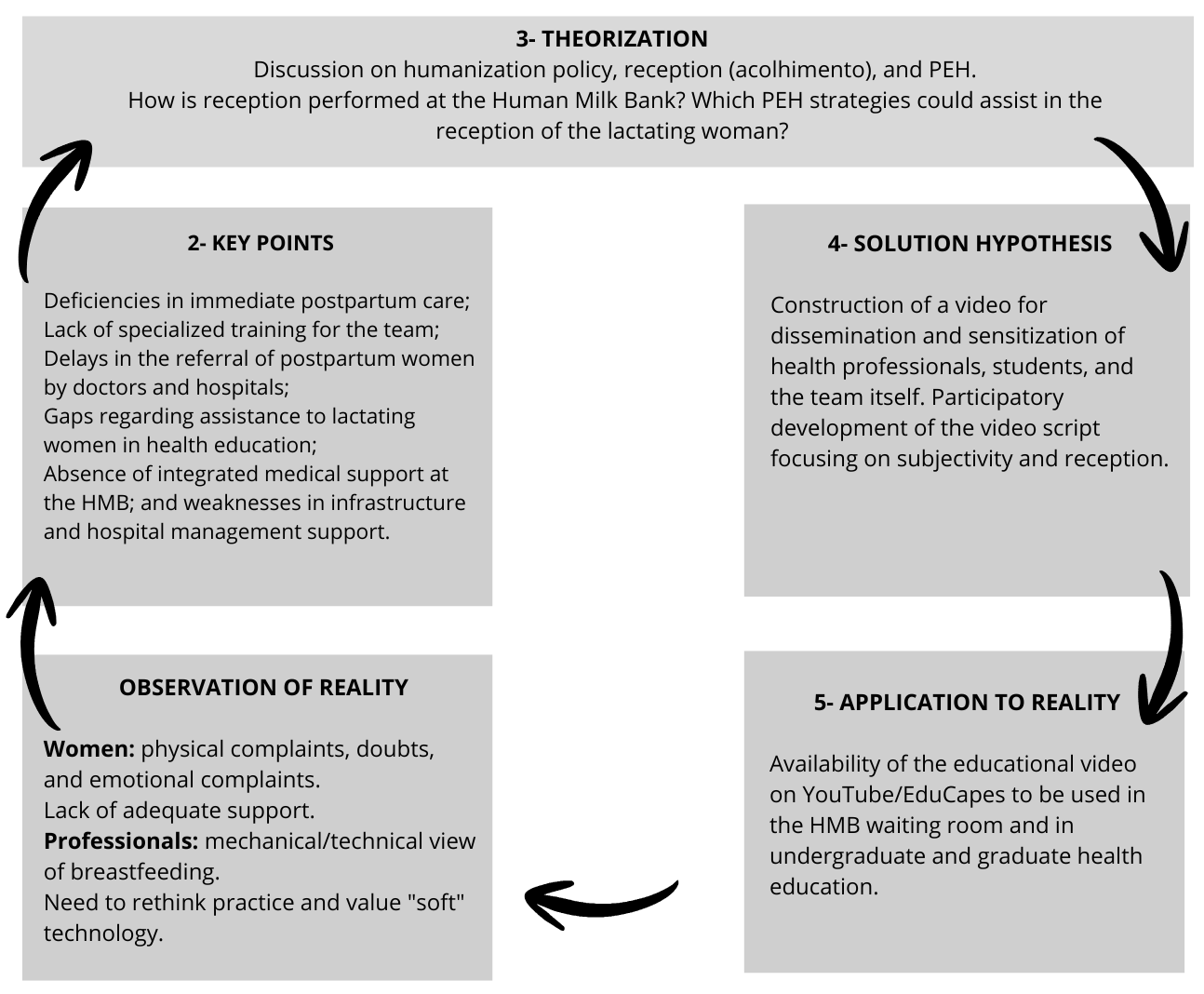
Based on the confrontation between the observed reality and user data, the team collectively identified the following critical nodes (Key Points): 1) deficiencies in immediate postpartum care; 2) lack of specialized training for the team; 3) delays in the referral of postpartum women by doctors and hospitals; 4) gaps regarding assistance to lactating women in health education; 5) absence of integrated medical support at the HMB; and 6) weaknesses in infrastructure and hospital management support.
At the end of the workshop, two guiding questions were developed for the Theorization stage: “How is reception performed at the HMB?” and “Which PEH strategies could assist the health professional in the reception of the lactating woman?”. In a conversation circle, each professional answered the questions, and the accounts were recorded for content analysis(12), serving as trigger material for the subsequent workshop.
Workshop 2: Theorization and solution hypotheses
The theorization stage was based on the content analysis(12) of the professionals' statements regarding the two developed questions, which generated 160 Recording Units (RUs) and 12 Meaning Units (MUs). The researcher began the workshop by presenting Chart 1 with the two central categories that emerged from this process. After the presentation, the professionals revisited their responses, now theoretically grounded by the scientific readings performed between the first and second workshops.
Chart 1 - Occurrences of MUs, categories, and subcategories found. Bardin Analysis. Niterói, RJ, Brazil, 2020
|
Code |
MUs |
Total occurrences |
Categories (%) |
Subcategories |
|
A |
Mother |
23 |
Category 1: The challenge for the HMB health team – the mother who is born after childbirth
98 (61.2%) |
Subcategory A: The recognition of the needs of lactating women by the HMB health team |
|
B |
Child |
15 |
||
|
C |
Breastfeeding |
22 |
||
|
D |
Breastfeeding difficulty |
13 |
Subcategory B: The HMB health team's contribution to the autonomy of the lactating woman |
|
|
E |
Birth |
9 |
||
|
F |
Autonomy |
8 |
||
|
G |
Challenges of being a mother |
8 |
||
|
H |
Mother's emotional health |
11 |
Category 2: HMB – a lap for the mother
62 (38.8%) |
Subcategory A: The role of the HMB professional in the reception of the lactating woman |
|
I |
Reception |
14 |
||
|
J |
Family Support |
8 |
Subcategory B: PEH in the context of the HMB |
|
|
L |
Professional support |
18 |
||
|
M |
PEH |
11 |
MUs = Meaning units.
Source: prepared by the authors, 2020.
Category 1, titled “The challenge for the team: the mother who is born after childbirth” (61.2%; n=98), evidenced the recognition of the need for a perspective that transcends the biological and promotes the woman's autonomy, although participants reported operational difficulties due to the workload:
We realize that the intense flow of milking sometimes makes us forget to ask how this woman slept or how she is feeling emotionally. (E1)
Category 2, “HMB – a lap for the mother” (38.8%; n=62), reinforced the role of the professional as emotional support and PEH as a strategy to strengthen the bond:
They are guided in the hospital, but when they go home, that is when the problem appears and they seek our help at the HMB with complaints, in search of support. (E4)
Based on this foundation, the group advanced to the fourth stage of the Arch. In the Solution Hypotheses phase, the group proposed: (1) meetings between lactating women and HMB professionals for video production; and (2) the creation of a video as an institutional PEH tool. The group validated the power of audiovisual technology for the standardization of guidelines and team sensitization:
The video helps because it standardizes the information and gives us visual support for the reception. (E5)
The collective construction resulted in the definition of the script and the essential contents for the educational technology, prioritizing the humanization of care and the subjective demands identified in the situational diagnosis. The final product was structured to reflect the reality of the sector and serve as practical support for reception.
Workshop 3: Application to Reality: The Production of an Educational Video
The final stage of Application to Reality culminated in the appraisal and validation of the educational technology produced. The video, developed by the researcher based on the script and contents collectively agreed upon with the team, was shown to the professionals to verify the final editing and technical adequacy. The group unanimously validated the product, highlighting that the audiovisual language adopted is consistent with the reality of the service and has strong potential as a sensitization tool for new professionals and students.
As a PEH strategy and aiming at the democratization of access, the team decided to make the video available on the YouTube platform (https://youtu.be/k9nDARGTAdY), in addition to the official registration on the EduCapes Portal. Figure 1 summarizes the methodological path and the results achieved in each stage of the problematizing workshops.
Figure 1 – Application of the Maguerez Arch. Niterói, RJ, Brazil, 2020
Source: prepared by the authors, 2020.
DISCUSSION
Revisiting reality triggers and the practice of reception at the HMB
The analysis of the results revealed a high quality of assistance provided by the HMB team, validated by the users who mostly classified it as “excellent”, “great”, or “wonderful”. The testimonials reinforce that the team’s practice transcends technical formalism, being perceived as a “friendly shoulder” and a “differential in the postpartum period”. This perception of inclusion and support demonstrates that reception, in the studied setting, operates as a highly resolute soft technology, capable of producing the encounter between professional knowledge and the user's needs(5-6).
Reception, as an ethical guideline for any health service, establishes a contract of respect for the needs and demands of users, based on resoluteness and commitment(17). The act of welcoming constitutes an action of approximation, a “being with” and “being close to”, which favors relations of care and qualified attention(18). In the daily routine of the HMB, this practice aims to stimulate humanization actions grounded in ethics and citizenship. The search for this humanized care expands the reflection on the relationship established between the professional and the SUS user, revealing the potential to go beyond mere mechanical service provision to reach the dimension of integral care(19).
This approach is strictly aligned with the National Humanization Policy (PNH), which positions reception as a transversal guideline and a pillar for the reorganization of services(7). From Merhy's perspective(5,13-16), reception qualifies the relationship by promoting attentive listening and bonding, essential elements of "living work in act”. More than a stage in the reception desk process, welcoming, in the context of this study, is configured as a theoretical-political milestone that enables multiprofessional work and equal access, shifting the focus of assistance toward the subject's needs(19-20). In this sense, reception sustains the relationship between the HMB team and lactating women, promoting the mutual recognition of rights and the production of accountability relations between those who care and those who are cared for(7,19). This intersection between Merhy's theory and the practice observed in the sector demonstrates that technical excellence only reaches its fullness when mediated by the technology of the encounter
The importance of the integral approach and the identified challenges
Although the team demonstrated a practice of excellence, the research also revealed gaps in assistance, such as the high demand for postpartum care and the lack of more adequate support outside the HMB. Suggestions from the lactating women to improve the service included the need for a responsible physician in the sector, infrastructure improvements (including a changing table), and more long-term follow-up in the milk collection process.
In this context, the data indicate that the HMB frequently operates as a "bottleneck" for failures occurring at other levels of the healthcare network. The lack of assertive guidance during prenatal care and late referrals from maternities and clinics overburden the HMB team with demands that exceed their immediate technical competence. This scenario requires professionals to redouble their reception efforts to reverse states of distress and insecurity established before arriving at the sector. Thus, the fragility in the articulation of the Health Care Network directly reflects on the dimensioning and resoluteness of the HMB, evidencing that reception does not depend solely on the individual posture of the professional, but on a network structure that supports the continuity of care.
Additionally, the application of the EPDS scale signaled that 27.27% of the participants presented emotional vulnerability, with a probability of postpartum depression. This data reinforces the complexity of care and the need for the team to go beyond technical management, recognizing the mother as a being with physical and emotional needs. It is noteworthy that, in this sample, 72.7% of the women had a high education level (university or postgraduate degree). However, cross-analysis revealed that high schooling did not act as a protective factor for mental health. This finding reinforces the thesis that reception at the HMB should not be based solely on the transmission of technical information, as the vulnerability of the postpartum period is independent of cultural capital. This justifies the need for Permanent Education in Health (PEH) technologies, such as the video produced in this research, which sensitize professionals to listening that goes beyond the user's education level, focusing on her subjective dimension.
The identified risk index for postpartum depression (27.27%) is a critical indicator for "living work in act”. It is known that psychological distress directly interferes with the milk ejection reflex and the woman's self-confidence, potentially leading to early weaning. Therefore, the use of this instrument allowed the team to understand that the clinical management of breastfeeding is inseparable from emotional support. Without the recognition of this subjective fragility, technical intervention risks becoming prescriptive and punitive, ignoring that the success of lactation depends on the stability and reception of this dyad.
The goal of health care is to act on the needs presented by the other, seeking to produce something that represents the conquest of control over suffering and/or the production of health. It is in the encounter between professionals that it becomes possible to use the entire “toolbox”, not only from work experience but also from one’s entire individual life history. According to Merhy(14), users, as bearers and producers of health needs, are complex; they have qualitative ways of living, require binding and welcoming relationships and encounters, have desires, and are also constituted by biological bodies.
Reflections emerged regarding the type of support offered by professionals attending the woman in the immediate postpartum period, and the professionals pointed out that when the woman arrives at the sector, she brings many doubts, complaints, and beliefs, requiring adequate guidance regarding breastfeeding management. For the health team, it is a challenge to welcome this mother who is "born after childbirth”. Some professionals highlighted the importance of early identification of difficulties and the needs of lactating women, emphasizing that the role of the HMB health team is to develop these women's autonomy.
The Maguerez Arch and PEH as transformation strategies
More than a rigorous methodological path, the application of the Maguerez Arch functioned as a catalyst for the team to transcend "passive complaints"—centered on the lack of doctors or structural resources—and assume a proactive stance. Reflection-in-action allowed professionals to re-signify their daily routine, realizing that although team sizing and external network failures are limiting factors, there is a space for autonomy in "living work," according to Merhy’s framework(15), to qualify reception. Thus, the Arch was not an end in itself, but a PEH strategy that made it possible to convert identified problems into a concrete technological product capable of sustaining a new care culture in the sector.
Merhy's precepts(15) converge with PEH policy due to their bottom-up nature, positioning professionals as active subjects who value their experiences and the context of the work-teaching-learning process. In this way, daily challenges gain new meanings for the actors involved. From this perspective, assistance emerges from living work in act, based on the system of relationships and the interpersonal encounter. This process enables spaces for listening and interpretation, generating moments of complicity and co-responsibility in facing problems, which consolidates the bond and reception(13).
The teaching-learning process, as described in PEH, occurs in the universe of work, based on the experiences and life stories of those who learn when faced with questions and answers while being in the world. It is a process distinct from mechanical teaching-learning, in which there is no necessary connection with daily life(16).
The gains that this PEH process can bring to the world of work and training are undeniable, as it transcends technical improvement by allowing worker-subjects to seek their autonomy and citizenship, as well as to reclaim their multidimensionality, reflecting on their work relationships(21-22).
Ensuring women's autonomy, according to the professionals, means ensuring that lactating women, after receiving all care, are capable of "managing" their needs, evolving in the care of their baby and in everything involving breastfeeding, becoming responsible for ensuring their own health and well-being and those of the baby.
The HMB is seen as a kind of "lap" (comfort) for the mother, and each member has an indispensable role in welcoming the lactating woman. PEH in the HMB is, therefore, a powerful strategy to ensure this "welcoming lap" and prevent it from being reduced to a "technical lap”. PEH proves to be a proposal for reconstructing practices adopted in daily work, assuming the responsibility of establishing direct relationships between teaching and service, considering local specificities and the needs for training and development. Its principles are based on action and reflection on the reality lived in health services and can assist the HMB health team in matters related to their practice.
The production of the educational vídeo as an application technology
As a result of the third workshop, the team chose to produce an educational video as the main hypothesis for solution and application to reality. The video was conceived as a PEH resource to be used in the HMB waiting room and in other teaching activities. Although the proposal for a face-to-face meeting with lactating women to record testimonials was not possible due to the COVID-19 pandemic, the video represents the realization of PEH as a strategy for sensitization and dialogue within the team.
It is worth noting that the produced video has an educational character and can be shared with lactating women; however, its primary function, in this study, is to act as a technological mediation tool for PEH. The central objective of the video is to sensitize and trigger continuous reflections in the team about "living work in act" and the importance of care beyond merely instructive aspects. Instead of focusing exclusively on milking techniques, the video content prioritized the subjective dimension of care.
The script, collectively validated, was structured into three axes: the first addresses reception at the front desk and the importance of qualified listening; the second focuses on emotional support in the face of the pain and insecurity of the lactating woman; and the third demonstrates the construction of the woman's autonomy in breastfeeding management. The validation by the team confirmed that the technology should not be a "conduct manual" but a sensitization instrument capable of triggering the debate on "being with" the user. Thus, the video materializes the product of the action research as a mediating technology that sustains the linearity between the initial situational diagnosis and the proposal for local practice transformation.
It is assumed that the video, as a PEH strategy, can contribute to the training of professionals who will work at the HMB, as well as lead the professionals who work there to rethink their practice, assisting them in building a more humanized work team. In an integrative review of the methodologies used by nurses in the production of educational videos, it was concluded that there is a need to improve the methodological framework and validation by the target audience, and that the development of videos with methodological rigor fosters the creation of high-quality teaching materials(23). Thus, the produced video was built and validated with the team, aiming to constitute a quality teaching material.
Among teaching methods that use Digital Information and Communication Technologies (DICTs), videos have gained prominence, especially with the widespread use of the internet during the pandemic. They stand out due to their ease of use, compatibility with digital platforms, and the presence of audiovisual elements that facilitate faster knowledge acquisition(24). The educational technology developed emerges as a product of this process and as a tool to enhance Continuing Education in Health (CEH) and, consequently, the quality of care provided to breastfeeding women.
Study limitations and implications
This study presents limitations that must be considered. Due to the COVID-19 pandemic, several research processes, especially in the final stage of product construction and validation, had to be adapted and revised. The initial proposal to hold a face-to-face meeting with lactating women to record testimonials was not feasible, necessitating an adjustment of the methodology to allow for the construction of the educational video exclusively with the participation of professionals.
The research highlighted a gap in postpartum healthcare, especially regarding care centered on the breastfeeding woman and her demands under an integral approach, which reinforces the need for the HMB to assume this role. Although the participating professionals demonstrated recognition and positive experience in receiving lactating women, a gap was observed in the understanding of this guideline by other hospital sectors, as well as by professionals from other institutions, the general population, and health academics—possibly resulting from limited exposure to this practice during professional training.
Regarding implications, the contribution of PEH stands out for favoring professional sensitization, dialogue, and critical reflection on practice and service. The present study highlights the importance of developing strategies within the health sphere that strengthen the reception of lactating women by professionals.
Additionally, this research points to a critical aspect: the gap in professional training, possibly due to the insufficient integration of students into HMB practice during undergraduate studies. Such findings reinforce the need to integrate the themes of reception and breastfeeding transversally across health curricula, so that integrality of care is not restricted to specialized sectors such as the HMB.
CONCLUSION
The study achieved its objective of analyzing the reception at the HMB and developing, in a participatory manner, an educational technology in video format for the team’s PEH. The application of the Maguerez Arch made it possible to diagnose that, although technical assistance is of excellence, there are subjective gaps and emotional vulnerabilities (such as the 27.27% risk for postpartum depression) that demand listening that transcends clinical management.
The produced technology fulfills its role as a trigger for reflection, using easily assimilated language to sensitize professionals and students regarding the importance of "being with" the lactating woman and fostering her autonomy beyond technical issues. As guiding axes for improving reception, the study points to the need for early identification of emotional demands and the integration of the HMB into the external health network, overcoming care isolation. It should be noted that the language adopted in the produced technology sought the simplicity necessary for sensitization, although it is recognized that specific technical deepening for each professional category will require future developments within the scope of PEH.
Finally, it is reiterated that the development of the video followed rigorous ethical precepts. All participants and professionals involved in the images and testimonials signed the TCLE and the TAUIV, and information regarding copyrights, institutional registration, and ethical aspects of the research was detailed and integrated into the final technology, made available on the EduCapes Portal and YouTube, ensuring the transparency of the production.
*This article was extracted from the Master’s dissertation entitled “Video as a strategy for continuing education to raise awareness among professionals regarding welcoming practices in the Human Milk Bank”, presented to the Professional Master’s Program in Health Education at Fluminense Federal University, Niterói, Rio de Janeiro, Brazil, in 2020.
CONFLICT OF INTERESTS
The authors declare no conflict of interests.
REFERENCES
1. Dias EG, Sena EPFR, Sampaio SR, Bardaquim VA, Campos LM, Araújo RA de. Estratégias de promoção do aleitamento materno e fatores associados ao desmame precoce. J Health NPEPS [Internet]. 2022 [cited 2024 July 16];7(1):e6109. Available from: https://periodicos.unemat.br/index.php/jhnpeps/article/view/6109.
2. Moreira TB, Silva LR da, Silva MDB, Silva LJ da, Mourão PP, Moreira APA. Maternal experience in the context of breastfeeding of the hospitalized newborn and submitted to surgical intervention. Esc Anna Nery. 2020;24:e20190281. https://doi.org/10.1590/2177-9465-EAN-2019-0281.
3. Iopp PH, Massafera GI, Bortoli C de FC de. A atuação do enfermeiro na promoção, incentivo e manejo do aleitamento materno. Enferm Foco. 2023;14:e202344. https://doi.org/10.21675/2357-707X.2023.v14.e-202344.
4. Marchiori GRS, Alves VH, Rodrigues DP, Vieira BDG, Pereira AV, Calandrini T do S dos S. Reflexão sobre a organização do trabalho de Enfermagem no banco de leite: cuidado compartilhado e multiprofissional. Esc Anna Nery. 2022;26:e20210174. https://doi.org/10.1590/2177-9465-EAN-2021-0174.
5. Merhy EE, Franco TB. Por uma composição técnica do trabalho em saúde centrado no campo relacional e nas tecnologias leves. Apontando mudanças para os modelos tecno-assistenciais. Saúde Debate [Internet]. 2003 [cited 2024 July 10];27(65):316-323. Available from: https://docs.bvsalud.org/biblioref/2023/05/676242/v27-n65-setdez-2003-12a-conferencia-nacional-de-saude-sergio-ar_DGKxlyw.pdf.
6. Sousa DD de, Sousa VT, Sousa PMLS de, Pinheiro VGM. O reflexo da educação permanente em saúde na prática de Enfermagem. RSC. 2025;8(1):996-1014. https://doi.org/10.61411/rsc202592518.
7. Ministério da Saúde (BR). Política Nacional de Humanização - PNH [Internet]. Brasília: Ministério da Saúde; 2013 [cited 2024 July 16]. Available from: https://bvsms.saude.gov.br/bvs/publicacoes/politica_nacional_humanizacao_pnh_folheto.pdf.
8. Higashijima MNS, Slomp Junior H, Ferla AA, Feuerwerker LCM, Merhy EE, Ceccim RB, et al. Principles and characteristics of Continuing Health Education: rescue and resistance in favor of a powerful SUS and in defense of life. Cien Saude Colet. 2025;30(suppl 1):e05902023. https://doi.org/10.1590/1413-812320242911.05902023EN. PMID: 40471595.
9. Ministério da Saúde (BR). Portaria nº 198, de 13 de fevereiro de 2004. Institui a Política Nacional de Educação Permanente em Saúde como estratégia do Sistema Único de Saúde para a formação e o desenvolvimento de trabalhadores para o setor e dá outras providências [Internet]. Brasília: Ministério da Saúde; 2004 [cited 2024 July 16]. Available from: https://www.nescon.medicina.ufmg.br/biblioteca/imagem/1832.pdf.
10. Santos MFS, Martins FC, Pasquali L. Escala de auto-avaliação de depressão pós-parto: estudo no Brasil. Rev Psiquiatr Clin. 1999;26:90-5.
11. Berbel NAN. Metodologia da problematização: experiências com questões de ensino superior, ensino médio e clínica. Londrina: Eduel; 1998.
12. Bardin L. Análise de conteúdo. Lisboa: Edição 70; 2011.
13. Franco TB, Merhy EE. Mapas analíticos: una mirada sobre la organización y sus procesos de trabajo. Salud Colect [Internet]. 2009 [cited 2024 July 16];5(2):181-194. Available from: https://www.scielo.org.ar/scielo.php?script=sci_arttext&pid=S1851-82652009000200003.
14. Merhy EE. Saúde: a cartografia do trabalho vivo. São Paulo: Hucitec; 2002.
15. Merhy EE. Educação Permanente em Movimento - uma política de reconhecimento e cooperação, ativando os encontros do cotidiano no mundo do trabalho em saúde, questões para os gestores, trabalhadores e quem mais quiser se ver nisso. Saúde Redes. 2015;1(1):07-14. https://doi.org/10.18310/2446-4813.2015v1n1p07-14.
16. Merhy EE. O desafio que a educação permanente tem em si: a pedagogia da implicação. Interface, Comun, Saúde, Educ. 2005;9(16):172-174. https://doi.org/10.1590/S1414-32832005000100015.
17. Lopes JRS, Silva SC, Fidalgo CL, Simão LA, Ferreira MS, Castelar M, et al. Acolhimento como tecnologia em saúde: revisão sistemática. Rev Saúde Pública Paraná. 2021;4(2):172-183. https://doi.org/10.32811/25954482-2021v4n2p172.
18. Figueredo EVN, Oliveira KCP do N, Costa L de MC, Cardoso DS dos A, Fortuna CM. Acolhimento na Atenção Primária à Saúde: uma perspectiva de humanização. Rev JRG Estud Acad. 2024;7(15):e151415. https://doi.org/10.55892/jrg.v7i15.1415.
19. Feitosa MVN, Candeias R das, Feitosa AKN, Melo WS de, Araújo FM, Carmo JF do, et al. Práticas e saberes do acolhimento na atenção primária à saúde: uma revisão integrativa. Rev Eletrônica Acervo Saúde. 2021;13(3):e5308. https://doi.org/10.25248/reas.e5308.2021.
20. Gusmão ROM, Casimiro FCC, Winters JR da F, Maciel R, Luiz DC, Junior RF da S. Welcoming in primary health care in the perception of the multidisciplinary team. Rev Pesq Cuid Fundam. 2021;13:1590-1595. https://doi.org/10.9789/2175-5361.rpcfo.v13.10533.
21. Ministério da Saúde (BR). A educação permanente entra na roda: polos de educação permanente em saúde, conceitos e caminhos a percorrer [Internet]. Brasília: Ministério da Saúde; 2005 [cited 2024 July 12]. Available from: http://bvsms.saude.gov.br/bvs/publicacoes/educacao_permanente_entra_na_roda.pdf
22. Iglesias A, Garcia DC, Pralon JA, Badaró-Moreira MI. Educação Permanente no Sistema Único de Saúde: Concepções de Profissionais da Gestão e dos Serviços. Psicol Ciênc Prof. 2023;43:e255126. https://doi.org/10.1590/1982-3703003255126.
23. Barbosa RFM, Gonzaga AKL de L, Jardim FA, Mendes KDS, Sawada NO. Methodologies used by Nursing professionals in the production of educational videos: An integrative review. Rev Lat Am Enfermagem. 2023;31:e3950. https://doi.org/10.1590/1518-8345.6690.3951. PMID: 37283420.
24. Bezerril M dos S, Costa MEG da, Ayllón FS, Oliveira AC de S, Feijã AR, Santos VEP. Teaching the nursing process according to youtube videos: A descriptive-exploratory study. Online Braz J Nurs. 2021;20:e20216478. https://doi.org/10.17665/1676-4285.20216478.
Submission: 19-Dec-2025
Approved: 09-Feb-2026
Editors:
Rosimere Ferreira Santana (ORCID: 0000-0002-4593-3715)
Geilsa Soraia Cavalcanti Valente (ORCID: 0000-0003-4488-4912)
Audrey Vidal Pereira (ORCID: 0000-0002-6570-9016)
Corresponding author: Elaine Antunes Cortez (elainecortez@id.uff.br)
Publisher:
Escola de Enfermagem Aurora de Afonso Costa – UFF
Rua Dr. Celestino, 74 – Centro, CEP: 24020-091 – Niterói, RJ, Brazil
Journal email: objn.cme@id.uff.br
|
AUTHORSHIP CONTRIBUTIONS |
|
Study conception: Lobo BMIS, Cortez EA. Data collection: Lobo BMIS. Data analysis: Lobo BMIS, Cortez EA. Data interpretation: Lobo BMIS, Cortez EA. All authors are responsible for the writing of the manuscript and critical revision of its intellectual content, for the final published version, and for all ethical, legal, and scientific aspects related to the accuracy and integrity of the study. |
