
ORIGINAL ARTICLE
ADAPTATION PROCESS IN PEOPLE WITH TRAUMATIC SPINAL CORD INJURIES: A MIDDLE-RANGE THEORY*
Kênia Rocha Leite Zaccaro1, Marcos Antonio Gomes Brandão2
1 National Traumatology and Orthopedics Institute. Rio de Janeiro, RJ, Brazil; Fluminense Federal University, Aurora de Afonso Costa Nursing School. Niterói, RJ, Brazil. ORCID: 0000-0002-0251-1651. Email: kzaccaro@id.uff.br.
2 Federal University of Rio de Janeiro, Anna Nery Nursing School. Rio de Janeiro, RJ, Brazil. ORCID: 0000-0002-8368-8343. Email: marcosantoniogbrandao@gmail.com.
ABSTRACT
Objective: To describe the elements of a middle-range theory about the adaptation process in people with traumatic spinal cord injuries, based on Roy's Adaptation model. Method: A theoretical research study of an explanatory and prescriptive nature, by means of the General Method of Theory Building in Applied Disciplines and of theorization strategies using terminological components for situation-producing theories. Results: The theory was applied to individuals aged at least 18 years old undergoing an adaptation process to spinal cord injuries, in a period of three years after the trauma. Concepts and inter-relations were defined. The research presented 10 relational assertions, 9 theoretical proposals and a number of technologies that guide the Nursing Process. Conclusion: The adaptation process in people with traumatic spinal cord injuries is presented by means of coping responses that arise in the scope of physiological human responses, of self-concept, of role changes and of inter-dependence, modulated by the meaning of life, by previous experiences and by internal stances in relation to the challenges, producing effective or impaired responses.
Descriptors: Nursing Theory; Nursing; Adaptation; Spinal Cord traumas; Nursing Process; Standardized Nursing Terminology.
|
How to cite: Zaccaro KRL, Brandão MAG. Adaptation process in people with traumatic spinal cord injuries: a middle-range theory. Online Braz J Nurs. 2026;25(1):e20266942. https://doi.org/10.17665/1676-4285.20266942 |
What is already known:
The adaptation process in people with traumatic spinal cord injuries involves physiological, psychosocial, spiritual and cultural aspects.
Traumatic spinal cord injuries represent a complex and multidimensional concept. Consequently, they require multiprofessional, interdisciplinary, collaborative and patient-centered assistance.
The assistance provided during rehabilitation should transcend the success/failure dichotomy in the adaptation process, but consider each person and each moment they underwent in this process.
What this articles adds:
This Middle-Range Theory describes and explains the adaptation process for spinal cord injuries as multidimensional, comprehensive, integrated and iterative, modulated by the meaning of life, by previous experiences and by each person's internal stance in the face of challenges.
It presents the adaptation process in people with traumatic spinal cord injuries with standardized language for the physiological coping, self-concept, role performance and inter-dependence responses.
The theory bridges a gap between large conceptual and abstract models and the real practice. It promotes the patients' leading role in the adaptation process for traumatic spinal cord injuries.
INTRODUCTION
Spinal cord injuries are a large-scale problem. It affects between 250,000 and 500,000 people every year(1,2). In 90% of the cases, it is due to traumas resulting from traffic accidents, falls and violence (including attempted suicide)(1–5). Such condition affects motricity and sensitivity immediately below the injury level, which determines greater or lower severity(3,4,6–8). Motor and functional gains take place more frequently during the first year after a spinal cord injury; however, a study indicates that they can be delayed up to the third year(3). Systemic, motor and sensibility changes generate psychological, emotional, spiritual and interpersonal consequences, especially related to feelings of powerlessness, lack of autonomy and dependence to perform tasks, also with impacts on self-care(9,10).
Learning to live with an acquired deficiency already in the adult phase is a challenge, as it implies initiating significant changes, suffering countless losses and assigning new meanings to different aspects of being and living, requiring affected people to search new resources to adapt to a new reality permeated by limitations, difficulties and possibilities(10). In this sense, each person's leading role in coping (with the consequent psychological, emotional and social adaptation to the trauma that led to the spinal cord injury) favors their adaptation to the new condition(11).
Various aspects related to traumatic spinal cord injuries have been researched over the years. However, such knowledge is disperse, with few correlated variables and approaches predominantly specialized and scarcely integrated. As for the Nursing discipline, it does not allow responding to the singularities of nurses' view in understanding the adaptation process, as well as to the theoretical integration and application of the Nursing process to this population group. Thus, producing theories more applicable to the practice (such as middle- and micro-range ones) is useful to explore their cumulative capacity, although without renouncing to the benefits of the evidence contributed by empirical research studies. It is essential to incorporate a description and explanation of the adaptation process, as well as to prescribe Nursing interventions that may ease this process.
Consequently, the current study aims at describing the elements of a middle-range theory about the adaptation process in people with traumatic spinal cord injuries, based on Roy's Adaptation Model.
METHOD
Type of study
This is a theoretical or basic study of an explanatory and prescriptive nature. The conceptualization and operationalization phases set forth in the General Method of Theory Building in Applied Disciplines (GMTBAD) by Swanson and Chermack(12) and the theorization strategies using terminological components for situation-producing theories by Brandão and Santana(13) were used to such end.
Methodological procedures
Deductive and inductive strategies were used in creating this Middle-Range Theory (MRT). The deductive phase consisted in preparing theoretical elements based on the constructs from Roy's Adaptation Model (RAM), which guide the categorization of the empirical data resulting from a scoping review (induction strategy used in the research) in a deduction and induction process. The theoretical construction process was initiated by selecting the study phenomenon, the base theory for deduction and the methods to be applied in its creation. Consequently, based on having chosen RAM, its constructs and concepts, as well as the terms from the reference taxonomies, were deducted at the conceptual level to guide the creation of the data extraction instrument for the scoping review and support the analysis and correlations in the theorization process.
In order to map the existing knowledge about the adaptation process in people with spinal cord injuries, a scoping review was conducted according to the methodology outlined by the Joanna Briggs Institute (JBI)(14). This scoping review followed these stages: Formulating the review question; Defining the inclusion and exclusion criteria; Locating the studies through searches; Selecting the studies to be included; Data extraction; and Analysis and synthesis of the relevant studies.
The search strategy was developed by the research team, with the help of a librarian. The databases researched were as follows: Literatura da Ciência da Saúde da América Latina e Caribe (LILACS) via the BVS Portal in Portuguese, English and Spanish, CINAHL, Cochrane Library, Embase, ERIC, MEDLINE via PUBMED, Ovid Journals JBI EBP database, SCIELO, Scopus, Web of Science and PsycINFO. The following sources of unpublished studies and Grey Literature were also researched: Open Grey, CAPES Catalogue of Theses and Dissertations, British Library EthOS, MedNar and Open Access Theses and Dissertations (OATD). No restrictions related to time, language or study type were applied. A total of 17,656 and 1,339 articles were retrieved from the scientific databases and from the Grey Literature, respectively. There were 6,841 duplicate studies, 10,699 papers were excluded after reading their titles and abstracts and 1,322 after reading the full texts. Therefore, the corpus was comprised by 133 studies included in the review. The scoping review was the starting point for the induction strategy used in the research, enabling defining the theoretical limits, selection of the concepts and correspondence between the RAM constructs and the NANDA-I taxonomy elements.
The following stages were implemented based on the analysis of the primary studies, namely: 1- Conceptualization and correlation of the theoretical constructs from Roy's Adaptation Model, 2- Grouping of the indicators into concepts by semantics or meaning; 3- Compatibility between these concepts and the RAM constructs, such as focal, contextual and residual stimuli, adaptive modes (physiological/physical, self-concept/group identity, role/function and inter-dependence) and Nursing Process; 4- Statistical description to resent concepts considering the frequency found in the studies; 5- Establishing the theory limits by identifying focal and contextual stimuli present in the scoping review corpus; and 6- Compatibility between the empirical elements and the domains and Nursing Diagnoses from the NANDA-I 2021-2023 interface taxonomy, by identifying the diagnostic elements found in the studies.
Few studies contained clear statements about the Nursing diagnosis or even about the identification of adaptive stimuli and modes. Therefore, the data extraction instrument was prepared including the elements described by the RAM, such as focal, contextual and residual stimuli, as well as adaptive behaviors in the physiological, self-concept, role performance and inter-dependence modes, adaptive or ineffective behaviors, positive adaptations, adaptation problems and adaptation level to life processes (integrated, compensatory and impaired). The same principle was adopted in relation to the Nursing diagnoses. After identifying the risk factors, defining characteristics, related factors, at-risk populations and associated conditions present in each of the studies, it was possible to select the human responses of the research participants.
In the inductive phase for creating the theory, the scoping review assisted in selecting the concepts, as well as in defining the limits and theoretical scope; in turn, the RAM deduction phase enabled their organization.
Ethical aspects
The current study did not directly involve human beings; however, it is worth noting that the authors' rights were respected.
RESULTS
The theory of the adaptation process in people with traumatic spinal cord injuries aims at explaining the adaptation process and at indicating possible Nursing interventions that may promote effective coping responses. It was applied to people aged at least 18 years old undergoing an adaptation process, in a period of up to three years after a traumatic spinal cord injury caused by a traffic accident, a fall or violence with firearms that may have affected any spine segment, characterizing paraplegia or tetraplegia, classified as ASIA A, B, C or D. the assumptions are understood as preconceived beliefs, stated as true and accepted without any need to verify them by means of an empirical test(15). The following MRT assumptions can be mentioned: the individual is the protagonist of their own story; the individual and the environment are in constant interaction via disturbance and accommodation waves, in a continuum of the adaptation process; the adaptation process in people with traumatic spinal cord injuries is multidimensional, interactive and integrated. Their responses take place simultaneously in the physiological, psychological, social, cultural and spiritual dimension, and Nursing professionals assist them in their adaptation process by implementing an individualized Nursing Process.
Theoretical conceptualization
In the theoretical conceptualization phase, the concepts were defined and organized in order to establish laws governing the interaction among them(12). The concepts were organized into categories comprised by the core concepts, the modulating ones, and those intrinsic to the physiological, self-concept, inter-dependence and role change human responses. They refer to way in which “individuals, families and communities respond to life processes or to health problems and to their proactive efforts to improve health and avoid these problems”(16). The effective and impaired coping responses were also grouped. Each concept was structured in terms of the Nursing diagnoses from NANDA-I and from the Systematized Nomenclature of Medicine — Clinical Terms (SNOMED CT) interface taxonomy. Such structuring is not the object of the current paper; however, Chart 1 shows its correspondence and an example of the theoretical structure of one of the intrinsic concepts of the physiological human responses.
Chart 1 - Correspondence between MRT, RAM and Nursing Diagnoses/interventions. Rio de Janeiro, RJ, Brazil, 2026
|
RAM |
MRT |
Example of the theoretical conceptualization structure |
||
|
MRT concept |
NANDA-I Nursing diagnosis |
Interventions mapped in SNOMED CT |
||
|
Focal stimuli |
Core concepts |
Autonomous spatial mobility |
Domain 4 Activity/Rest Class 2 Activity/Physical exercise
|
Assessment procedures: - 430481008 | Assessment of mobility (procedure) | - 370866001 | Mobility deficit assessment (procedure) | - 430481008 | Assessment of mobility (procedure) |
Assessment scale: - 273933004 | World Health Organization mobility handicap scale (assessment scale) | Interventions:
|
|
Residual stimuli |
Modulating concepts |
|||
|
Physiological adaptive mode |
Intrinsic concepts to physiological human responses |
|||
|
Self-concept adaptive mode |
Intrinsic concepts to self-concept human responses |
|||
|
Role performance adaptive mode |
Intrinsic concepts to human responses related to role changes |
|||
|
Inter-dependence adaptive mode |
Intrinsic concepts to human responses inherent to inter-dependence relations |
|||
|
Adaptive behaviors |
Effective coping responses |
|||
|
Ineffective behaviors |
Impaired coping responses |
|||
Source: prepared by the author, 2026.
The core concepts are those that ground how the theory is understood, namely: Adaptation process in people with traumatic spinal cord injuries; and Coping responses. The first one is defined as the systemic and continuous process of coping responses to a traumatic event that results in a spinal cord injury, and is expressed through behaviors that alter the physiological, psychological, emotional, social, cultural and spiritual balance in an attempt to achieve integrity in the person. Coping responses are human responses and other conditions linked to health that are triggered when a person suffers a spinal cord injury and are usually manifested in physiological, self-concept, inter-dependence and role change categories.
The intrinsic concepts to the physiological human responses are those inherent to the human responses related to functioning of the body systems; the self-concept ones are those inherent to the feelings and beliefs a person has about themselves; those related to role changes are those inherent to the social behaviors, activities and responsibilities expected from a person in each of the functions attributed to them in each of the spaces they are in; and those of the inter-dependence relations are those inherent to the close interpersonal relationships aimed at furnishing for love, affection, respect and care needs.
These responses are influenced by modulating concepts that may favor effective or impaired coping responses. The set of this systematic process is non-linear; it results in what is herein conceptualized as adaptation process. There is an iterative relationship between the core concepts of the theory and the modulating ones. Likewise, the modulating concepts also exert an influence on the selection and production of coping answers that provide feedback to the adaptation process in people with spinal cord injuries.
Figure 1 illustrates the core theoretical sense. The base image is the very autonomy of the spinal cord and its physiology represents the relationship between the conceptual categories established. The adaptation process of people with traumatic spinal cord injuries is in the center. The vessels that supply blood to the spinal cord in its entire extension represent the modulating concepts. The categories of human responses (self-concept, physiological, interdependence and roles) are represented by the meninges that closely and inter-relatedly surround the adaptation process. The sensibility and motor neurons represent the interaction between the person and the environment. This interaction generates effective or impaired responses.
Figure 1 - Graphical representation of the adaptation process in people with traumatic spinal cord injuries. Rio de Janeiro, RJ, Brazil, 2026
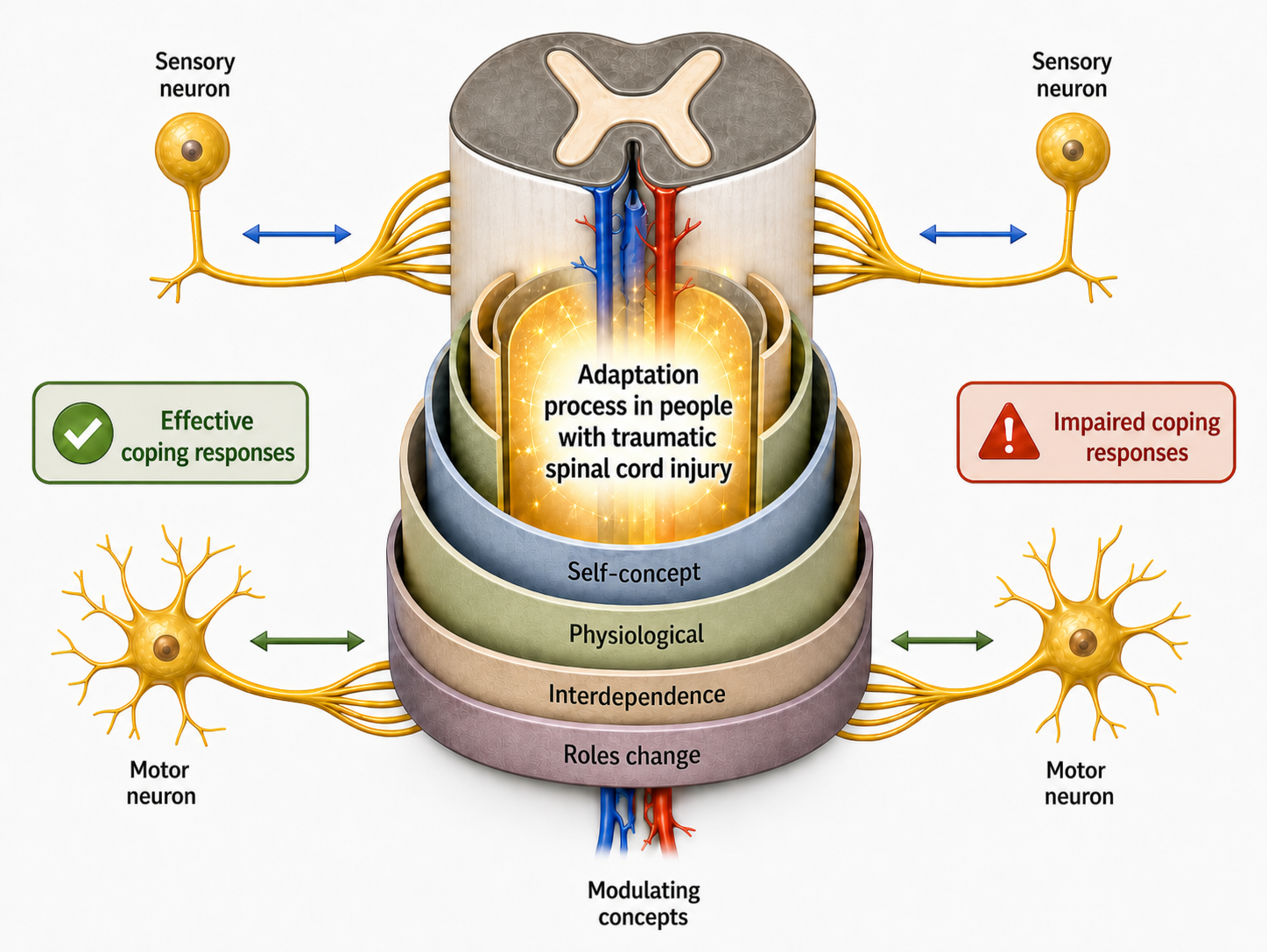
Source: prepared by the authors with the aid of generative artificial intelligence, 2026.
Relational assertions are statements that show the existence of relationships between concepts. The relational assertions of the theory(17) are as follows:
1. The adaptation process in people with traumatic spinal cord injuries is characterized by coping responses that are modulated by the meaning of life, by previous experiences, by internal stances in relation to the challenges in a recursive way and by an environment marked by social and community inclusion.
2. The coping responses encompass physiological human responses, self-concept responses, role change responses and those inherent to inter-dependence relations.
3. The physiological human responses are as follows: autonomic dysreflexia; orthostatic hypotension; neurogenic bladder; neurogenic bowel; pain; pressure injury; autonomous spatial mobility; physical activity; and self-care.
4. The self-concept human responses are as follows: self-consistency; self-efficacy; self-esteem; resilience; spirituality; hope; anxiety; hopelessness; powerlessness; chronic grief; and spiritual distress.
5. The human responses related to role changes include the following: role conflicts; role performance; ineffective occupational role performance; social and community inclusion; recreation activities; interrupted family processes; sexuality; role changes; and participation in groups.
6. The human responses inherent to inter-dependence relations are as follows: affective adaptation; autonomy; significant relationships; support systems; reverse support; separation anxiety risk.
7. Pain impairs autonomous spatial mobility, practicing physical activity, self-care, self-consistency, self-efficacy, self-esteem, autonomy, role performance and participation in groups and in recreation activities.
8. Autonomous spatial mobility includes impaired physical mobility, but it expands its limits by establishing close relationships with autonomy, self-efficacy, self-esteem and hope.
9. Vindications for social and community inclusion should be present in the agendas, as they are associated with deeper engagement in effective coping responses.
10. Nurses are the professionals in charge of promoting the adaptation process in people with traumatic spinal cord injuries, following a care plan that encompasses its multidimensionality, interactivity and integrality characteristics.
Theoretical operationalization
The proposals identify the results expected, given the structure of the set of concepts, getting the theory closer to the empirical reality in an attempt to clarify the more concrete relationships among the concepts in the theory scope(12). The theoretical proposals set forth by the MRT of the adaptive process in people with spinal cord injuries(17) are as follows:
1. If the person reasserts their life purpose and leading role, there are more adaptation chances.
2. If the person has positive previous experiences regarding social accessibility and inclusion for people with disabilities, they are more likely to produce effective coping responses.
3. If the person's internal stance in relation to the challenges is proactive and focuses on the problem, there are effective responses to the adaptation process.
4. If the person's internal stance in relation to the challenges is focused on emotions and negative feelings, there are barriers for the adaptation process to de developed.
5. Pain can generate impaired coping responses such as feelings of powerlessness, chronic grief, ineffective occupational role performance and separation anxiety risk.
6. The greater a person's freedom to act according to their will independently and autonomously beyond the physical function, the higher their participation in self-care, in practicing physical activity, in group and recreation activities, in social role performance, in creating and preserving healthy and significant relationships and in social and community integration.
7. When related to effective coping responses, resilience, hope or spirituality can increase self-efficacy, self-esteem and self-consistency.
8. Negative feelings in relation to trauma can generate impaired coping responses such as self-care deficits, anxiety, hopelessness, feelings or powerlessness, chronic grief, spiritual distress and role conflicts.
9. Prolonged hospitalization and rehabilitation times contribute to interrupted family process, to role changes, to feelings of powerlessness and to separation anxiety.
DISCUSSION
The MRT for the adaptation process in people with traumatic spinal cord injuries has Callista Roy's Adaptation Theoretical Model as a starting point. This choice is justified because it falls within the interactive-integrative paradigm; in other words, it is close to the Post-Positivist school of science, in addition to having a multidimensional and contextual world view in which both objectivity and subjectivity are desirable(15). This world view is in line with the necessary perspective to contemplate the phenomenon of the adaptation process of a given person to the abrupt consequences of a high-energy trauma that led to a spinal cord injury. In this sense, the core concepts of the theory, the adaptation process and the coping responses are fundamental to understand the phenomenon. It is necessary to understand these physiological and self-concept responses, as well as those related to social roles and to inter-dependence relations, to allow multidimensional, comprehensive and integrating assessments.
In an attempt to do that, the intrinsic concepts to the physiological responses not only contemplate cell changes but also systemic alterations that can be assessed and subjected to autonomous and/or collaborative Nursing interventions. From this physiological and systemic perspective, it is possible to find lack of sensitivity and motricity below the injury level and, depending on this level, respiratory, cardiac, sexual, urinary and bowel dysfunctions, in addition to ineffective thermal regulation and various metabolic disorders, including those related to insulin secretion(6,7,18,19). Some of the problems resulting from immobilization are spasticity, pressure injuries, pain, ineffective airway clearance, heterotopic ossification, osteoporosis and autonomic dysreflexia(6,7,18–20). These systemic, motor and sensibility alterations generate psychological, emotional, spiritual and interpersonal consequences. Motor limitations and dependence to perform tasks (including self-care) lead to a feeling of powerlessness, to a sensation of having lost autonomy and to anxiety related to functional gain expectations. This is how the self-concept human responses are configured.
In opposition to negative impacts, Positive Psychology emphasizes that psychological adaptation to chronic diseases and to disabilities involves the ability and resources to deal with adversities, crises, traumas and stressful events. This includes self-motivation to actively pursue and implement life objectives, motivation to grow in the personal and interpersonal domains, finding a purpose, meaning and benefits after adversity and showing competency, dexterity, autonomy and commitment(21,22). Self-efficacy is related to a person's perception about their own ability to perform and action and, consequently, to achieve the expected rehabilitation result(23). This cognitive process exerts an influence on human motivation, actions and behaviors adopted by the person(24). To the same extent, resilience, religiousness and spirituality (as well as the global meaning a person attributes to their life) modulate their coping strategies in the face of a spinal cord injury.
In the scope of the human responses related to changes in the social roles performed, there is a significant contribution of leisure(25), recreational and occupational activities, preferably those that generate income(26). These activities exert a positive impact on the adaptation process. However, employability among people in wheelchairs is lower than in those that can walk(26). Sexual dysfunctions are a physiological human response, but it also affects self-concept responses related to roles, and even those of inter-dependence(27). Such concept exemplifies the complexity of the phenomenon, which although described by means of fragmented human responses, requires nurses and multidisciplinary teams to overcome the strictly biomedical discourse, implementing multidimensional, comprehensive and integrated assessments and interventions(28). In this sense, it is indispensable to assess the support networks for rehabilitation and social/community reinsertion of people with traumatic spinal cord injuries by means of the inter-dependence human responses. The caregivers, family members, spouses and friends of people with spinal cord injuries are fundamental for the patients to adhere to rehabilitation care(29,30).
The advances in assistive technologies (as well as using exoskeletons(31), lower limb robots(32) and even Artificial intelligence(33–35) for treatments, rehabilitation and social/community reinsertion) present an increasing trend, contributing significant benefits to the adaptation process in people with traumatic spinal cord injuries. However, the cost is very high and is only affordable for the wealthier population or for those living in developed countries. Efforts for them to be more affordable should be made by the entire population.
The MRT integrative approach to the adaptation process in people with traumatic spinal cord injuries allows the individual affected to play the leading role in such process which, in addition to the biological and functional gain limits) encompasses self-concept, self-image, returning to the job market, participation in groups and in recreation activities and seeking social and community inclusion, among others. Such correlations evidence the intertwined network woven in creating this theory and which explains the alliance between the Nursing art and science, especially for presenting important aspects regarding its application in the practice by means of elements that are part of the Nursing Process.
However, this study does present limitations. The empirical induction process was implemented by means of a scoping review with data produced by other research studies as substrate, that is to say, secondary data. This yielded the benefit of all continents being represented in the contribution to the theoretical construction, but also the possibility of bias in selecting these concepts. This is because they can be more researched topics for raising greater interest among researchers or for enjoying more funding.
CONCLUSION
This middle-range theory enables understanding the adaptation process in people with traumatic spinal cord injuries and its application in nurses' clinical practice, considering that it offers a theoretical framework based on standardized taxonomies. It presents a pictorial scheme including its concepts and inter-relations.
The adaptation process in people with traumatic spinal cord injuries is complex and multidimensional; in addition, it requires nurses to analyze the phenomenon and implement interventions guided by the interactive-integrative paradigm, respecting each person's individuality and specificities. Such perspective allows understanding that this disciplinary knowledge corpus equips nurses in applying the Nursing Process in their clinical practice, aligning theory and practice with the objective of assisting people with traumatic spinal cord injuries in their adaptation process, integrating the biological, existential, social, cultural and political dimensions.
*Article extracted from the PhD Thesis entitled “A middle-range theory about the adaptation process in people with traumatic spinal cord injuries, based on Roy's Adaptation Model”, presented in 2022 at the Graduate Nursing Program of the Federal University of Rio de Janeiro, Rio de Janeiro, RJ, Brazil.
CONFLICT OF INTERESTS
The authors declare no conflict of interests.
USE OF ARTIFICIAL INTELLIGENCE
The generative artificial intelligence tool ChatGPT Plus (OpenAI) was used to assist in the creation of Figure 1, titled “Graphical representation of the adaptation process in people with traumatic spinal cord injuries,” based on the theoretical framework developed in this study.
REFERENCES
1. Jazayeri SB, Maroufi SF, Mohammadi E, Dabbagh Ohadi MA, Hagen E, Chalangari M, et al. Incidence of traumatic spinal cord injury worldwide: A systematic review, data integration, and update. World Neurosurg X. 2023;18:100171. https://doi.org/10.1016/j.wnsx.2023.100171. PMID: 36910686.
2. World Health Organization; The International Spinal Cord Society. International perspectives on spinal cord injury [Internet]. Geneva: WHO; 2013 [cited 2021 Oct 20]. Available from: https://www.who.int/publications/i/item/international-perspectives-on-spinal-cord-injury.
3. Ko H-Y. Management and Rehabilitation of Spinal Cord Injuries. Singapore: Springer Singapore; 2019. https://doi.org/10.1007/978-981-10-7033-4
4. Weidner N, Rupp R, Tansey KE. Neurological Aspects of Spinal Cord Injury. Switzerland: Springer Cham; 2017. https://doi.org/10.1007/978-3-319-46293-6
5. World Health Organization. Health equity for persons with disabilities: guide for action. Executive summary [Internet]. Geneva: WHO; 2025 [cited 2025 Dec 19]. Available from: https://iris.who.int/handle/10665/380145.
6. Grayev A. Functional Anatomy of the Spinal Cord. Radiol Clin North Am. 2024;62(2):263-272. https://doi.org/10.1016/j.rcl.2023.09.001. PMID: 38272619.
7. Patek M, Stewart M. Spinal cord injury. Anaesthesia and Intensive Care Medicine. 2023;24(7):406-411. https://doi.org/10.1016/j.mpaic.2023.04.006
8. Srikandarajah N, Alvi MA, Fehlings MG. Current insights into the management of spinal cord injury. J Orthop. 2023;41:8-13. https://doi.org/10.1016/j.jor.2023.05.007. PMID: 37251726.
9. Pereira MEM da SM, Araujo TCCF de. Enfrentamento e reabilitação de portadores de lesão medular e seus cuidadores. Psico (Porto Alegre) [Internet]. 2006 [cited 2025 Dec 19];37:37–45. Available from: https://revistaseletronicas.pucrs.br/revistapsico/article/view/1410.
10. Moreira RB, Souza AM. Meanings of acquired disability in adulthood: implications of severe spinal cord injury. Psicol Estud. 2017;22(2):243. https://doi.org/10.4025/psicolestud.v22i2.31669
11. Rueda Ruiz MB, Aguado Díaz A-L, Alcedo Rodríguez MA. Estrés, afrontamiento y variables psicológicas intervinientes en el proceso de adaptación a la Lesión Medular (LM): una revisión de la bibliografía. Psychosoc Interv [Internet]. 2008 [cited 2025 Dec 19];17(2):109–124. Available from: http://scielo.isciii.es/scielo.php?script=sci_arttext&pid=S1132-05592008000200002&lng=es.
12. Swanson RA, Chermack TJ. Theory building in applied disciplines. San Francisco: Berrett-Koehler Publishers; 2013.
13. Brandão MAG, Santana RF. Toward a theorizing strategy with components of terminologies, classifications, and nursing theories. Int J Nurs Knowl. 2023;34(3):236-244. https://doi.org/10.1111/2047-3095.12396. PMID: 36205479.
14. Peters MDJ, Godfrey C, McInerney P, Munn Z, Tricco AC, Khalil, H. Chapter 11: Scoping Reviews (2020 version). In: Aromataris E, Munn Z, editors. JBI Reviewer’s Manual. Adelaide: JBI; 2020. https://doi.org/10.46658/JBIRM-20-01
15. McEwen M, Wills EM. Theoretical Basis for Nursing. Wolters Kluwer; 2018.
16. Herdman TH, Kamitsuru S, Lopes CT. Diagnósticos de enfermagem da NANDA-I: definições e classificação 2024-2026. 13. ed. Porto Alegre: Artmed; 2024.
17. Zaccaro KRL. Teoria de médio alcance do processo adaptativo da pessoa com lesão traumática da medula espinhal baseado no modelo de adaptação de Roy [thesis]. Rio de Janeiro: Universidade Federal do Rio de Janeiro; 2022.
18. Meade MA, Yin Z, Lin P, Kamdar N, Rodriguez G, McKee M, et al. Type 2 Diabetes Increases the Risk of Serious and Life-Threatening Conditions Among Adults With Traumatic Spinal Cord Injury. Mayo Clin Proc Innov Qual Outcomes. 2023;7(5):452-461. https://doi.org/10.1016/j.mayocpiqo.2023.08.002. PMID: 37818139.
19. Trompeter A. The management of traumatic spinal cord injury. Injury. 2023;54(4):1039-1040. https://doi.org/10.1016/j.injury.2023.01.050. PMID: 36797115.
20. Soegaard K, Sig JR, Nielsen C, Verhaeghe S, Beeckman D, Biering-Sørensen F, et al. "I am just trying to live a life!" -a qualitative study of the lived experience of pressure ulcers in people with spinal cord injuries. J Tissue Viability. 2024;33(1):50-59. https://doi.org/10.1016/j.jtv.2023.11.009. PMID: 38044163.
21. Livneh H. Can the Concepts of Energy and Psychological Energy Enrich Our Understanding of Psychosocial Adaptation to Traumatic Experiences, Chronic Illnesses and Disabilities?. Front Psychol. 2022;13:768664. https://doi.org/10.3389/fpsyg.2022.768664. PMID: 35310232.
22. Smith G, Thompson AR, McCulloch A, Moses J. Post-traumatic growth following spinal cord injury: a systematic review and meta-ethnography. Disabil Rehabil. 2025;47(25):6536-6548. https://doi.org/10.1080/09638288.2025.2487564. PMID: 40275537.
23. Bhattarai M, Shigemoto Y, Smedema SM. Role of self-efficacy on functional limitations among persons with spinal cord injury. Chronic Illn. 2025;21(1):94-104. https://doi.org/10.1177/17423953231203731. PMID: 37750175.
24. Barreiro RG, Lopes MV de O, Cavalcante L de P. Middle-Range Theory for the Nursing Diagnosis of Low Self-Efficacy in Health. Rev Bras Enferm. 2020;73(5):e20190370. https://doi.org/10.1590/0034-7167-2019-0370. PMID: 32638935.
25. Nazari S, Moradi M, Danyali Z, Marzaleh MA, Hadi V, Hadi S. Lifestyle assessment in individuals with spinal cord injuries caused by accidents and disasters in qualitative studies published from 1990 to 2020: A meta-synthesis of qualitative study. Health Sci Rep. 2023;6(6):e1328. https://doi.org/10.1002/hsr2.1328. PMID: 37334044.
26. Halvorsen A, Steinsbekk A, Leiulfsrud AS, Post MWM, Biering-Sørensen F, Pape K. Labour market participation after spinal cord injury. A register-based cohort study. Spinal Cord. 2023;61(4):244-252. https://doi.org/10.1038/s41393-023-00876-4. PMID: 36717734.
27. Taylan S, Özkan İ, Kolaç N. Dyadic adjustment and the relationship between sexual self-consciousness and sexual dysfunction in individuals with spinal cord injuries: A descriptive study. J Spinal Cord Med. 2024;47(1):79-90. https://doi.org/10.1080/10790268.2022.2135732. PMID: 36441021.
28. Angel S, Steensgaard R, Kolbaek R, Frimann S. Competing discourses as barriers to change in rehabilitation nursing: a discourse analysis. Front Rehabil Sci. 2023;4:1267401. https://doi.org/10.3389/fresc.2023.1267401. PMID: 38149111.
29. Ikin Anderson M, Gopinath B, Fiona Jones K, Morey P, Simpson GK. Testing the stability of a family resilience model at 2 and 5 years after traumatic brain injury or spinal cord injury: A longitudinal study. Ann Phys Rehabil Med. 2023;66(6):101734. https://doi.org/10.1016/j.rehab.2023.101734. PMID: 37030248.
30. Galehdar N, Heydari H. Exploring caregivers' perceptions of community-based service requirements of patients with spinal cord injury: a qualitative study. BMC Prim Care. 2023;24(1):94. https://doi.org/10.1186/s12875-023-02051-3. PMID: 37038113.
31. Gil-Agudo Á, Megía-García Á, Pons JL, Sinovas-Alonso I, Comino-Suárez N, Lozano-Berrio V, et al. Exoskeleton-based training improves walking independence in incomplete spinal cord injury patients: results from a randomized controlled trial. J Neuroeng Rehabil. 2023;20(1):36. https://doi.org/10.1186/s12984-023-01158-z. PMID: 36964574.
32. Zhao H, Yang J, Yang J, Jiang H, Qin Y, Lei Q. Evaluation of the improvement of walking ability in patients with spinal cord injury using lower limb rehabilitation robots based on data science. Transl Neurosci. 2023;14(1):20220320. https://doi.org/10.1515/tnsci-2022-0320. PMID: 37954153.
33. Brehon K, MacIsaac R, Bhatia Z, Buck T, Charbonneau R, Crochetiere S, et al. Outcomes of Implementing a Webinar-Based Strategy to Improve Spinal Cord Injury Knowledge and Community Building: Convergent Mixed Methods Study. JMIR Rehabil Assist Technol. 2023;10:e46575. https://doi.org/10.2196/46575. PMID: 37351945.
34. Dietz N, Vaitheesh Jaganathan, Alkin V, Mettille J, Boakye M, Drazin D. Machine learning in clinical diagnosis, prognostication, and management of acute traumatic spinal cord injury (SCI): A systematic review. J Clin Orthop Trauma. 2022;35:102046. https://doi.org/10.1016/j.jcot.2022.102046. PMID: 36425281.
35. Temel MH, Erden Y, Bağcıer F. Information Quality and Readability: ChatGPT's Responses to the Most Common Questions About Spinal Cord Injury. World Neurosurg. 2024;181:e1138-e1144. https://doi.org/10.1016/j.wneu.2023.11.062. PMID: 38000671.
Submission: 19-Dec-2025
Editors:
Rosimere Ferreira Santana (ORCID: 0000-0002-4593-3715)
Geilsa Soraia Cavalcanti Valente (ORCID: 0000-0003-4488-4912)
Renan Alves Silva (ORCID: 0000-0002-6354-2785)
Corresponding author: Kênia Rocha Leite Zaccaro (kzaccaro@id.uff.br)
Publisher:
Escola de Enfermagem Aurora de Afonso Costa – UFF
Rua Dr. Celestino, 74 – Centro, CEP: 24020-091 – Niterói, RJ, Brazil
Journal email: objn.cme@id.uff.br
