
ORIGINAL ARTICLE
SKILLS TRAINING AS A STRATEGY FOR DEVELOPING SELF-CONFIDENCE AND SATISFACTION IN UNDERGRADUATE NURSES
Stephany da Conceição Limeira Aguiar1, Bianca Campos Oliveira2, Amanda Ramiro Gomes da Silva3, Vanessa Galdino de Paula4, Cristiane Helena Gallasch5, Patrícia Britto Ribeiro de Jesus6
1 Universidade do Estado do Rio de Janeiro, Centro Biomédico, Faculdade de Enfermagem. Rio de Janeiro, RJ, Brazil. ORCID: 0000-0002-9937-383X. E-mail: stephanyaguiar18@gmail.com.
2 Universidade do Estado do Rio de Janeiro, Centro Biomédico, Faculdade de Enfermagem. Rio de Janeiro, RJ, Brazil. ORCID: 0000-0002-6348-3287. E-mail: bianca.campos.oliveira@gmail.com.
3 Universidade Federal Fluminense, Escola de Enfermagem Aurora de Afonso Costa. Niterói, RJ, Brazil. ORCID: 0000-0002-6383-5449. E-mail: amandaramiro@id.uff.br.
4 Universidade do Estado do Rio de Janeiro, Centro Biomédico, Faculdade de Enfermagem. Rio de Janeiro, RJ, Brazil. ORCID: 0000-0002-7147-5981. E-mail: vanegalpa@gmail.com.
5 Universidade do Estado do Rio de Janeiro, Centro Biomédico, Faculdade de Enfermagem. Rio de Janeiro, RJ, Brazil. ORCID: 0000-0002-0823-0818. E-mail: cristiane.gallasch@gmail.com.
6 Universidade do Estado do Rio de Janeiro, Centro Biomédico, Faculdade de Enfermagem. Rio de Janeiro, RJ, Brazil. ORCID: 0000-0003-4523-3740. E-mail: patty_brj@hotmail.com.
ABSTRACT
Objective: To analyze the contributions of laboratory skills training to the education of nursing undergraduates regarding medication administration routes. Method: An analytical, observational, cross-sectional study conducted with 39 students from a public higher education institution. Data collection was performed via an electronic form containing the Student Satisfaction and Self-Confidence in Learning Scale. Data were analyzed using descriptive statistics. Results: The scores obtained evidenced high levels of satisfaction and self-confidence among nursing undergraduates within the context of laboratory skills training. The scale items presented a predominantly positive distribution, indicating a favorable perception by participants regarding simulation-mediated practical activities. Conclusion: The findings indicate that laboratory skills training, mediated by simulation-based experiences, is associated with high levels of satisfaction and self-confidence among nursing undergraduates. The results reinforce the relevance of simulation-based experience as a pedagogical strategy in nursing education, as it fosters the integration of theory and practice and supports initial training within the context of clinical care.
Descriptors: Nursing; Knowledge; Professional Training; Simulation Training; Satisfaction.
|
How to cite: Aguiar SCL, Oliveira BC, Silva ARG, Paula VG, Gallasch CH, Jesus PBR. Skills training as a strategy for developing self-confidence and satisfaction in undergraduate nurses. Online Braz J Nurs. 2026;25(1):e20266937. https://doi.org/10.17665/1676-4285.20266937 |
What is already known:
Skills training and simulation-based experiences favor the integration of theory and practice, contributing to nursing learning.
Simulation-based strategies tend to increase student motivation and engagement during practical activities.
There remains a gap regarding the evaluation of the effects of simulation-based experiences on the satisfaction and self-confidence levels of undergraduates in the early stages of training.
What this article adds:
It describes undergraduate perceptions regarding satisfaction and self-confidence in skills training related to medication administration routes.
It demonstrates a moderate-to-strong positive association between satisfaction and self-confidence, expanding the understanding of the relationship between these constructs in simulation-based experience education.
It contributes evidence that reinforces the role of simulation-based experience as a pedagogical strategy related to the perception of preparedness and safety for clinical practice in initial nursing education.
INTRODUCTION
Nursing education requires the articulated development of theoretical knowledge and practical skills that underpin the safe execution of care and clinical decision-making. Simulation-based experiences (SBE) allow students to engage with situations close to healthcare reality, fostering the integration of theory and practice and enabling experiences that cannot be immediately reproduced in real clinical settings(1-2). In this context, laboratory skills training constitutes an essential strategy for the technical, cognitive, and emotional development of the undergraduate, contributing to their autonomy, clinical reasoning, and safety in care(3-4).
Simulation-based experience has been recognized as an active methodology capable of providing a safe environment for experimentation, reflection, and competency improvement, expanding the student's capacity to apply acquired knowledge and strengthening self-confidence for professional practice(1,5). Studies reinforce that simulated practice contributes to meaningful learning, prepares the student to face complex situations, and contributes to improving the quality of care provided(6-7).
Despite the advancement of simulation-based experience methodologies in nursing education, it is observed that national evidence specifically investigating how laboratory skills training influences the satisfaction and self-confidence levels of undergraduates remains limited, especially in the early stages of training. Recent studies have reinforced the importance of evaluating these indicators to qualify pedagogical practices and guide the incorporation of more effective strategies in the development of clinical competencies(8-9). However, a gap persists regarding the understanding of the effects of this approach in real teaching contexts, which justifies the conduction of the present study.
Considering the relevance of skills training for the qualification of the teaching-learning process and for student safety prior to their insertion into clinical settings, it becomes essential to understand how this strategy contributes to the development of fundamental competencies for professional practice(10-11).
Given this scenario, the present study aimed to analyze the contributions of laboratory skills training to the education of nursing undergraduates regarding medication administration routes.
METHOD
This is an analytical, observational, cross-sectional study. The study site was a public higher education institution in the municipality of Rio de Janeiro. Data collection took place from June to October 2025, with an interruption in July due to the academic recess.
In this context, it should be noted that, as this was a convenience sampling, no prior sample size calculation was performed. Thus, the final sample consisted of 39 participants who met the eligibility criteria: being undergraduates regularly enrolled in the second and third semesters who participated in the theoretical classes and skills training on medication administration routes. Undergraduates away on maternity leave or health-related leave were excluded, as well as those with prior certifications as nursing technicians or other healthcare-related backgrounds.
The skills training related to medication administration routes was developed in a simulated practice laboratory at a public university’s school of nursing through structured simulated practice guided by an internal checklist previously developed by faculty members of the Semiology discipline. The activity encompassed sequential stages of the safe medication administration process—including material preparation, safety measures, technical execution, and post-administration care—and was conducted under faculty supervision.
The activity was carried out across three practical teaching laboratories, each managed by a faculty member. Two stations were organized in each room, with an average duration of 15 minutes per student, distributed in groups of ten students, always under faculty supervision. The checklist served as a guide for activity execution and as a tool for immediate formative feedback at the end of each stage.
Participants were recruited during theoretical undergraduate classes, where they were informed about the research objectives and invited to participate. Following acceptance and the signing of the Informed Consent Form (ICF), students were directed to an electronic form (Google Forms), where they responded to the questionnaire containing the proposed scale. The form was self-administered without researcher intervention, ensuring standardized collection and reducing potential information biases.
Responses were provided individually, anonymously, and voluntarily, without participant identification or association with academic evaluations, which helped minimize social desirability bias. The study was publicized at different times during the academic term, encouraging spontaneous student participation until the final number of respondents was reached. While the possibility of selection bias—inherent to convenience sampling and voluntary participation—is acknowledged, efforts were made to minimize it through uniform dissemination of the research and equal access to participation for all eligible students.
Data collection utilized the Student Satisfaction and Self-Confidence in Learning Scale, validated for the Portuguese language. This is a five-point Likert-type instrument consisting of 13 items distributed between the domains of satisfaction (five items) and self-confidence (eight items), originally developed to measure satisfaction and self-confidence acquired from high-fidelity simulation(12). Although the instrument was originally developed for that specific type of simulation, its validation in Portuguese and its recurrent use across different simulation formats in nursing education support its application in this study. To ensure data quality, efforts were made to reduce potential selection and information biases; however, it is recognized that convenience sampling and voluntary participation may introduce limitations inherent to this study design.
Data were organized, coded, and tabulated in Microsoft Excel® and subsequently analyzed using the Statistical Package for the Social Sciences (IBM SPSS®) software, version 22.0. Quantitative analysis was performed using simple descriptive statistics, employing measures of central tendency and dispersion, such as mean, median, standard deviation, interquartile range, and absolute and relative frequencies.
Thus, the instrument variables were analyzed by item and according to the domains of Satisfaction (five items) and Self-Confidence in Learning (eight items), following the original structure of the validated scale. For statistical analysis, responses were treated using the five-point Likert scale, ranging from 1 (strongly disagree) to 5 (strongly agree), and the reported means reflect the average behavior of responses within this interval. No missing data were observed in the completed instruments; therefore, no specific techniques for handling attrition were required.
Prior to inferential analyses, data distribution was evaluated using the Shapiro–Wilk normality test. Considering the ordinal nature of Likert-type scales and the normality test results, non-parametric methods were prioritized.
The inferential analysis aimed to investigate the association pattern between the Satisfaction and Self-Confidence constructs. To this end, Spearman’s correlation coefficient was employed, which is suitable for identifying the strength and direction of the association between non-parametric variables. The inferential analyses (Spearman correlation and simple linear regression) were conducted with an exploratory character, and the findings should be interpreted in light of the limitations regarding representativeness and sample size.
Additionally, as a complementary exploratory analysis, a simple linear regression model was adjusted using the means of the items composing each construct, treated as continuous variables for analytical purposes. A significance level of 5% (p<0.05) was adopted.
The research protocol was approved by the Research Ethics Committee involving Human Beings, under CAAE 88432725.2.0000.5282 and opinion No. 7.657.735, complying with CNS Resolution No. 466/2012, COFEN Resolution No. 564/2017, and CONEP/MS regulations.
RESULTS
The study included 39 students, for whom descriptive statistics enabled the analysis of scores for the "satisfaction" and "self-confidence" constructs regarding the simulated laboratory practical training used for teaching medication administration skills.
All means presented in the results vary according to the five-point Likert scale used in the instrument, in which 1 represents total disagreement and 5 represents total agreement. Consequently, higher values correspond to greater levels of satisfaction or self-confidence.
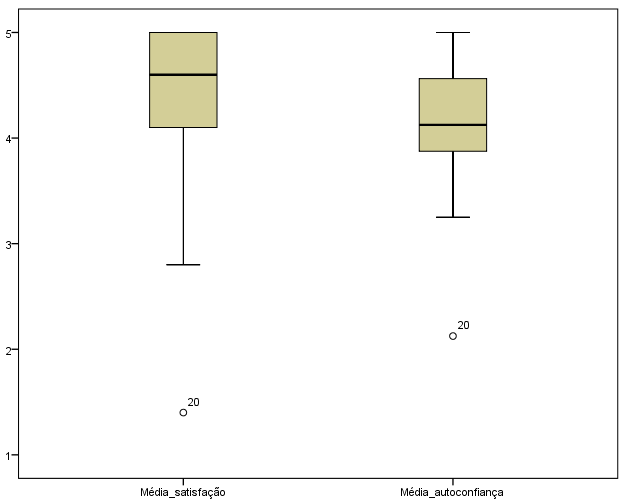
The results of the Shapiro-Wilk normality test demonstrated that both Satisfaction and Self-Confidence followed a non-normal distribution (p<0.05). Although the distribution indicated non-normality, scores were also presented as mean and standard deviation to allow for comparability with previous studies; the median and interquartile range (IQR) were utilized as complementary measures, with the central tendency expressed by the median. The visual distribution of these scores can be observed in the boxplot presented in Figure 1.
Figure 1 – Distribution and variability of mean scores for the Satisfaction and Self-Confidence constructs among Nursing undergraduates (n=39). Rio de Janeiro, RJ, Brazil, 2025
Source: prepared by the authors, 2025.
The median for Satisfaction was higher than that for Self-Confidence. Greater dispersion was observed in Satisfaction (IQR=0.90) compared to Self-Confidence (IQR=0.69), with the presence of outliers.
The mean and standard deviation (SD) were maintained to enable comparability with the scientific literature in the field. Regarding the satisfaction construct, Table 1 presents the results of the analysis of its constituent scale items.
Table 1 – Descriptive statistics of the evaluation items for the “Satisfaction” construct using the Student Satisfaction and Self-Confidence in Learning Scale (n=39). Rio de Janeiro, RJ, Brazil, 2025
|
Scale Items |
Mean (SD*) |
SD** (1) |
D (2) |
N (3) |
A (4) |
SA (5) |
|
Fi* (%) |
Fi (%) |
Fi (%) |
Fi (%) |
Fi (%) |
||
|
"Satisfaction" Construct |
4.24 (±0.21) |
|
|
|
|
|
|
The teaching methods used in this simulation were helpful and effective. |
4.46 (±0.72) |
- |
- |
5 (12.8%) |
11 (28.2%) |
23 (59.0%) |
|
The simulation provided me with a variety of learning materials and activities to promote my learning of the medical-surgical curriculum. |
4.1 (±0.91) |
1 (2.6%) |
- |
8 (20.5%) |
15 (38.5%) |
15 (38.5%) |
|
I enjoyed how my instructor taught through simulation. |
4.56 (±0.91) |
1 (2.6%) |
1 (2.6%) |
2 (5.1%) |
6 (15.4%) |
29 (74.4%) |
|
The teaching materials used in this simulation were motivating and helped me learn. |
4.13 (±1.0) |
1 (2.6%) |
2 (5.1%) |
5 (12.8%) |
14 (35.9%) |
17 (43.6%) |
|
The way my instructor taught through simulation was suitable for the way I learn. |
4.46 (±0.88) |
1 (2.6%) |
- |
4 (10.3%) |
9 (23.1%) |
25 (64.1%) |
Key: *SD: Standard Deviation; **SD (1): Strongly Disagree; D (2): Disagree; N (3): Neutral/Indifferent; A (4): Agree; SA (5): Strongly Agree. ***Fi: Absolute frequency; %: Relative frequency. Mean, standard deviation, absolute frequency, and relative frequency were calculated and analyzed using descriptive statistics.
Source: prepared by the authors, 2025.
The analysis of Table 1 demonstrates that the highest-rated items within the "Satisfaction" construct are related to the instructor's teaching method and the suitability of the method to the students' learning styles. Notably, the items “I enjoyed how my instructor taught through simulation,” with a mean of 4.56 (±0.91) and the highest frequency in the "agree" (n=6; 15.4%) and "strongly agree" (n=29; 74.4%) categories, and “The way my instructor taught through simulation was suitable for the way I learn,” with a mean of 4.46 (±0.88) and a predominance of "strongly agree" responses (n=25; 64.1%), stand out. The lowest-scoring item in this construct pertained to the variety of teaching materials and activities to promote learning (μ=4.10±0.91).
Table 2 presents the analysis regarding the self-confidence construct.
Table 2 – Descriptive statistics of evaluation items for the “Self-Confidence” construct using the Student Satisfaction and Self-Confidence in Learning Scale (n=39). Rio de Janeiro, RJ, Brazil, 2025
|
Scale Items |
Mean (SD*) |
SD** (1) |
D (2) |
N (3) |
A (4) |
SA (5) |
|
|
|
Fi* (%) |
Fi (%) |
Fi (%) |
Fi (%) |
Fi (%) |
|
"Self-Confidence" Construct |
4.18 (± 0.21) |
|
|
|
|
|
|
I am confident that I am mastering the content of the simulation activity that my instructor presented to me. |
3.82 (± 0.85) |
- |
2 (5.1%) |
12 (30.8%) |
16 (41.0%) |
9 (23.1%) |
|
It is the instructor's responsibility to tell me what I need to learn of the theme developed in the simulation during class. |
4.13 (± 0.86) |
- |
1 (2.6%) |
9 (23.1%) |
13 (33.3%) |
16 (41.0%) |
|
I know how to use simulation activities to learn skills. |
4.36 (± 0.81) |
- |
2 (5.1%) |
2 (5.1%) |
15 (38.5%) |
20 (51.3%) |
|
I am confident that this simulation covered critical content necessary for the mastery of the curriculum. |
4.54 (± 0.72) |
- |
1 (2.6%) |
2 (5.1%) |
11 (28.2%) |
25 (64.1%) |
|
I know how to get help when I do not understand the concepts covered in the simulation. |
4.18 (± 0.94) |
- |
2 (5.1%) |
8 (20.5%) |
10 (25.6%) |
19 (48.7%) |
|
I am confident that I am developing skills and obtaining the required knowledge from this simulation to perform necessary procedures in a clinical setting. |
4.05 (± 0.94) |
- |
3 (7.7%) |
7 (17.9%) |
14 (35.9%) |
15 (38.5%) |
|
My instructor used helpful resources to teach the simulation. |
4.1 (± 0.91) |
- |
2 (5.1%) |
8 (20.5%) |
13 (33.3%) |
16 (41.0%) |
|
It is my responsibility as the student to learn what I need to know from this simulation activity. |
4.23 (± 1.01) |
1 (2.6%) |
1 (2.6%) |
7 (17.9%) |
9 (23.1%) |
21 (53.8%) |
Key: *SD: Standard Deviation; **SD (1): Strongly Disagree; D (2): Disagree; N (3): Neutral/Indifferent; A (4): Agree; SA (5): Strongly Agree. ***Fi: Absolute frequency; %: Relative frequency. Mean, standard deviation, absolute frequency, and relative frequency were calculated and analyzed using descriptive statistics.
Source: prepared by the authors, 2025.
In the "Self-Confidence" construct, the item with the highest mean was “I am confident that this simulation included the necessary content for the mastery of the curriculum” (μ=4.54±0.72), with the highest frequency in the "agree" (n=11; 28.2%) and "strongly agree" (n=25; 64.1%) categories. The item with the lowest mean was “I am confident that I am mastering the content of the simulation activity that my instructor presented to me” (μ=3.82±0.85).
It is observed that, although some items presented lower means within the construct, the scores remain high within the context of the scale (>3.5).
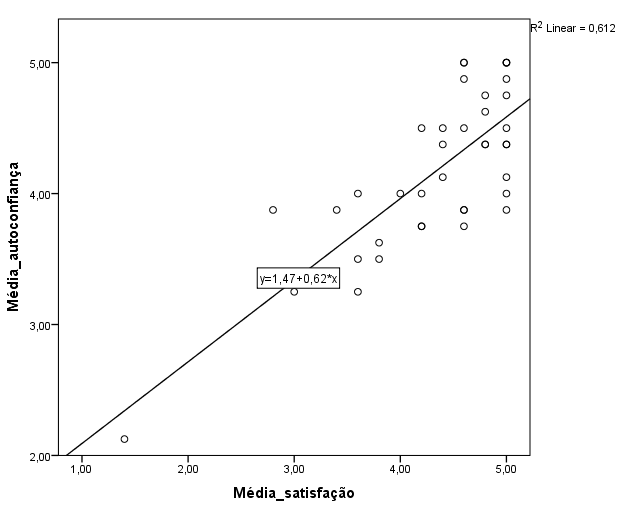
Considering the previously identified absence of normality, the analysis of the association between Satisfaction and Self-Confidence was conducted using the non-parametric Spearman correlation test. The analysis revealed a moderate-to-strong positive association between satisfaction and self-confidence (ρ=0.66; p<0.001).
Figure 2 presents the visual representation of the relationship between the constructs based on the inferential data obtained.
Figure 2 – Correlation between Satisfaction and Self-Confidence scores among Nursing undergraduates (n=39). Rio de Janeiro, RJ, Brazil, 2025
Source: prepared by the authors, 2025.
The scatter plot reveals an upward trend, indicating a positive association between the mean scores of satisfaction and self-confidence.
To explore the predictive relationship between the constructs, a simple linear regression model was fitted, the adequacy of which was confirmed by the normality analysis of the residuals (p=0.194). The results demonstrated a coefficient of determination (R2) of 0.612, indicating that 61.2% of the variability in the undergraduates' self-confidence was statistically associated with their satisfaction scores regarding the laboratory training.
DISCUSSION
The results of this study demonstrated high levels of satisfaction and self-confidence among undergraduates after participating in medication administration route training mediated by simulation-based experiences. These findings indicate that the strategy was associated with more favorable perceptions of learning and the strengthening of safety in skill execution, fulfilling the proposed objective.
Within the satisfaction construct, a predominance of positive evaluations was observed, which corroborates studies identifying simulation as a tool associated with greater engagement, motivation, and meaningful learning experiences(8,9,13,14). The literature highlights that structured practical activities can favor active student participation and broaden the understanding of content, aligning with the pattern found in this study(13,14).
The lowest-rated item in the satisfaction construct was related to reflection on one's own performance. This aspect partially converges with studies demonstrating that the quality of debriefing can directly influence the depth of the reflective process(9,15). Thus, the lower score observed may reflect the need to improve this stage to enhance the consolidation of learning.
In the evaluation of the self-confidence construct, undergraduates reported feeling more prepared to apply the acquired knowledge, converging with research findings that indicate simulation as an important strategy for strengthening student autonomy and safety(8,16). Similar studies also observed that the perception of content mastery and familiarity with the simulated environment contribute to greater self-confidence during clinical practice(9,14).
The positive association observed between Satisfaction and Self-Confidence (ρ=0.66) can be classified as moderate to strong, indicating that students who are more satisfied with the simulated experience tend to present higher levels of self-confidence in learning. Similar results have been reported in recent studies, which demonstrate a consistent relationship between well-structured simulated experiences, greater student satisfaction, and increased self-confidence for clinical practice(17).
The linear regression analysis indicated that 61.2% of the variability in Self-Confidence presented a statistical association with Satisfaction scores. In health education studies, high R2 values are uncommon, as educational phenomena are multifactorial and influenced by individual, academic, and contextual variables. Recent evidence suggests that models aimed at understanding phenomena related to simulation rarely reach high coefficients of determination, which reinforces the relevance of the value observed in this study(18).
Despite the observed association, 38.8% of the variance remained unexplained by the model, which is expected in constructs of a complex and multifactorial nature. Recent studies highlight that factors such as previous academic experiences, educational maturity, individual characteristics, and complementary pedagogical strategies also influence students' perception of self-confidence(19,20). Thus, the variability not explained by satisfaction with the training reinforces the need for integrated educational approaches and future investigations that consider multiple dimensions of the formative process.
The limitations of this study include the convenience sampling, which restricts the generalization of results, and the fact that it was conducted in a single teaching setting. Furthermore, the use of a self-report instrument may introduce biases, such as social desirability. The cross-sectional design, without prior assessment, prevents the establishment of causal relationships or the analysis of the temporal evolution of learning.
Thus, the results reinforce that training mediated by simulation-based experiences constitutes a strategy associated with higher levels of satisfaction, the strengthening of self-confidence, and support for the development of essential competencies in nursing education. It is recommended that future studies explore different simulation formats, the influence of debriefing, and the use of longitudinal designs to evaluate knowledge retention and its application in real clinical environments.
CONCLUSION
High levels of self-reported satisfaction and self-confidence were observed among undergraduates following laboratory skills training mediated by simulated practice. A positive association was identified between satisfaction and self-confidence scores. These findings suggest that structured practical activities in the laboratory can support initial nursing education, though their interpretation must account for the limitations of the cross-sectional design and the convenience sampling.
CONFLICT OF INTERESTS
The authors declare that there are no conflicts of interest.
USE OF ARTIFICIAL INTELLIGENCE
During the preparation of this work, the authors used the generative artificial intelligence tool ChatGPT (OpenAI) to support textual revision, manuscript organization, and assistance in searching for scientific articles. The search conducted with the aid of the tool was complementary in nature, with the retrieved studies subsequently submitted to critical analysis by the authors regarding their relevance, quality, and appropriateness to the proposed topic, prior to their incorporation into the manuscript. Following the use of the tool, the authors thoroughly reviewed and edited all content and assume full responsibility for the accuracy of the data presented and the integrity of the references cited.
1. Lima EJA, Tavares WLRG, Candido MHM, Lima RE de, Barros LP de, Barros LP de, et al. A importância do treinamento prático na formação do profissional de enfermagem. Rev. Foco. 2023;16(11):e3238. https://doi.org/10.54751/revistafoco.v16n11-006.
2. Burrell SA, Ross JG, Byrne C, Heverly M. The effects of a simulation-based experience with standardized participants on learning and clinical decision-making related to nursing management of oncologic emergencies. J Cancer Educ. 2023;38(3):870-7. https://doi.org/10.1007/s13187-022-02199-z. PMID: 35869363.
3. Silva AOV, Carvalho ALRF, Vieira RM, Pinto CMCB. Clinical supervision strategies, learning, and critical thinking of nursing students. Rev Bras Enferm. 2023;76(4):e20220691. https://doi.org/10.1590/0034-7167-2022-0691. PMID: 37820150.
4. Canever BP, Costa DG, Magalhães ALP, Gonçalves N, Bellaguarda ML dos R, Prado ML. Skills training by skills development techniques for nursing students. REME. 2022;26:e-1457. https://doi.org/10.35699/2316-9389.2022.38545.
5. Ma L, Yan R, Wang X, Gao X, Fan N, Liu L, et al. Enhancing surgical nursing student performance: comparative study of simulation-based learning and problem-based learning. J Multidiscip Healthc. 2024;17:991-1005. https://doi.org/10.2147/JMDH.S440333. PMID: 38476255.
6. Moloney M, Murphy L, Kingston L, Markey K, Hennessy T, Meskell P, et al. Final year undergraduate nursing and midwifery students' perspectives on simulation-based education: a cross-sectional study. BMC Nurs. 2022;21(1):299. https://doi.org/10.1186/s12912-022-01084-w. PMID: 36335322.
7. Moura ÚH dos S, Delmondes G de A, Souza JL de, Rocha G da S, Penha SEM, Brito MLP, et al. Simulação realística como estratégia de ensino-aprendizagem em feridas na formação de enfermeiros: revisão sistemática. Rev Enferm Atenção Saúde. 2025;15(1):e20257954. https://doi.org/10.18554/8vhg2g74.
8. Souza CC de, Santos WG dos, Salgado P de O, Prado Junior PP do, Toledo LV, Paiva LC. Evaluating the "satisfaction" and "self-confidence" in nursing students in undergoing simulated clinical experiences. Rev Esc Enferm USP. 2020;54:e03583. https://doi.org/10.1590/S1980-220X2018038303583. PMID: 32813798.
9. Jawabreh N, Hamdan-Mansour A, Harazne L, Ayed A. Effectiveness of high-fidelity simulation on practice, satisfaction, and self-confidence among nursing students in mental health nursing class. BMC Nurs. 2025;24(1):622. https://doi.org/10.1186/s12912-025-03300-9. PMID: 40450268.
10. Santiago G da ST, Oliveira CCL, Silva JFV da, Oliveira MAC de, Santos VEFA dos. A simulação realística como ferramenta pedagógica no ensino de enfermagem: relato de experiência. EU. 2022 [cited 2025 Oct 07];7(13):1663. Available from: https://www.periodicos.ufc.br/eu/article/view/86426.
11. Santana TCP de, Silva LM da, Sousa LN de, Silva VVL da, Ferreira TCM, Silva EV da, et al. Percepção de estudantes de enfermagem no desenvolvimento das habilidades e competências na simulação realística. Acervo Saúde. 2023;23(6):e12634. https://doi.org/10.25248/reas.e12634.2023.
12. Almeida RG dos S, Mazzo A, Martins JCA, Baptista RCN, Girão FB, Mendes IAC. Validation to Portuguese of the Scale of Student Satisfaction and Self-Confidence in Learning. Rev Lat Am Enfermagem. 2015;23(6):1007-13. https://doi.org/10.1590/0104-1169.0472.2643. PMID: 26625990.
13. Alwawi A, İnkaya B. The effect of two different simulation modalities in palliative care teaching on nursing students' knowledge, satisfaction, self-confidence, and skills: a randomized controlled trial. Comput Inform Nurs. 2022;41(4):246-57. https://doi.org/10.1097/CIN.0000000000000965. PMID: 36729953.
14. Butafava EP de A, Oliveira RA, Quilici AP. Satisfação e autoconfiança de estudantes na simulação realística e a experiência de perpetuação do saber. Rev. bras. educ. med. 2022;46(4):e166. https://doi.org/10.1590/1981-5271v46.4-20210479.
15. Teixeira A, Tavares JP, Cogo ALP. Satisfaction and self-confidence of nursing students as participants and observers in realistic simulations. Rev Gaucha Enferm. 2022;43:e20210344. https://doi.org/10.1590/1983-1447.2022.20210344.pt. PMID: 36478011.
16. Thomas CM, Mraz MA. Exploration Into How Simulation Can Effect New Graduate Transition. Clin Simul Nurs. 2017;13(10):465-70. https://doi.org/10.1016/j.ecns.2017.05.013.
17. Gabbouj SB, Zedini C, Naija W. Nursing Students' Satisfaction and Self-Confidence with Simulation-Based Learning and Its Associations with Simulation Design Characteristics and Educational Practices. Adv Med Educ Pract. 2024;15:1093-102. https://doi.org/10.2147/AMEP.S477309. PMID: 39559264.
18. Tho TTN, My TT, Trang TCH. Predictors of satisfaction and self-confidence in simulation learning among healthcare students in Vietnam. Clin Simul Nurs. 2025;108:101828. https://doi.org/10.1016/j.ecns.2025.101828.
19. Santana TCP de, Silva LM de, Sousa LN de, Silva VVL da, Ferreira TCM, Silva EV da, et al. Percepção de estudantes de enfermagem no desenvolvimento das habilidades e competências na simulação realística. Acervo Saúde. 2023;23(6):e12634. https://doi.org/10.25248/reas.e12634.2023.
20. Fernandes MG, Magalhães ELC, Palma NS, Nunes SAN. Fatores influenciadores da autoconfiança robusta. PsicolArgum. 2021;39(104):261-76. https://doi.org/10.7213/psicolargum.39.104.ao06.
Submission: 19-Dec-2025
Editors:
Rosimere Ferreira Santana (ORCID: 0000-0002-4593-3715)
Geilsa Soraia Cavalcanti Valente (ORCID: 0000-0003-4488-4912)
Corresponding author: Bianca Campos Oliveira (bianca.campos.oliveira@gmail.com)
Publisher:
Escola de Enfermagem Aurora de Afonso Costa – UFF
Rua Dr. Celestino, 74 – Centro, CEP: 24020-091 – Niterói, RJ, Brazil
Journal email: objn.cme@id.uff.br

.