
REFLECTION ARTICLE
APPLICATION OF IMOGENE KING’S THEORY OF GOAL ATTAINMENT IN CONTINUING HEALTH EDUCATION: A REFLECTION
Milena Mendes Jorge1, Heloisa Duarte Gabriel2, Paulo Philip de Abreu Gonzaga3, Cristine Alves Costa de Jesus4, Diana Lúcia Moura Pinho5
1 University of Brasília, Master’s student in the Graduate Program in Nursing, Brasília, Federal District, Brazil. ORCID: 0000-0002-4864-1603. E-mail: milenamendes.jorge@gmail.com.
2 University of Brasília, Master’s student in the Graduate Program in Nursing, Brasília, Federal District, Brazil. ORCID: 0000-0002-0846-5983. E-mail: heloisagabriel@gmail.com.
3 University of Brasília, Master’s student in the Graduate Program in Nursing, Brasília, Federal District, Brazil. ORCID: 0000-0002-1195-282X. E-mail: ppdagenf@gmail.com.
4 University of Brasília, Faculty member of the Department of Nursing, Brasília, Federal District, Brazil. ORCID: 0000-0002-8638-4468. E-mail: cristine@unb.br.
5 University of Brasília, Faculty member of the Department of Nursing, Brasília, Federal District, Brazil. ORCID: 0000-0003-4212-2340. E-mail: diana@unb.br.
ABSTRACT
Objective: To reflect on the applicability of Imogene King’s theory of goal attainment in the context of continuing health education (CHE). Method: This is a theoretical-reflective essay that analyzes the correlation between Imogene King’s theory of goal attainment and CHE practices developed by health professionals. Development: The articulation between the concepts proposed by King and the practical application of CHE can be understood in light of the principles of andragogy and interprofessionality. As a contribution of this study, an adaptation of King’s schematic model is proposed, aligning it with the context of CHE in order to expand its applicability in this setting. From this perspective, the model can be reinterpreted as a process that favors the construction of collective transactions between the educator and other health professionals. Conclusion: The reflections presented show that Imogene King’s theory of goal attainment constitutes a relevant tool for guiding CHE practices, since its applicability is grounded in interaction, communication, and the establishment of shared goals.
Descriptors: Continuing Education; Nursing Theory; Nursing Care.
|
How to cite: Jorge MM, Gabriel HD, Gonzaga PPA, Jesus CAC, Pinho DLM. Application of Imogene King’s theory of goal attainment in continuing health education: a reflection. Online Braz J Nurs. 2026;25(1):e20266919. http://doi.org/10.17665/1676-4285.20266919 |
What is already known:
Imogene King’s theory of goal attainment has been widely used to guide nursing practice, research, and education, with emphasis on establishing shared goals between professionals and patients;
Continuing health education proposes collective learning processes in the workplace, based on the problematization of real situations from practice;
Studies that articulate classical nursing theories with continuing health education remain limited, especially in interprofessional contexts.
What this article adds:
The study proposes a theoretical articulation between Imogene King’s theory of goal attainment, continuing health education, and the principles of andragogy and interprofessionality;
It presents an adaptation of King’s schematic model for the context of continuing health education, expanding its applicability in health professional development;
King’s theory can support educational processes based on interaction, collective transactions, and the establishment of shared goals in the workplace.
INTRODUCTION
Historically, nursing practice developed under strong influence from the biomedical model, which resulted in a predominantly instrumental approach. Practices were often restricted to traditional and ritualistic tasks, frequently performed without clear justification or consistent conceptual grounding. Conceptual models and theories emerged as fundamental tools for nurses to express their professional convictions, establish moral and ethical foundations for their actions, and adopt a systematic and reflective approach to care practice(1).
The introduction and consolidation of nursing theories from the second half of the 20th century represented a significant paradigmatic shift in the development of the profession. This movement contributed to the construction of a distinct body of knowledge and enabled the transition toward a critical, autonomous, and scientifically oriented practice(2).
The application of nursing theories provides an organized framework for knowledge in the field, allowing systematic data collection to describe, explain, and predict practice as a phenomenon. In addition, it promotes a more rational and evidence-based approach, contributing to the definition of goals, outcomes, and purposes of care practice. In this way, it strengthens nursing autonomy and increases its visibility among other health professions. At the same time, it contributes to the consolidation of a distinct body of knowledge, promoting more coordinated and less fragmented care(1).
Imogene King’s theory of goal attainment, published in 1981(3), is grounded in conceptual models that emphasize interpersonal interactions between professionals and clients, focusing on collaboration to achieve specific objectives. From this perspective, individuals, understood as active participants in the process, seek to achieve their goals within three interconnected systems: personal, interpersonal, and social.
The personal system encompasses concepts such as perception, self, growth and development, body image, space, and time. The interpersonal system includes interaction, communication, transaction, roles, and stress. The social system involves aspects such as organization, authority, power, status, and decision-making. These systems are interconnected and directly influence how individuals establish and achieve their goals(3).
The clear and structured definition of concepts and subconcepts is essential for the development of a theory, as it allows a more precise approach aligned with the proposed structure. This conceptual organization facilitates its application in practice, contributing to improvements in care and to professional development in nursing(4). In this sense, the theory of goal attainment stands out for its systematic approach and applicability to practice, being widely used to guide nursing care, education, and research(3).
Several studies have used King’s theory as a theoretical framework in different contexts. Among its applications are the development of instruments to organize nursing care, capable of enhancing patient safety and the quality of care(5); the evaluation of the effectiveness of nursing interventions, with positive impacts on adherence to the treatment of diabetes mellitus and improvement in care(6); and the development of continuing education models in nursing, with benefits for both participating nurses and users of health services, in addition to contributing to the advancement of the profession(7). Such evidence reinforces the potential of this theory to strengthen institutional development and professional qualification.
Continuing health education (CHE), defined by the National Policy on Continuing Health Education (PNEPS), is configured as a pedagogical device that articulates training, management, and care. Its central purpose is to integrate teaching and service in an organic manner, promoting institutional development, continuous professional qualification, and strengthening social control(8).
CHE emerges as a strategy to overcome the fragmentation of training processes by proposing collective learning practices based on concrete problems from the reality of health services. This approach values collective actions that incorporate social, political, economic, and historical dimensions present in the work environment, promoting a more contextualized education aligned with the real demands of the sector(9). It seeks to articulate the personal, interpersonal, and social systems (or dimensions).
Imogene King’s theory of goal attainment and CHE converge by promoting critical reflection, dialogue, and the valorization of everyday experiences as central elements for improving the quality of care. Both support the development of practices grounded in evidence, sustained by the systematic analysis of care phenomena and by learning within the work context(9).
The following question therefore arises: how can the theory of goal attainment contribute to the practical application of CHE?
King’s theory aligns with the principles of CHE, particularly through its conceptual structure based on the personal, interpersonal, and social systems, mediated by central concepts such as interaction, communication, decision-making, roles, perception, and transaction. These elements converge with the CHE proposal of promoting meaningful learning based on the concrete needs of services, fostering individual, collective, and organizational changes(10). Both share the premise that learning, like care, constitutes a collaborative and dynamic process that requires active participation from individuals.
Thus, the theory of goal attainment offers a theoretical framework capable of supporting CHE in the workplace, articulating professional development, organization of care, and improvement of health outcomes. The aim of this study is to reflect on the applicability of Imogene King’s theory of goal attainment in CHE practices within the interprofessional context.
METHOD
This is a theoretical-reflective essay developed from studies and discussions conducted in the course “Theoretical and Philosophical Foundations in Nursing,” offered by the Academic Graduate Program in Nursing (PPGEnf) at the University of Brasília (UnB), from October 2024 to February 2025. The course has a total workload of 60 hours, organized into weekly 4-hour sessions, conducted by two permanent PPGEnf faculty members, nurses holding doctoral degrees. Eleven students regularly enrolled in the program participated in the course, eight at the master’s level and three at the doctoral level.
The reflections presented in this essay emerged from an in-depth reading of Imogene King’s original work, articulated with the analysis and discussion of classical and contemporary references on nursing theories, adult education, CHE, and interprofessional education. These discussions were conducted by the authors, nurses with practical experience in teaching, management, and health care. To expand and support the theoretical discussion, an exploratory search was conducted in the PubMed database, complemented by reference works on nursing theories and by public policy documents in the health field.
The PubMed search strategy was constructed through the combination of controlled descriptors (Medical Subject Headings and Descritores em Ciências da Saúde) and free terms in English, including: “King’s Theory of Goal Attainment”, “Imogene King”, “nursing theory”, “continuing education”, “continuing professional development”, “health personnel”, “adult learning”, “andragogy”, “health professionals”, “interprofessional education”, “collaborative practice”, and “teamwork”. The Boolean operators AND and OR were used in different combinations to broaden the scope of retrieval and include empirical studies, reviews, and theoretical essays related to the topic.
The inclusion criteria adopted were full-text articles published in English, Portuguese, or Spanish that addressed: (a) the theory of goal attainment or Imogene King’s conceptual system applied to practice, research, or health education; (b) CHE and/or continuing education processes or continuing professional development in health, with a focus on adult learning; and/or (c) interprofessional education and collaborative practice in health, particularly in team-based work contexts.
The search covered, as a temporal horizon, both classical publications related to King’s theory produced between the 1970s and 1990s and relevant contemporary publications on CHE, interprofessional education, and continuing professional development published up to the year 2025. This strategy allowed the compilation of a manageable set of conceptual and empirical studies aligned with the theme of this essay.
The selected materials were analyzed critically and reflectively with the aim of identifying conceptual convergences between the theory of goal attainment and the assumptions of CHE, particularly with regard to adult learning processes, interaction among professionals, and continuing development in health. From this analysis, the following guiding question emerged: how can the theory of goal attainment contribute to the practical application of CHE?
DEVELOPMENT
Principles and central concepts of King’s theory
The relationship between nurse and client involves the exchange of information, the establishment of shared goals, and joint decision-making, processes that result in transactions and the achievement of proposed objectives(3). In this context, King emphasizes the active participation of the client in the decision-making process, seeking to improve the effectiveness of nursing care. By working together in defining and achieving goals, professionals and clients strengthen a more person-centered care practice, promoting better health outcomes.
Concepts attribute meaning to perceptions captured by the senses, enabling the formulation of generalizations about people, objects, and events(4). Perception refers to how professionals and clients interpret reality. Communication constitutes an essential process for mutual understanding, decision-making, and goal attainment. Interaction corresponds to the exchange of information between the parties. Interpersonal relationships involve interactions established between individuals with the objective of achieving common goals. Transaction represents the process through which professional and client define and establish goals jointly. Stress is a factor that may influence these interactions, whereas decision-making is characterized as a shared process oriented toward achieving defined objectives(3).
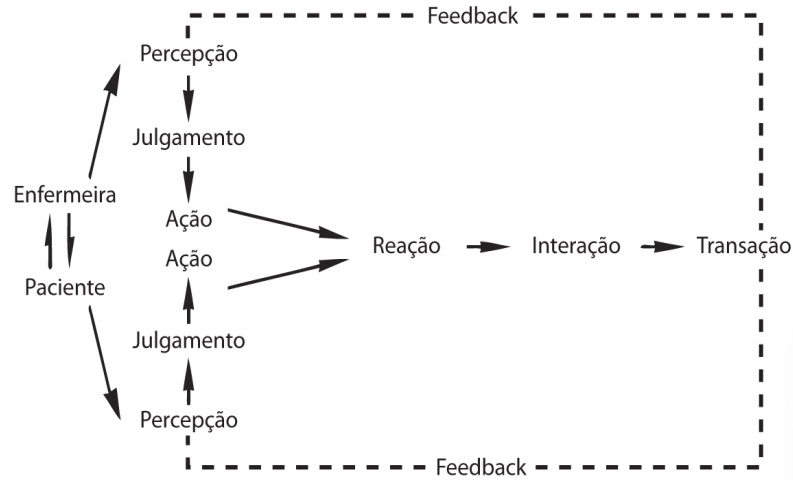
The interaction model between nurse/professional and client constitutes the main schematic representation of the theory (Figure 1). This model describes human behavior as a sequence of actions interpreted through perceptions and judgments, which are not directly observable but inferred. Interactions involve verbal and nonverbal communication oriented toward goals and are influenced by factors such as knowledge, expectations, needs, and prior experiences of each individual. Both the nurse and the client assess the situation, formulate judgments, and make decisions that guide their actions throughout the care process(3).
Figure 1 - Schematic representation of the process of human interactions. Brasilia, DF, Brazil, 2025
Source: translated and adapted from King, 1981.
Interactions may evolve into transactions, which represent the realization of jointly established goals. For this to occur, nurse and client must share perceptions, negotiate goals, and reach consensus regarding the methods to achieve them. Active participation in concrete events and the joint movement toward the goal promote changes in those involved, a dynamic sustained by the central concepts of perception, communication, judgment, and decision-making(3).
King’s theory has been widely used in health practice, since nursing is grounded in interactions between individuals and groups(5-7). Professionals who understand the concepts of the theory tend to interpret more comprehensively the experiences of clients and their families and may propose more effective care approaches. The theory and its interaction model have been applied in various health services, both nationally and internationally, and also constitute a theoretical basis for multiple studies in the field(4-7).
The relationship between Imogene King’s theory of goal attainment and continuing health education
The articulation between the concepts defined by King and the practical application of CHE can be established with the support of andragogy theory and the principles of interprofessionality. Based on these frameworks, an adaptation of King’s schematic model is proposed, aligning it with the context of CHE in order to expand its applicability in professional development in health.
Andragogy is grounded in the understanding of how the teaching-learning process occurs in adults, considering their particularities and previous experiences(11). In this context, interaction among professionals promotes learning opportunities based on the clinical experiences accumulated by team members(12).
Thus, the professional’s previous experience, autonomy, and readiness to learn are recognized, reinforcing andragogical principles and the conception that learning should arise from the needs and knowledge of individuals, as recommended by the PNEPS(10). The articulation with andragogy highlights the convergence between these frameworks, supporting educational processes oriented toward solving real problems and achieving shared goals(11).
In addition, the teaching-learning process involves continuous interactions and shared responsibilities among different professionals on the team. In this sense, education in the workplace favors collaborative practice and interprofessional education in health(13), enabling a more comprehensive view of care and contributing to greater effectiveness in patient care(14).
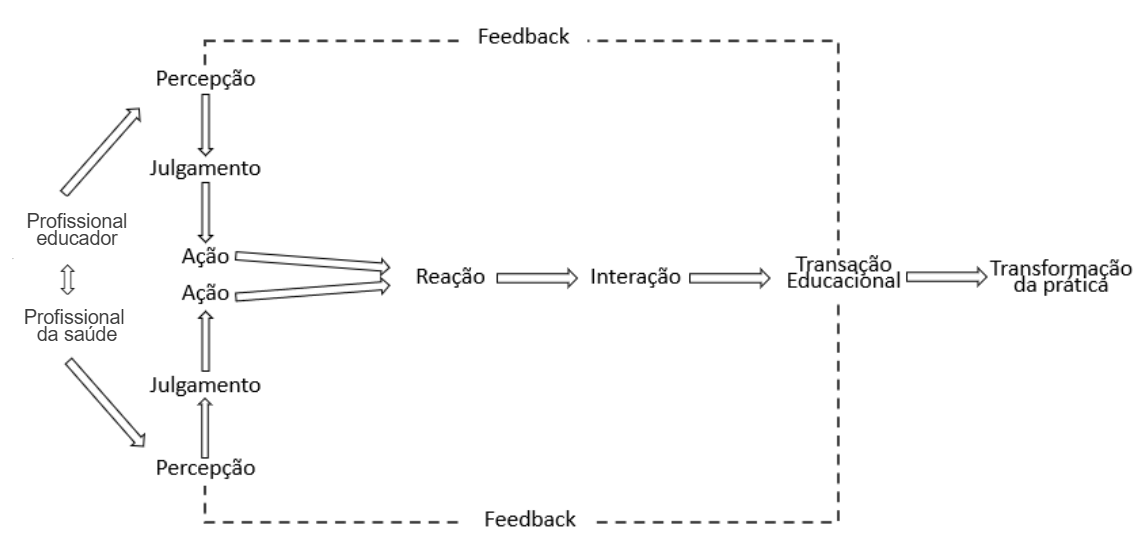
Figure 2 presents a schematic model of King’s theory of goal attainment adapted by the authors, summarizing the applicability of the theory in the context of CHE. In the proposed model, the educator, as the health professional responsible for the educational process, assumes the role of mediator of teaching-learning, aligning practice with the principles of andragogy. In this way, the aim is to ensure active learning based on participatory environments that foster professional development. At the same time, interprofessionality is understood as an opportunity for knowledge exchange among professionals from different fields, recognizing that both care and learning constitute collective constructions.
Figure 2 - Process of human interactions applied in the context of continuing health education. Brasilia, DF, Brazil, 2025
Source: adapted from King, 1981.
In the adapted model, the concept of perception expands beyond the relationship with the environment to also include forms of learning and knowledge assimilation. This concept is directly related to the andragogical principle of previous experience, recognizing that the accumulated experiences of professionals constitute valuable resources in the adult learning process. These experiences significantly influence how new concepts are understood and developed, affecting the construction of knowledge(11).
Communication assumes a central role in this process. It is the educator’s responsibility to promote open and active dialogue, encouraging the exchange of experiences and expanding the understanding of the care pathway(14-16). To do so, communication must be conducted flexibly, using active methodologies appropriate to the participants’ level of knowledge consolidation(11). Interaction among those involved therefore becomes essential for establishing objectives and advancing the stages of the transaction process.
Judgment occurs almost automatically after the initial interactions between the educator and health professionals and the processing of essential information. It results from the interaction between the message received, individual experiences, and perceptions, followed by an action in response(3).
The reaction generated in this process may directly influence the teaching-learning process, making it essential to consider it in educational planning. There are instruments capable of assessing participants’ levels of reaction after educational interventions, providing relevant data to improve the educational process. In this context, the importance of assessing the principle of readiness to learn stands out, as it promotes greater engagement and contributes to knowledge retention and consolidation(11).
The transaction stage occurs when a teaching situation capable of promoting continuous exchanges of knowledge is established, enabling the achievement of the defined goals. This process is related to the concepts of interpersonal relationships proposed by King(3). In addition, it aligns with the principles of the PNEPS, which include: the problematization of work practices as the central educational axis; meaningful learning based on the real needs of services; integration between teaching, service, management, and social control; the protagonism of workers in identifying and solving problems; and the collective construction of knowledge as a strategy for transforming care practices(17).
Transactions among participants must occur continuously to ensure the sustainability of interactions. This process should remain open to constant feedback, promoting continuous improvements and contributing to participants’ motivation, in accordance with andragogical principles that seek to make learning more meaningful(11).
Thus, Figure 2 can be reinterpreted as a process that generates collective transactions between the educator and other health professionals, mediated by the exchange of experiences, active listening, critical reflection, shared decision-making oriented toward care needs, and the construction of bonds of trust.
In this sense, CHE, oriented toward continuous professional development, is sustained by the interaction among professionals who, based on their experiences and lived realities, build a collective learning process. This movement fosters collaboration, interprofessionality, and improvement in care quality, promoting the construction of shared goals and joint decisions in the care process(18,19-20).
Barath and Ross (2024)(12) highlight that interprofessional continuing professional development expands knowledge about the roles of different professionals, strengthens networking, and fosters the development of collaborative relationships. This process contributes to the establishment of mentoring practices, collaboration, and new learning opportunities.
The integration between CHE and interprofessionality enhances continuous and reflective learning processes in the workplace, grounded in collaboration and the problematization of real care practices(19,21). In this context, the theory of goal attainment can support the achievement of professional and interprofessional goals by strengthening processes of communication, shared decision-making, and transaction. In this way, goal attainment ceases to represent an individual outcome and becomes a collective commitment oriented toward user needs, the comprehensiveness of care, and the improvement of care practices.
In summary, CHE corresponds to a learning process that occurs in the daily routine of health services, arising from encounters among professionals and the exchange of knowledge and experiences. Thus, “the more the body is exposed to encounters with other workers, the greater the capacity to perceive and understand the reality of work, and the more the mind will be able to express its ideas and propose actions”(20).
Among the limitations of this study are its theoretical-reflective nature and the scarcity of studies directly relating Imogene King’s theory of goal attainment to CHE settings. This gap may limit both the depth of the reflections and the breadth of empirical evidence available for dialogue with the theory.
CONCLUSION
This theoretical essay made it possible to reflect on the articulation between Imogene King’s theory of goal attainment and CHE, highlighting fundamental concepts of the theory that strengthen, from a practical perspective, the principles of CHE. The integration of the systems proposed by King strengthens processes of shared decision-making, collaboration, and interprofessionality, contributing to reducing the fragmentation of educational and care practices and fostering comprehensive and effective care. In addition, the study offers an innovative perspective by integrating classical nursing theories with contemporary educational models.
The reflections presented indicate that Imogene King’s theory of goal attainment constitutes a relevant tool for guiding CHE practices, since its applicability is grounded in interaction, communication, and the establishment of shared goals. This relationship reinforces the importance of the active participation of health professionals in their own learning processes and in continuing professional development, promoting meaningful educational practices aligned with the needs of care.
CONFLICT OF INTEREST
The authors declare no conflict of interest.
USE OF ARTIFICIAL INTELLIGENCE
A language model–based artificial intelligence tool (ChatGPT, OpenAI) was used to support grammatical revision, improve textual fluency and coherence, organize academic writing, and assist in the interpretation of some data.
REFERENCES
1. McEwen M, Wills EM. Bases teóricas de enfermagem. Garcez R, tradutora. 4th ed. Porto Alegre: Artmed; 2016.
2. Silva PC, Fedrigo PC, Crispim JS de SA, Regis IM, Rodrigues JAP, Menezes ACC. A evolução da enfermagem e a construção da identidade uma revisão narrativa da literatura. CLCS. 2025;18(1):e14556. https://doi.org/10.55905/revconv.18n.1-164.
3. King I. A theory for nursing: systems, concepts, process. Albany (NY): Delmar Publishers Inc.; 1981.
4. Tomey AM, Alligood MR. Nursing theorists and their work. 8th ed. St. Louis: Mosby, Elsevier; 2014.
5. Ventura-Silva JMA, Silva Martins MMFP, Trindade L de L, Faria A da CA, Barros SC da C, Melo RM da C, et al. Nurses' Work Methods Assessment Scale: a study of content validation. Rev Bras Enferm. 2023;76(2):e20220396. https://doi.org/10.1590/0034-7167-2022-0396. PMID: 36753258.
6. Araújo ESS, Silva L de F, Moreira TMM, Almeida PC, Freitas MC, Guedes MVC. Nursing care to patients with diabetes based on King's Theory. Rev Bras Enferm. 2018;71(3):1092-8. https://doi.org/10.1590/0034-7167-2016-0268. PMID: 29924160.
7. Brown ST, Lee BT. Imogene King's conceptual framework: a proposed model for continuing nursing education. J Adv Nurs. 1980;5(5):467-73. https://doi.org/10.1111/j.1365-2648.1980.tb03178.x. PMID: 6903574.
8. Brasil. Ministério da Saúde. Portaria nº 1.996, de 20 de agosto de 2007. Diretrizes para a implementação da Política Nacional de Educação Permanente em Saúde [Internet]. Diário Oficial da União, Brasília (DF); 22 ago 2007 [cited 19 Jan 2025]. Available from: https://bvsms.saude.gov.br/bvs/saudelegis/gm/2007/prt1996_20_08_2007.html.
9. Lavich CRP, Terra MG, Mello A de L, Raddatz M, Arnemann CT. Permanent education actions of nurse facilitators at a nursing education centre. Rev Gaucha Enferm. 2017;38(1):e62261. https://doi.org/10.1590/1983-1447.2017.01.62261. PMID: 28443970.
10. Ceccim RB, Ferla AA. Dicionário da Educação Profissional em Saúde [Internet]. Rio de Janeiro: Fundação Oswaldo Cruz; 2009 [cited 2025 Dec 14]. Available from: https://www.sites.epsjv.fiocruz.br/dicionario/verbetes/edupersau.html.
11. Knowles MS. The modern practice of adult education: from pedagogy to andragogy. 2nd ed. New York: Cambridge Books; 1980.
12. Barath S, Ross AJ. Conceptualising the experiences of continuing professional development of young private sector audiologists as an attribute of andragogy. Health SA. 2024;29(0):2683. https://doi.org/10.4102/hsag.v29i0.2683. PMID: 39114338.
13. Organização Mundial da Saúde. Marco para Ação em Educação Interprofissional e Prática Colaborativa. Genebra: OMS; 2010 [cited 2025 Nov 29]. Available from: https://untref.edu.ar/uploads/Marco%20formacion%20interprofesional%20OMS-portugues.pdf.
14. Sousa FMS, Severo AK de S, Félix-Silva AV, Amorim AK de MA. Educação interprofissional e educação permanente em saúde como estratégia para a construção de cuidado integral na Rede de Atenção Psicossocial. Physis. 2020;30(1):e300111. https://doi.org/10.1590/s0103-73312020300111.
15. Peduzzi M, Norman IJ, Germani ACCG, da Silva JAM, de Souza GC. Interprofessional education: training for healthcare professionals for teamwork focusing on users. Rev Esc Enferm USP. 2013;47(4):977-83. https://doi.org/10.1590/S0080-623420130000400029. PMID: 24310699.
16. Junqueira T da S, Cotta RMM. Matriz de ações de alimentação e nutrição na Atenção Básica de Saúde: referencial para a formação do nutricionista no contexto da educação por competências. Ciênc. saúde coletiva. 2014;19(5):1459-74. https://doi.org/10.1590/1413-81232014195.11932013.
17. Ferraz E de M, Mendonça F de F, Carvalho BG, Nunes E de FP de A, Santini SML. Educação permanente em saúde: estratégia de fortalecimento na formação e atuação de equipes gestoras municipais no Sistema Único de Saúde. Physis. 2025;35(3):e350304. https://doi.org/10.1590/s0103-73312025350304pt.
18. Farias DN, Ribeiro KSQS, Anjos UU, Brito GEG. Interdisciplinaridade e interprofissionalidade na estratégia saúde da família. Trab. educ. saúde. 2017;16(1):141-62. https://doi.org/10.1590/1981-7746-sol00098.
19. Reeves S, Fletcher S, Barr H, Birch I, Boet S, Davies N, et al. A BEME systematic review of the effects of interprofessional education: BEME Guide No. 39. Med Teach. 2016;38(7):656-68. https://doi.org/10.3109/0142159x.2016.1173663. PMID: 27146438.
20. Figueiredo EBL, Souza  C, Abrahão A, Honorato GLT, Paquiela EO de A. Educação Permanente em Saúde: uma política interprofissional e afetiva. Saúde debate. 2022;46(135):1164-73. https://doi.org/10.1590/0103-1104202213515.
21. Interprofessional Education Collaborative. IPEC Core Competencies [Internet]. Washington (DC): IPEC; 2025 [cited 2025 Nov 29]. Available from: https://www.ipecollaborative.org/ipec-core-competencies
Submission: 19-Dez-2025
Approved: 13-Fev-2026
Editors:
Rosimere Ferreira Santana (ORCID: 0000-0002-4593-3715)
Geilsa Soraia Cavalcanti Valente (ORCID: 0000-0003-4488-4912)
Corresponding author: Milena Mendes Jorge (milenamendes.jorge@gmail.com)
Publisher:
Escola de Enfermagem Aurora de Afonso Costa – UFF
Rua Dr. Celestino, 74 – Centro, CEP: 24020-091 – Niterói, RJ, Brazil
Journal email: objn.cme@id.uff.br
|
AUTHORSHIP CONTRIBUTIONS |
|
Study design: Jorge MM, Gabriel HD, Gonzaga PPA. Data collection: Jorge MM, Gabriel HD, Gonzaga PPA. Data analysis: Jorge MM, Gabriel HD, Gonzaga PPA, Jesus CAC, Pinho DLM. Data interpretation: Jorge MM, Gabriel HD, Gonzaga PPA, Jesus CAC, Pinho DLM. All authors are responsible for the textual writing and critical review of the intellectual content, the final version published, and all ethical, legal, and scientific aspects related to the accuracy and integrity of the study. |
