
ORIGINAL ARTICLE
BETWEEN RECOGNITION AND INVISIBILITY: A HISTORICAL-DOCUMENTARY STUDY ON THE IMPLEMENTATION OF THE MINIMUM WAGE FOR BRAZILIAN NURSING*
Mariana Kissia Santos Lins de Carvalho1, Laís de Miranda Crispim Costa2, Tânia Cristina Franco Santos3, Jarbas Ribeiro de Oliveira4, Sóstenes Ericson5, Amanda Cavalcante de Macedo6
1 Universidade Federal de Alagoas, Nursing School. Maceió, Alagoas, Brazil. ORCID: 0000-0001-6581-6308. Email: marianalinsc65@gmail.com
2 Universidade Federal de Alagoas, Nursing School. Maceió, Alagoas, Brazil. ORCID: 0000-0003-4997-567X. Email: lais.costa@eenf.ufal.br
3 Universidade Federal do Rio de Janeiro, Anna Nery Nursing School. Rio de Janeiro, Brazil. ORCID: 0000-0003-2325-4532. Email: taniacristinafsc@gmail.com
4 Universidade Federal de Alagoas, Arapiraca Campus Nursing Course. Arapiraca, Alagoas, Brazil. ORCID: 0000-0001-8519-2432. Email: jarbas.oliveira@arapiraca.ufal.br
5 Universidade Federal de Alagoas, Arapiraca Campus Nursing Course. Arapiraca, Alagoas, Brazil. ORCID: 0000-0003-0905-1376. Email: sostenes.silva@arapiraca.ufal.br
6 Universidade Estadual de Ciências da Saúde de Alagoas, Bachelor's Degree in Nursing. Maceió, Alagoas, Brazil. ORCID: 0000-0002-4630-2771. Email: amanda.macedo@uncisal.edu.br
ABSTRACT
Objective: To examine the legal trajectory of Law No. 14,434/2022, highlighting the agents, institutions, and competing interests involved throughout its legislative process and regulation. Method: A qualitative, descriptive social-historical study grounded in Pierre Bourdieu’s Social World theory. Primary sources consisted of official documents available on the platforms of the Federal Senate, House of Representatives, Federal Supreme Court, and National Congress. The study was conducted in Brazil and covered the period from 2009 to 2024. Data interpretation followed the historical method through contextual unit analysis. Results: Although Law No. 14,434/2022, which establishes the minimum wage for nursing professionals, represents a historical milestone for the category, its enactment did not fully resolve the challenges faced by the profession. Structural, legal, and operational barriers persist, limiting the law’s practical effects. Conclusion: The effective recognition of nursing requires a broader social commitment. Ensuring fair pay is only one of the necessary steps; it is essential to invest in better working conditions, adequate infrastructure, reduced workload, and psychological and emotional support for professionals.
Descriptors: Nursing; Salaries and Benefits; Legislation; Nurses; Occupational Health.
|
How to cite: Carvalho MKSL, Costa LMC, Santos TCF, Oliveira JR, Ericson S, Macedo AC. Between recognition and invisibility: a historical-documentary study on the implementation of the minimum wage for Brazilian nursing. Online Braz J Nurs. 2025;24:e20256874. https://doi.org/10.17665/1676-4285.20256874 |
INTRODUCTION
Brazilian nursing is shaped by political, economic, and ideological forces that have historically influenced national and global health systems. These forces determine access to services, available infrastructure, and responses to crises(1). Despite the profession’s technical and scientific progress and the training of more qualified nurses, working conditions have progressively deteriorated(2-3).
This deterioration is reflected in the flexibilization of contracts, outsourcing, and subcontracting, which subject nursing staff to long working hours and low wages — often paid hourly without rest periods, days off, or vacations guaranteed by the Consolidation of Labor Laws (CLT). Such conditions have contributed to an increasing prevalence of illness among these professionals(4).
To understand these processes, it is necessary to analyze the historical evolution of nursing practice through Pierre Bourdieu’s lens, linking it to the history of labor division and class struggle. This theoretical framework enables the examination of power relations and helps to understand how different sectors within nursing compete for recognition and legitimacy through economic, cultural, social, and symbolic capital(5).
Historically, the labor movement has played a key role in securing workers’ rights. Within this context, the Brazilian Nursing Association (ABEn) has had a decisive role in fostering the creation of unions and promoting professional recognition. The leadership of figures such as Dr. Glete de Alcântara and ABEn’s institutional efforts contributed to key legal milestones, including the recognition of nursing as a higher education profession (Law No. 3,780/1960) and, later, its regulation through the creation of the Federal Council of Nursing (COFEN) and the Regional Councils of Nursing (CORENs) (Law No. 5,905/1973)(6).
In 2020, nursing gained global visibility for its frontline role in combating COVID-19. The “anonymous heroes” narrative brought public recognition but also romanticized overwork, resource shortages, and job insecurity. Coincidentally, that year marked the bicentennial of Florence Nightingale, whose environmental theory — proposed more than 160 years ago — proved highly relevant during the pandemic response(7).
The health crisis reignited long-standing demands — such as the 30-hour workweek and the establishment of a minimum wage — bringing them to the center of public debate. In Brazil, there was widespread mobilization for the approval of Bill No. 2,564/2020, which resulted in Law No. 14,434/2022, instituting the nursing minimum wage. However, its implementation began facing vetoes and obstacles in 2023, primarily due to the alleged lack of funding sources for wage payments(8).
Accordingly, this study aims to examine the legal trajectory of Law No. 14,434/2022, identifying the agents, institutions, and competing forms of capital involved throughout its legislative process and regulation.
METHOD
Study type
This is a social-historical study with a qualitative, descriptive approach, grounded in documentary analysis of the chronological trajectory of Law No. 14,434/2022. History is understood as an instrument of political struggle, whose strength lies in the interpretation assigned to reality, influenced by the — often unconscious — reading of traces from the past. Documentary sources do not faithfully mirror historical facts; rather, a document is a monument to be shaped by the researcher according to their motivations and questions, in order to confer historical meaning(9-10).
To analyze the complex social reality surrounding the implementation of the nursing minimum wage in Brazil, we adopted Pierre Bourdieu’s theoretical framework, especially his theory of the Social World(5). This model conceives society as a multidimensional space composed of relatively autonomous fields in which interactions and power disputes occur among agents — individuals, groups, or institutions — endowed with specific dispositions(11).
Bourdieu identifies four main forms of capital: economic, cultural, social, and symbolic. In any field, these capitals are distributed unequally, generating tensions between the dominant (holders of greater capital) and the dominated (holders of lesser capital). Such inequalities result in forms of symbolic violence — a subtle domination exercised through the tacit acceptance of social rules, norms, and assessments, often without contestation(12).
Direct and indirect sources
Multiple historical sources were used to strengthen the study’s analytical rigor. Documentary research enables the examination of materials that problematize social practices and challenge stigmas(13). A rigorous historical analysis is not possible without recourse to primary sources, since it is through them that the researcher constructs an authentic, well-grounded historiographical reflection(14).
A source is considered direct when it consists of records contemporaneous with the event under study, such as official documents, eyewitness accounts, testimonies, or reports produced in the context of the occurrence(15). Accordingly, we used official documents available on the platforms of the Federal Senate, the House of Representatives, the Supreme Federal Court (STF), and the National Congress, in addition to statements and records from professional bodies representing the field, such as COFEN and the CORENs.
Setting and spatiotemporal scope
The study setting is Brazil, with a temporal scope from 2009 to 2024. The starting point (2009) corresponds to Bill No. 4,924/2009, although it was necessary to look further back to contextualize the profession’s union trajectory and the accumulation of political forces within the nursing field, as expected in historical research methods. The end point (2024) refers to Constitutional Amendment Proposal (PEC) No. 19/2024, introduced by Senator Eliziane Gama (Social Democratic Party, Maranhão), which proposes amending the Federal Constitution to link the nursing minimum wage to a maximum 30-hour workweek.
Documentary analysis comprises techniques aimed at verifying the reliability and suitability of information to assess and explain historical processes(16). Since the qualitative nature of this research, we employed this approach to examine contemporary legal documents related to the establishment of the nursing minimum wage in Brazil. Findings were selected and interpreted using the historical method, in the modality of context-unit analysis, which entails triangulation among the historical context, theoretical choices, and investigative hypotheses(17).
Ethical considerations
Because the study used exclusively public-domain content and did not involve human participants, it was exempt from research ethics review, in accordance with Resolution No. 510 of April 7, 2016.
RESULTS
Deputy Mauro Nazif (Brazilian Socialist Party, Rondônia) authored the first bill proposing the creation of a minimum wage for Brazilian nursing. Grounded in labor legislation and the 1988 Federal Constitution (CF/88), the text advocated the need for fair remuneration proportional to professional responsibilities.
The congressman argued that nursing categories face double shifts, overload, and low pay, with repercussions for workers’ health and the quality of care. As a response, he proposed a floor of 10 minimum wages for nurses — R$ 4,650.00 in 2009 — with 50% of that amount for technicians and 40% for auxiliaries and midwives.
Bill No. 4,924/2009 was shelved in 2015 due to the change in legislature, under article 105 of the Internal Rules of the House of Representatives. Still in 2015, the discussion resumed with Bill No. 459/2015, authored by Deputy André Moura (Social Christian Party, Sergipe), which significantly increased the proposed remuneration. Article 15-A of the bill established:
It is hereby set a minimum wage of R$ 7,880.00 (seven thousand, eight hundred and eighty reais) for nurses, to be adjusted in the month of this law’s publication by the accumulated variation of the National Consumer Price Index – INPC.
Bill No. 459/2015 was approved by the Committee on Social Security and Family in 2018, but its progress alternated between shelving and unshelving: it was unshelved in 2019 and shelved again in 2021. Final shelving occurred in light of progress on Bill No. 2,564/2020, which also addressed the nursing minimum wage; with the latter’s approval, the earlier bill was considered redundant and detrimental to the legislative process and was shelved by the House of Representatives.
That same Bill No. 459/2015 received 18 appended bills on the same topic, all of which were rejected in opinions issued by the rapporteur, Deputy Carmen Zanotto (Popular Socialist Party, Santa Catarina): Bill No. 597/2015; Bill No. 729/2015; Bill No. 1,477/2015; Bill No. 1,823/2015; Bill No. 9,961/2018; Bill No. 10,553/2018; Bill No. 1,268/2019; Bill No. 2,982/2019; Bill No. 2,997/2020; Bill No. 4,275/2020; Bill No. 1,830/2021; Bill No. 1,768/2021; Bill No. 1,773/2021; Bill No. 1,874/2021; Bill No. 2,127/2021; Bill No. 2,884/2021; Bill No. 5,640/2020; Bill No. 1,553/2021.
The minimum wage agenda ebbed and flowed until it gained greater political and social traction from 2020 onward, when Bill No. 2,564/2020 became the main vehicle for these demands, propelled by the public recognition of nursing’s role during the COVID-19 pandemic.
Senator Fabiano Contarato (Workers’ Party, Espírito Santo), author of Bill No. 2,564/2020, proposed amending Law No. 7,498 of June 25, 1986, to establish a national minimum wage for nurses. In his justification, he stated that “nursing and its auxiliary activities, carried out by selfless professionals who risk their own health to save lives, remain surprisingly undervalued throughout Brazil,” highlighting wage disparities across health professions — especially compared with medicine — and stressing that the COVID-19 pandemic exposed the centrality of nursing work and the need for greater recognition. According to the senator, the reference for the nurses’ floor would be seven minimum wages. Nursing technicians would receive 70% of that amount, and nursing auxiliaries and midwives, 50%, in line with the level of complexity and required training within the country’s hierarchical professional structure.
On April 20, 2021, Senator José Reguffe (Podemos, Federal District) revived debate on Bill No. 2,564/2020 through Request No. 1,410/2021 (RQS), seeking its inclusion on the Order of the Day. This urgent initiative was endorsed by other senators, including Contarato. Subsequently, Contarato and other members submitted RQS No. 1,527/2021, reinforcing the urgency of recognizing nursing and referring to the historic processing of Bill No. 2,295/2000 on a 30-hour workweek.
On April 28, 2021, the rapporteur, Senator Zenaide Maia (Social Democratic Party, Rio Grande do Norte), issued a favorable opinion on Bill No. 2,564/2020, underscoring the category’s historical struggle for a 30-hour workweek, with mention of Bill No. 2,295/2000.
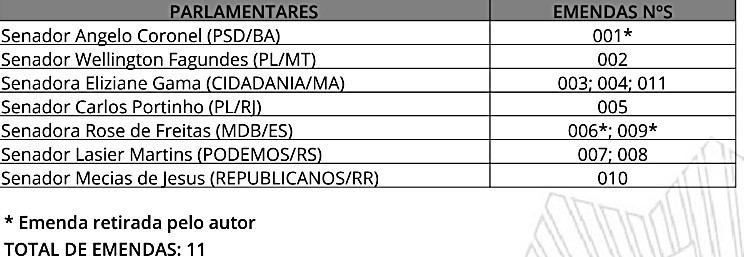
The broadened debate led to the submission of 11 amendments to the Bureau of the Federal Senate (Figure 1).
Source: Federal Senate Journal, 2021.
Figure 1 – Amendments submitted for review by the Bureau of the Federal Senate
Following Request No. 1,582/2021, introduced by Senator Jader Barbalho (Brazilian Democratic Movement, Pará), new motions reinforced the urgency of the matter. On September 14, 2021, Senator Wellington Fagundes (Liberal Party, Mato Grosso) submitted Parliamentary Amendment No. 2, which, mindful of budgetary implications, emphasized the Union’s role in funding health investments and the remuneration of nursing professionals — civil servants, public employees, or contractors — within the proposed limits and percentages.
Senator Fagundes argued that the financial responsibility for implementing the minimum wage should rest with the Union, in accordance with the Federative Pact. Thus, monthly amounts intended for professionals should be transferred to municipalities by the federal government through the National Health Fund (FNS). He contended that, without such support, many municipalities would be unable to maintain their nursing staff, potentially leading to a lack of care for the population. His substitute amendment added this funding provision to Article 15-C of the bill.
Subsequently, in October 2021, Senator Eliziane Gama (Social Democratic Party, Maranhão) submitted a Parliamentary Amendment that significantly reduced the initially proposed minimum wage for nurses, setting it at R$ 4,750.00, with annual adjustments based on the National Consumer Price Index (INPC). During the same period, she introduced Parliamentary Amendment No. 4, reaffirming the importance of approving Bill No. 2,564/2020. In justifying the earlier reduction (Amendment No. 3), Eliziane explained that the measure aimed to avoid penalizing professionals earning slightly above the proposed floor and to align the value with the country’s regional economic realities.
Parliamentary Amendment No. 5, introduced in November 2021 by Senator Carlos Portinho (Liberal Party, Rio de Janeiro), proposed another reduction of the minimum wage to R$ 3,500.00, arguing that states and municipalities might face budgetary difficulties with the adjustment. He claimed that the final cost would ultimately be passed on to health care users and insurance premiums, which could rise significantly. To support his proposal, he noted that the average salary for nurses in Brazil was around R$ 3,159.00 and that the increase would more than double payroll costs for private hospitals and public health institutions.
In Parliamentary Amendment No. 6, later withdrawn, Senator Rose de Freitas (Podemos, Espírito Santo) expressed economic concerns, arguing that a sudden wage increase could prompt rapid administrative reforms, workforce reductions or substitutions, and even the bankruptcy of some institutions unable to absorb the new costs.
Senator Lasier Martins (Podemos, Rio Grande do Sul) submitted two amendments. Amendment No. 7 suggested that paying entities adjust their fees to cover the wage increase, while Amendment No. 8 proposed raising the floor to R$ 4,000.00, with progressive adjustments proportional to federal, state, district, and municipal employees, allowing time for institutions to adapt financially.
Also in November, Rose de Freitas (Podemos, Espírito Santo) presented a new proposal of R$ 4,200.00 for the floor but later formally withdrew Amendment No. 9. In Amendment No. 10, Senator Mecias de Jesus (Republicans, Roraima) included a provision recognizing and valuing Indigenous peoples by adding item III, which acknowledged the role of Indigenous midwives.
Concluding the series of proposals, Senator Eliziane Gama (Social Democratic Party, Maranhão) resubmitted the value of R$ 4,750.00 in Amendment No. 11, reaffirming the need for periodic updates and historical justice for the profession, consolidating rights long demanded by the category.
After reviewing the 11 amendments and related proposals, on November 24, 2021, rapporteur Senator Zenaide Maia (Social Democratic Party, Rio Grande do Norte) issued Opinion No. 317, recommending the approval of Bill No. 2,564/2020, authored by Senator Fabiano Contarato (Workers’ Party, Espírito Santo). The opinion rejected Amendments No. 5, 7, and 10, partially accepted Amendments No. 2, 3, 4, and 8, and fully approved Amendment No. 11 (Substitute), with editorial adjustments to preserve the bill’s summary. Amendments No. 1 and 6 were formally withdrawn by their authors.
The bill was approved by the Federal Senate on November 24, 2021, and forwarded to the House of Representatives, where new motions were presented to ensure its inclusion on the Order of the Day as a priority agenda. In Request No. 2,498/2021, dated November 30, 2021, Deputy João Daniel (Workers’ Party, Sergipe) emphasized that it was inconceivable for a proposal to remain pending for more than two decades without approval, as had occurred with the historic Bill No. 2,295/2000.
On May 4, 2022, the discussion began in the House of Representatives, with Deputy Carmen Zanotto (Citizenship Party, Santa Catarina) as rapporteur. In her report, she acknowledged that the proposal satisfactorily addressed nursing’s pay demands but noted financial and budgetary inadequacies, as it lacked federal impact estimates and shifted municipal expenses to the federal level.
On July 15, 2022, the Speaker of the House, Arthur Lira (Progressive Party, Alagoas), forwarded the proposal for presidential sanction. On August 5, 2022, the presidential sanction of Law No. 14,434, dated August 4, 2022, was published in the Official Gazette of the Union, Section 1, amending the Professional Practice Law to establish the national minimum wage for nursing. Article 15-A stated:
The national minimum wage for nurses employed under the Consolidation of Labor Laws (CLT), approved by Decree-Law No. 5,452 of May 1, 1943, shall be R$ 4,750.00 (four thousand seven hundred and fifty reais) per month. I – 70% (seventy percent) for Nursing Technicians; II – 50% (fifty percent) for Nursing Auxiliaries and Midwives.
The law was sanctioned with a partial veto of Article 15-D, which provided for annual adjustment by the INPC. Veto No. 43/2022 was based on the unconstitutionality of Article 15-D:
Article 15-D. The minimum wage provided for in this Law shall be updated annually based on the National Consumer Price Index (INPC).
The veto was grounded in a violation of federative autonomy (Articles 18 and 25 of the CF/88), as it imposed automatic adjustments on subnational entities. The text also highlighted the risk of salary asymmetry between public and private sectors, contrary to the intended parity.
On August 8, 2022, the National Health Confederation filed Direct Action of Unconstitutionality (DAU) No. 7,222 before the STF. In a preliminary decision, Justice Luís Roberto Barroso suspended the law’s effects and requested information from public and private institutions regarding financial impacts and employment risks.
As an institutional response, on December 22, 2022, Constitutional Amendment (CA) No. 127 was enacted, amending the CF/88 to authorize the Union to provide supplementary financial assistance to states, municipalities, and the Federal District, as well as to philanthropic entities and other providers serving ≥60% of patients through the Unified Health System (SUS).
In the 57th Legislature – 1st Ordinary Legislative Session, the vote published on April 26, 2023, confirmed the maintenance of Veto No. 43/2022 by the National Congress, with 57 votes in favor and 10 against (Figure 2).

Source: National Congress, 2023.
Figure 2 – Voting on Partial Veto No. 43/2022 in both Legislative Houses.
Following CA No. 127, President Luiz Inácio Lula da Silva sanctioned Law No. 14,581, dated May 11, 2023, which opened a special credit of R$ 7.3 billion in the FNS budget to provide supplementary financial support to states and municipalities for paying the wage floor.
To further refine the legislation, Senator Eliziane Gama (Social Democratic Party, Maranhão) presented PEC No. 19/2024 on May 15, 2024, proposing to amend Article 198 of the CF/88 to constitutionally link the minimum wage to a maximum 30-hour workweek and ensure annual adjustments indexed to inflation. The initiative aims to address gaps left by Law No. 14,434/2022 and the STF’s ruling in DAU No. 7,222, which conditioned the application of the wage floor to a 44-hour workweek.
DISCUSSION
Brazil’s historical trajectory of labor-rights claims highlights the sociopolitical mobilization of popular sectors in defense of better working conditions. In the health subfield, nursing follows this dynamic, but its still-limited participation hampers advances in professional recognition and the fulfillment of rights, shaping an ongoing symbolic dispute.
Persistent power imbalances and precarious conditions over time have molded a specific nursing habitus, with low representation of the category in political decision-making arenas. This distance restricts the ability to set core demands — better working conditions, a 30-hour workweek, and dignified pay — and underscores the need for active engagement by political representatives aligned with the profession’s causes.
Within this context, Deputy Mauro Nazif (Brazilian Socialist Party, Rondônia) emerges as a relevant actor by introducing, in 2009, the first Bill focused on a nursing minimum wage. The shelving of that proposal, however, stalled the debate until 2015, which only gained momentum from 2020 onward.
During the COVID-19 pandemic, amid a public calamity and a strained health system, Senator Fabiano Contarato (Workers’ Party, Espírito Santo) sent Official Letter No. 31/2020 on May 18, 2020, to the President of the Federal Senate requesting priority for Bill No. 2,564/2020 as a means of recognizing and valuing nursing at a critical moment for public health.
Despite mobilization by the category and extensive media visibility, the minimum wage sparked intense political debate and exposed a symbolic struggle for professional recognition. Between 2020 and 2021, disagreements among legislators — expressed in motions, letters, and proposals — slowed the bill’s progress and culminated in the submission of 11 amendments in the Senate.
Parliamentary Amendment No. 1, by Senator Angelo Coronel (Social Democratic Party, Bahia), proposed including physical therapists and occupational therapists in the text, shifting the focus away from nursing’s specific demand. By diluting the centrality of the agenda, this move reinforced a dynamic of symbolic violence by relativizing the category’s historical struggle for recognition(5). The senator later withdrew the proposal, formally restoring nursing’s central place in the debate.
Proposals to reduce the wage floor align with a logic that reaffirms nursing’s subordinate position in the health field, minimizing its value compared with other categories. From this perspective, Senator Eliziane Gama’s amendment (Social Democratic Party, Maranhão), by sharply lowering the amount, reproduces structural inequalities and hinders the attainment of economic and symbolic capital equivalent to that of other professions, reinforcing limits historically imposed on less-valued categories.
According to Bourdieu(5), symbolic violence occurs when seemingly rational practices or discourses are used to impose norms that legitimize the subordination of certain groups. By justifying the reduction of the minimum wage as a measure to protect professionals earning slightly above that level and as a “reasonable” amount for less-developed regions, Senator Eliziane Gama (Social Democratic Party, Maranhão) reinforces nursing’s subordinate position, naturalizing regional inequalities and reproducing structures of domination.
Similarly, Senator Carlos Portinho’s (Liberal Party, Rio de Janeiro) rationale for reducing the wage floor can be interpreted as a strategy to legitimize the prevailing economic order. By emphasizing the financial impact on the health sector, the senator reaffirms the primacy of capital over social justice claims, maintaining nursing in a state of historical undervaluation.
Senator Zenaide Maia (Social Democratic Party, Rio Grande do Norte), meanwhile, although publicly acknowledging the importance of valuing nursing, did not present funding sources capable of ensuring the financial sustainability of the wage floor across states, the Federal District, and municipalities. Her position reflects the political and social consensus that has long marked the profession’s trajectory — one composed mostly of workers who hold multiple jobs to supplement their income. The most striking contrast in this symbolic dispute lies in the disparity of economic and political capital between nursing workers and large health care corporations. While the category fought for over a decade for approval of the wage floor, private entities, backed by financial and legal power, obtained in just 30 days an injunction against the law(18-19).
As Peduzzi(19) notes, the National Health Confederation’s rapid action in filing a precautionary measure in a DAU before the STF demonstrates the influence of capital within the legal field. The argument of potential hospital closures, mass layoffs, and bed reductions illustrates how economic interests take precedence over the valuation of health professionals, converting financial power into political and institutional agency.
From a legal standpoint, Barbosa(18) argues that the law contravenes the principles of Brazilian federalism by imposing a financial obligation without budgetary provision, thereby undermining the autonomy of federative entities and risking fiscal imbalance.
Veto No. 43, which followed the sanction of Law No. 14,434/2022, marked a decisive moment in the symbolic dispute between health professionals and government institutions. Although the law represents a historic milestone and the result of broad mobilization, it does not fully resolve the structural, legal, and operational challenges facing nursing.
In this scenario, the Inter-Union Department of Statistics and Socioeconomic Studies (DIEESE) plays an essential technical advisory role by producing analyses that demonstrate the financial feasibility of the wage floor(20), its positive impact on the SUS, salary disparities within the health sector, and the correlation between professional recognition and improvements in patient safety and quality of care(21).
Finally, PEC No. 19/2024, authored by Senator Eliziane Gama (Social Democratic Party, Maranhão), represents a crucial step forward for Brazilian nursing. The proposal seeks to constitutionally link the wage floor to a maximum 30-hour workweek and ensure annual inflation-based adjustments, addressing the gaps left by Law No. 14,434/2022 and the STF’s decision in DAU No. 7,222, which tied the floor’s application to a 44-hour workweek. This measure strengthens the pursuit of recognition, dignity, and economic security for a category essential to public health in Brazil.
CONCLUSION
The COVID-19 pandemic, as a disruptive social event, reshaped the frameworks through which nursing is perceived and valued. Bill No. 2,564/2020 became an instrument of struggle to transform this symbolic capital into tangible gains, seeking to rebalance historically entrenched hierarchies of power and value within the field.
Bill No. 4,924/2009 set an ideal remuneration equivalent to 10 minimum wages for nurses. A total of 16 years later, the category continues to demand a nearly identical amount. This persistence raises a central question: under current conditions, would the implementation of the wage floor represent a substantial gain in economic capital for workers? This inquiry calls for broader reflection on the scope of financial recognition amid decades of accumulated devaluation.
Law No. 14,434/2022 does not exhaust nursing’s challenges. Despite the federal government’s financial transfers through the FNS, the progress represented by PEC No. 19/2024, and the financial feasibility demonstrated by DIEESE, coordinated federative planning remains essential. Beyond fair pay, effective recognition requires a collective social commitment to improving working conditions, providing adequate infrastructure, reducing overload, and offering psychological and emotional support.
Further research is recommended on the wage floor and on historical issues shaping nursing labor, such as the struggle surrounding Bill No. 2,295/2000 on the 30-hour workweek, which symbolizes yet another invisible barrier to the guarantee of rights and dignified working conditions.
*Article derived from the Master’s Thesis titled “Between recognition and invisibility: nursing and the debate on the minimum wage in Brazil,” presented to the Graduate Nursing Program at the Universidade Federal de Alagoas, Maceió, Alagoas, Brazil, in 2025.
ACKNOWLEDGMENTS
To the Graduate Nursing Program at the Universidade Federal de Alagoas.
CONFLICT OF INTERESTS
The authors declare no conflicts of interest.
REFERENCES
1. Barreira I de A. Memória e história para uma nova visão da enfermagem no Brasil. Rev Lat Am Enfermagem. 1999;7(3):87-93. https://doi.org/10.1590/S0104-11691999000300012
2. Fernandez M, Lotta G, Passos H, Cavalcanti P, Corrêa MG. Condições de trabalho e percepções de profissionais de enfermagem que atuam no enfrentamento à covid-19 no Brasil. Saúde Soc. 2021;30(4):e201011. https://doi.org/10.1590/S0104-12902021201011
3. Neto Ximenes FRG, Machado MH, Freire NP, Silva MCN da, Santos BMP dos, Wermelinger MC de MW. Denúncias da enfermagem brasileira sobre a exposição a riscos laborais durante a pandemia de COVID-19. Nursing (Ed. bras., Online). 2021;24(280):6191-6198. https://doi.org/10.36489/nursing.2021v24i280p6191-6198
4. Pereira ÁAC, Lemos M, Cunha CLF, Souza HS de, Alvarenga EC, Ferreira GRON, et al. Impacts of the Labor Reform on Nursing work. REME. 2022;26:e-1439. https://doi.org/10.35699/2316-9389.2022.39242
5. Bourdieu P. O poder simbólico. 16. ed. Rio de Janeiro: Bertrand Brasil; 2012.
6. Oguisso T. História da legislação do exercício da enfermagem no Brasil. Rev Bras Enferm. 2001;54(2):197-207. https://doi.org/10.1590/S0034-71672001000200005
7. Breigeiron MK, Vaccari A, Ribeiro SP. Florence Nightingale: Legacy, present and perspectives in COVID-19 pandemic times. Rev Bras Enferm. 2021;74(Suppl 1):e20201306. https://doi.org/10.1590/0034-7167-2020-1306
8. Barros FS, Gomes RK, Castorino AB. A pandemia da covid-19 aprofunda a precarização das condições de trabalho dos profissionais de enfermagem. Rev. enferm. UFPE on line. 2021;15(2):e247359. https://doi.org/10.5205/1981-8963.2021.247359
9. Mendes CMM. A importância da pesquisa de fontes para os estudos históricos. Acta Sci. Educ. (Online). 2011;33(2):205-209. https://doi.org/10.4025/actascieduc.v33i2.14174
10. Grazziotin LS, Klaus V, Pereira APM. Documentary historical analysis and bibliographic research: study subjects and methodology. Pro-Posições (Online). 2022;33:e20200141. https://doi.org/10.1590/1980-6248-2020-0141EN
11. Valle IR. A obra do sociólogo Pierre Bourdieu: uma irradiação incontestável. Educ. Pesqui. (Online). 2007;33(1):117-134. https://doi.org/10.1590/S1517-97022007000100008
12. Grenfell M. Pierre Bourdieu: conceitos fundamentais. Petrópolis (RJ): Editora Vozes; 2018.
13. Cechinel A, Fontana SAP, Della KGP, Pereira AS, Prado SS do. Estudo/análise documental: uma revisão teórica e metodológica. Criar Educ. 2016;5(1). https://doi.org/10.18616/ce.v5i1.2446
14. Barros JD. Fontes Históricas: uma introdução à sua definição, à sua função no trabalho do historiador, e à sua variedade de tipos. Cad. Tempo Presente. 2020;11(02):03-26. https://doi.org/10.33662/ctp.v11i02.15006
15. Barros JCD. Fontes Históricas: revisitando alguns aspectos primordiais para a Pesquisa Histórica. Mouseion [Internet]. 2012 [citado 2025 Jul 27];(12):129-159. Disponível em: https://revistas.unilasalle.edu.br/index.php/Mouseion/article/view/332
16. Padilha MI, Bellaguarda ML dos R, Nelson S, Maia ARC, Costa R. The use of sources in historical research. Texto contexto enferm. (Online). 2017;26(4):e2760017. https://doi.org/10.1590/0104-07072017002760017
17. Cardoso CF, Vainfas R, organizadores. Domínios da História: ensaios de teoria e metodologia. 5. ed. Rio de Janeiro: Campus; 1997.
18. Barbosa CS. Piso salarial nacional em benefício dos enfermeiros, técnicos de enfermagem, auxiliares de enfermagem e parteira, em contraposição à autonomia dos Entes Federados: piso salarial e autonomia dos Entes Federados. Revista de Direito e Atualidades [Internet]. 2022 [citado 2025 Jul 27];2(5):157-173. Disponível em: https://www.portaldeperiodicos.idp.edu.br/rda/article/view/6845
19. Peduzzi M. Os vários sentidos da recusa à aplicação do piso salarial da enfermagem. Rev Paul Enferm [Internet]. 2022 [citado 2025 Jul 27];33:ed. Disponível em: https://repositorio.usp.br/item/003127706
20. Departamento Intersindical de Estatística e Estudos Socioeconômicos; Organização Pan-Americana da Saúde. Gestão e organização do trabalho na rede SUS: produto 5 - relatório das entrevistas com dirigentes sindicais sobre a gestão do trabalho no SUS. Carta Acordo SCON2023-00216 [Internet]. São Paulo: DIEESE; 2024 [citado 2025 Jul 27]. Disponível em: https://www.dieese.org.br/relatoriotecnico/2024/opasRel5.pdf
21. Departamento Intersindical de Estatística e Estudos Socioeconômicos. Estudo técnico: a limitação da jornada de trabalho da enfermagem em 30 horas semanais. Estimativa de impactos no emprego e nos gastos com remuneração de pessoal no setor da saúde e da administração pública [Internet]. Brasília (DF): DIEESE; 2014 [citado 2025 Jul 27]. Disponível em: https://www2.camara.leg.br/atividade-legislativa/comissoes/grupos-de-trabalho/54a-legislatura/grupo-de-trabalho-da-enfermagem-30hs-semanais/documentos/outros-documentos/OfcioDIEESE.pdf
Submission: 29-Jul-2025
Approved: 14-Oct-2025
Editors:
Rosimere Ferreira Santana (ORCID: 0000-0002-4593-3715)
Geilsa Soraia Cavalcanti Valente (ORCID: 0000-0003-4488-4912)
Nuno Felix (ORCID: 0000-0002-0102-3023)
Corresponding author: Laís de Miranda Crispim Costa (lais.costa@eenf.ufal.br)
Publisher:
Escola de Enfermagem Aurora de Afonso Costa – UFF
Rua Dr. Celestino, 74 – Centro, CEP: 24020-091 – Niterói, RJ, Brazil
Journal email: objn.cme@id.uff.br
|
AUTHORSHIP CONTRIBUTIONS |
|
Study conception: Carvalho MKSL, Costa LMC. Data acquisition: Carvalho MKSL, Costa LMC. Data analysis: Carvalho MKSL, Costa LMC, Santos TCF, Oliveira JR, Ericson S, Macedo AC. Data interpretation: Carvalho MKSL, Costa LMC, Santos TCF, Oliveira JR, Ericson S, Macedo AC. All authors are responsible for drafting the manuscript, critically revising its intellectual content for the final published version, and ensuring the study’s accuracy and integrity with regard to ethical, legal, and scientific aspects. |
