
ORIGINAL ARTICLE
PUBLIC EMPLOYMENT OPPORTUNITIES FOR NURSING PROFESSIONALS IN BRAZIL: A DOCUMENTARY STUDY
Hercules de Oliveira Carmo1, Moises Rizzo Campos2, André Almeida de Moura3, Ana Luiza de Siqueira Simão4, Maristela Santini Martins5, Jonas Sâmi Albuquerque de Oliveira6
1 Universidade de São Paulo, Escola de Enfermagem, Departamento de Orientação Profissional. São Paulo, SP, Brazil. ORCID: 0000-0002-6996-4233. E-mail: hercules.enf@usp.br
2 Universidade de São Paulo, Escola de Enfermagem. São Paulo, SP, Brazil. ORCID: 0009-0000-7588-6676. E-mail: moisesrizzo@usp.br
3 Universidade de São Paulo, Escola de Enfermagem, Departamento de Orientação Profissional. São Paulo, SP, Brazil. ORCID: 0000-0003-2990-5375. E-mail: andalmo@usp.br
4 Universidade de São Paulo, Escola de Enfermagem, Programa de Pós-graduação em Gerenciamento em Enfermagem. São Paulo, SP, Brazil. ORCID: 0000-0001-9043-3421. E-mail: ana.simao@usp.br
5 Universidade de São Paulo, Escola de Enfermagem, Departamento de Orientação Profissional. São Paulo, SP, Brazil. ORCID: 0000-0002-0730-3923. E-mail: maristelasanti@usp.br
6 Universidade Federal do Rio Grande do Norte, Departamento de enfermagem. Natal, RN, Brazil. ORCID: 0000-0003-0303-409X. E-mail: jonas.albuquerque@ufrn.br
ABSTRACT
Objective: to examine the regional, contractual, and salary configuration of public employment opportunities for nursing professionals in Brazil. Method: this is a quantitative, descriptive, and documentary study, based on the analysis of 181 public notices published between January and August 2024, available on the PCI Concursos platform. The data were subjected to descriptive statistical analysis and interpreted in light of the Marxist framework on the labor process. Results: 4,358 vacancies were identified, mostly for nurses and technicians, with a significant concentration in the Northeast Region. Permanent positions and 40-hour work weeks predominated, although 46% of the opportunities corresponded to a reserve list and different contractual regimes coexisted. There were vacancies reserved for Black people, Indigenous people, and people with disabilities. A broad requirement for post-graduation specialization courses was observed, especially in highly complex areas such as intensive care and oncology. Compensation showed great variability between regions, positions, and work hours, with a high proportion of salaries below the national minimum wage for technicians and assistants. Conclusion: regional, contractual, and salary inequalities were evident in the supply of public nursing jobs, reinforcing the need for integrated policies to value and plan the health workforce.
Descriptors: Employment; Labor Market; Health Services; Personnel Selection; Nursing.
|
How to cite: Carmo HO, Campos MR, Moura AA, Simão ALS, Martins MS, Oliveira JSA. Public employment opportunities for nursing professionals in Brazil: a documentary study. Online Braz J Nurs. 2026;25(1):e20266864. https://doi.org/10.17665/1676-4285.20266864 |
What is already known:
The nursing workforce in Brazil presents persistent inequalities in regional distribution, hiring practices, and remuneration.
Previous studies indicate increasing job insecurity, multiple employment relationships, and difficulties in professional integration.
There is a scarcity of research that uses public tender notices as a source to understand the configuration of employment opportunities in nursing.
What this article adds:
Reveals that public employment opportunities during the study period were concentrated in the Northeast, with a predominance of positions for reserve lists and heterogeneity of contractual arrangements.
Identifies salary inequalities, showing that a large portion of the positions for nursing technicians and assistants remain with pay below the national minimum wage.
Highlights the presence of positions reserved for Black people and people with disabilities, revealing advances in equity policies in public nursing recruitment processes.
INTRODUCTION
Health is one of the essential pillars for the functioning of any society. Guaranteeing universal and equitable access to services depends on the availability, qualification, and adequate distribution of the health workforce(1). In this context, nursing constitutes the largest occupational category in the sector, representing approximately 59% of professionals globally(2) and approximately 3 million in Brazil, distributed among nurses, nursing technicians, nursing assistants, and midwives, working at all levels of care(3).
In the country, the nursing category comprises approximately 70% of the health workforce(4), with a strategic presence in primary care and specialized services. The density of professionals grew from 0.96 to 12.97 per thousand inhabitants between 1990 and 2022(5), although regional inequalities still compromise equitable access and the effectiveness of services(6).
The expansion of the nursing job market in Brazil was driven by the consolidation of the Unified Health System (SUS) and by changes in the care model, with an emphasis on primary care(7). However, this market is shaped by dynamics between supply and demand, which regulate employment relationships and the professional profiles recruited(8), directly affecting the criteria defined in public notices. In addition to regulation by supply and demand, the labor market must be understood according to the dynamics of insertion, absorption and conditions of use of the workforce, including the ways in which relations between capital and labor are established(9).
According to data from the Ministry of Health, SUS has more than 300,000 establishments and employs more than 3.5 million health professionals(10). Nursing represents the largest category in the system, with approximately 87% of registered employment(11), reflecting its centrality in the provision of care.
Despite the expansion of training, the public system has not proportionally absorbed this workforce. Population aging and the growth of chronic diseases intensify the demand for qualified professionals, but employability challenges persist. The unemployment rate among nursing professionals reached 10.1% in the period analyzed in research on the nursing profile(12), revealing a mismatch between training and effective job opportunities(13).
Professional insertion is also hampered by requirements such as prior experience and high competition, in addition to the perception of favoritism in selection processes(14). The precariousness of work, fostered by neoliberal policies, expands fragile employment relationships and makes rights more flexible, individualizing risks(15,16), weakening the stability of professional trajectories.
Although the Federal Constitution (art. 37, II) mandates public competitive examinations as a compulsory means of access to positions, and Law No. 8.112/1990 regulates the legal regime of civil servants of the Union, multiple hiring regimes coexist in the health sector, such as statutory, CLT (Consolidation of Labor Laws), temporary, and others provided for in subnational legislation(17). Furthermore, the expansion of public-private partnerships, especially through Social Organizations (SO), has impacted the forms of hiring in health(18). These entities, governed by management contracts, frequently use their own selection processes, outside of public competitive examinations, compromising labor rights and professional standards of nursing.
Furthermore, the opening of calls for applications in the public sector is subject to variations related to political-administrative factors, such as fiscal contingencies, restrictions during election periods, changes in government management, administrative reorganizations, implementation or suspension of public policies, and economic crises that affect the budget allocated to health.
In this context of regulatory flexibility, the use of digital platforms as a strategy for intermediation between workers and vacancies is growing(19). Such opportunities are promoted by both public and private institutions and professional entities(20,21). A recent study on the nursing labor market also points to the emergence of new forms of digital intermediation, such as the use of private platforms for the dissemination of vacancies, such as LinkedIn®(22). This study highlighted employability trends in the private sector, opening space for complementary investigations on the public sector, whose recruitment and linking logic presents normative and structural specificities.
Despite the quantitative growth of the workforce, structural inequalities (contractual, wage, racial and regional) persist that hinder the appreciation of the profession(22). The debate on the nursing job market articulates structural and conjunctural issues, reflecting political options and social trends(13). However, systematic analyses that use public tender notices as sources of information to understand the conditions of insertion, the demands and the rewards of nursing work in Brazil are still scarce.
Considering this context, this research seeks to answer: how were public employment opportunities for nursing professionals configured in Brazil in 2024, the period subsequent to the implementation of the category's minimum wage? The answer to this question can support policies for appreciation, planning and training, favoring a more stable, equitable professional insertion compatible with the needs of the SUS.
Therefore, the present study aimed to examine the regional, contractual and salary configuration of public employment opportunities for nursing professionals in Brazil.
METHOD
This is a quantitative, exploratory, and descriptive study based on document analysis, developed according to the recommendations of the Strengthening the Reporting of Observational Studies in Epidemiology (STROBE) checklist.
As a data source, the PCI Concursos website (https://www.pciconcursos.com.br/) was used, one of the main electronic portals dedicated to the dissemination of public employment opportunities in Brazil. It is a private, freely accessible platform that consolidates information on public competitions nationwide, including the publication of notices, descriptions of available vacancies, and guidance for candidates. Since 2009, PCI Concursos has stood out as the largest specialized website in this segment in the country.
The choice of this source is justified by the free access to documents, the national scope, and the continuous updating of information regarding vacancies offered in all regions of the Brazilian territory. It is recognized, however, that the use of a single source may not encompass all public tenders held during the period, which is why the findings should be interpreted as representative of the potential supply of vacancies advertised nationally, and not as the absolute universe of public employment opportunities in nursing.
The documentary universe of the study consisted of 234 public tender notices for the hiring of nursing professionals, with registration periods open until the first half of September 2024. Notices with vacancies for the categories of nurse, nursing technician, and nursing assistant to work in health services were included. Notices that exclusively contemplated vacancies for nursing teachers, those duplicated on the platform, and those with registration deadlines that had closed at the time of data collection were excluded. After applying these criteria, the final set analyzed consisted of 181 notices.
The time frame covered the period from January to August 2024, justified by two main aspects: (i) it corresponds to the period following the implementation of the nursing salary floor, established by Law No. 14,434/2022(23) and regulated in 2023 by the Ministry of Health, through the second guidance booklet on the subject(24), making it possible to analyze how the calls for applications began to incorporate this normative reference; and (ii) it precedes the electoral restrictions provided for in Law No. 9,504/1997 (art. 73, V), which limit hiring and appointments in the three months preceding the election, and may reduce the publication of calls for applications in the second half of the year(25). Thus, the period analyzed is relevant both for the context of administrative reorganization to enable the payment of the floor and for the normative limitations inherent to an election year.
Data collection was carried out in September 2024 by the responsible researchers, through a complete reading of the job postings and systematic recording of the information in a structured instrument developed in Microsoft Excel®. The variables collected included: number of vacancies, publication period, geographic region, federative unit, position according to professional category (nurse, technician or nursing assistant), work regime, type of vacancy (immediate or reserve list), type of selection, form of hiring, weekly hours, remuneration and mention of the Complementary Financial Assistance (CFA) of the nursing salary floor(23).
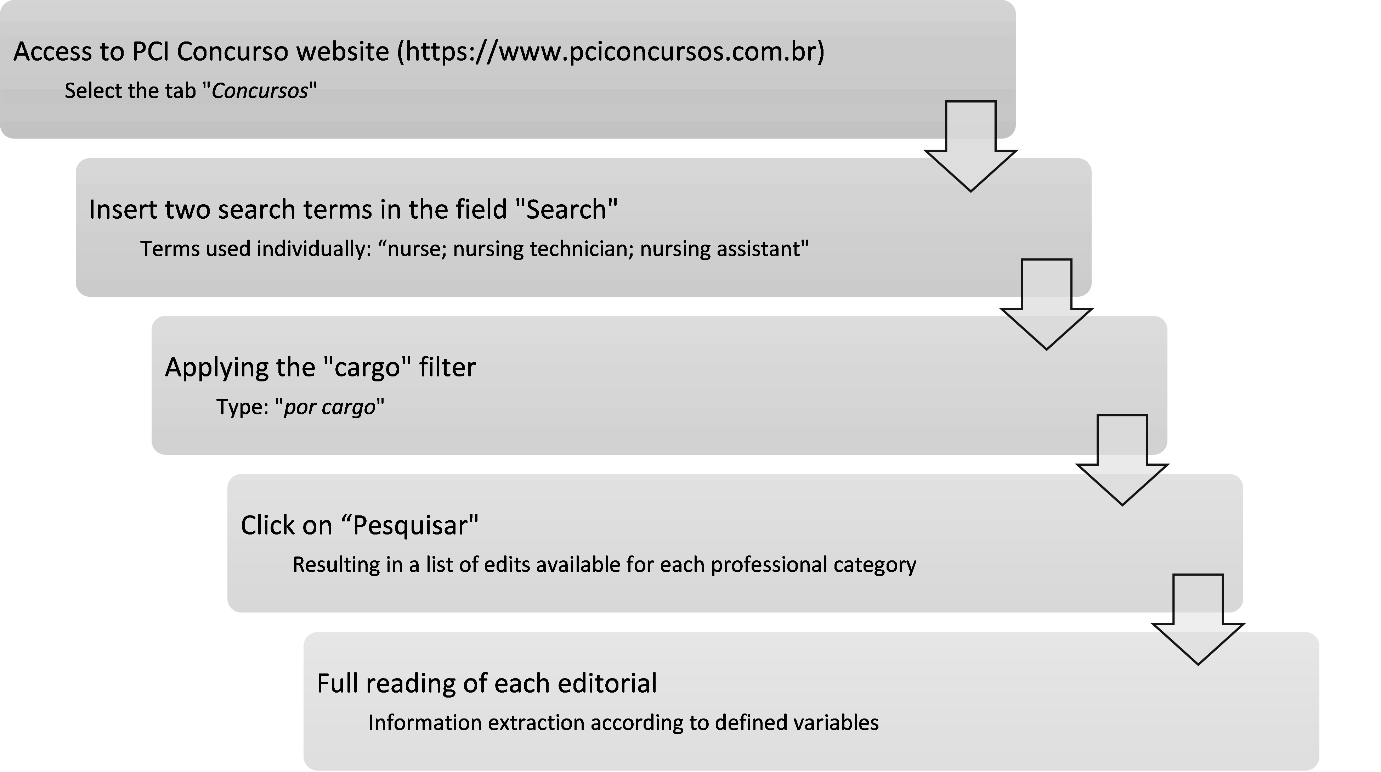
To ensure the traceability of the data collection process, a systematized search procedure was developed for the PCI Concursos website, consisting of standardized sequential steps, as shown in Figure 1.
Source: prepared by the authors 2025.
Figure 1 – Flowchart for accessing data on the PCI Concursos website to identify public tender notices for nursing positions. São Paulo, SP, Brazil, 2024
Initially, the platform's main page was accessed, selecting the search field by professional area. Then, the term "nursing" was used, and filters were applied to delimit the period from January to August 2024. After listing the results, the notices that presented vacancies for nurses, nursing technicians, or nursing assistants were read in full. Duplicate notices, those intended exclusively for teaching, and those with closed registrations at the time of data collection were excluded. The final set was then exported to a spreadsheet, ensuring the consolidation of variables and the traceability of the documentary sources analyzed.
To ensure the reliability of the process, double-checking of the collected information was carried out, with the aim of minimizing registration errors and ensuring the consistency of the analyzed data. It is recognized, however, that the notices may present different levels of detail, which constitutes a potential risk of information bias. The notices that did not present complete information on remuneration, working hours, or type of contract were kept in the analysis of the other available variables, being excluded only from the specific analyses related to the missing information.
The data were processed using the Statistical Package for the Social Sciences (SPSS®) software, version 20.0. Descriptive statistical analysis was performed, with calculation of absolute and relative frequencies and measures of central tendency, in order to identify observable patterns and differences between the variables extracted from the notices. Because it is a census survey, and not a probabilistic sample, inferential analyses were not applied, since the objective of the study was to fully describe the investigated phenomenon.
For the interpretation of the results, the concept of work process, as proposed by Karl Marx, was adopted, which allows us to understand the professional practice of nursing in its historical and social context. From this perspective, the work process is made up of elements such as the workforce, the objectives of the activity, the methods and instruments used, and is analyzed in conjunction with the social relations of production that condition its use, organization and valuation within the health system(26). Thus, the nursing work process may be influenced by factors such as working conditions, social organization of production and forms of work regulation, expressing contradictions between the social centrality of care and the persistent devaluation of the workforce(27). This framework enabled a critical analysis of the composition of the nursing workforce, the modalities of insertion in the public sector and the contradictions that permeate the structure of the job opportunities offered.
Regarding ethical aspects, it is important to note that the PCI Concursos platform is in the public domain with open access. There was no contact with platform users or collection of primary data involving human beings. Therefore, it was not necessary to submit the study to a Research Ethics Committee with Human Beings, in accordance with the guidelines of the National Health Council.
RESULTS
In the period analyzed, corresponding to the month of publication of the notices, it was observed that the month of August concentrated the largest number of vacancies offered, totaling 3,016 (69%) opportunities, followed by July, with 802 (18%).
In total, 4,358 vacancies were identified for nursing professionals to work in public health services. The regional distribution revealed a predominance of the Northeast Region, which concentrated 2,498 (57%) vacancies, followed by the Southeast (769 vacancies; 17%), North (475 vacancies; 11%), South (388 vacancies; 9%) and Midwest (228 vacancies; 5%) regions.
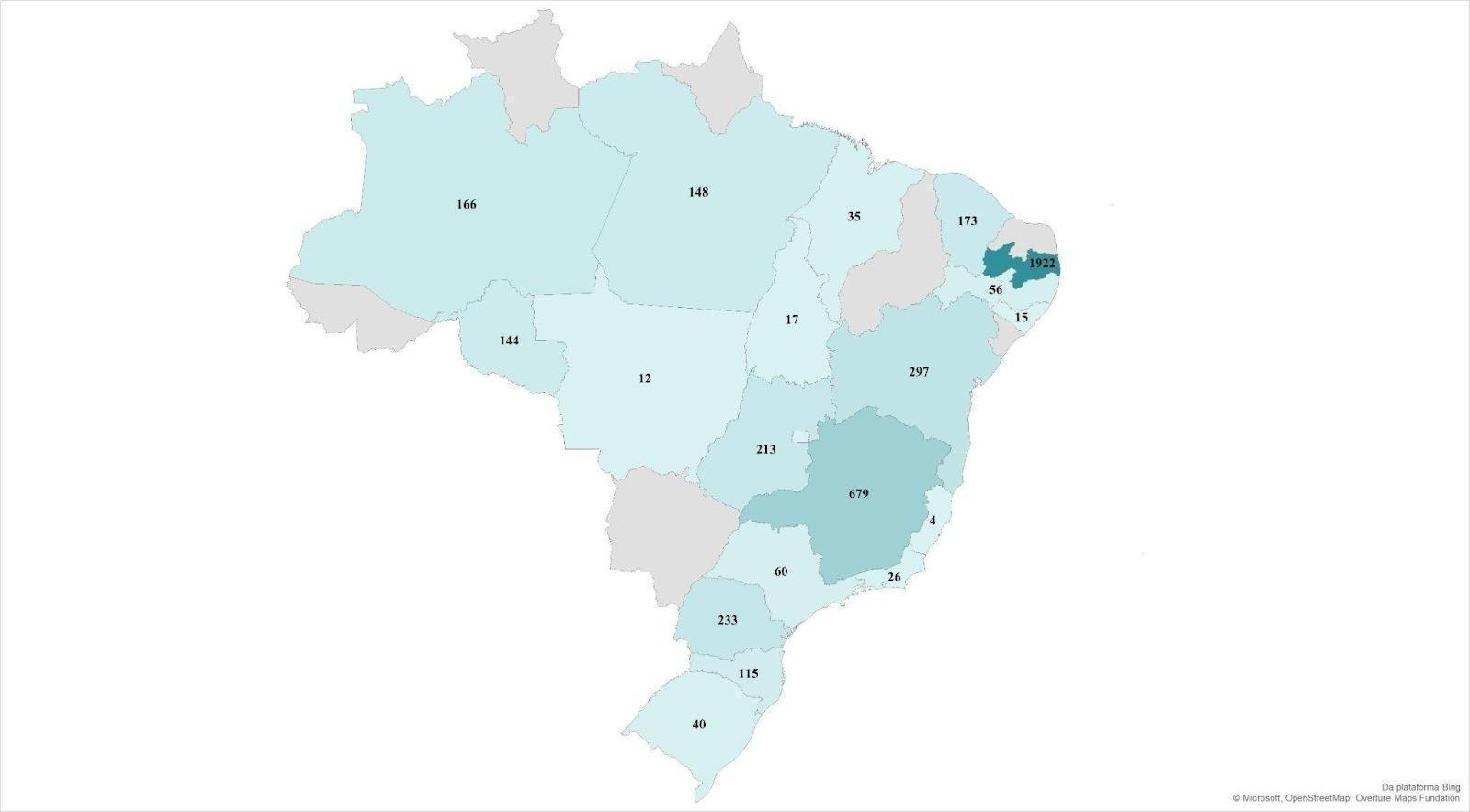
The findings in Figure 2 show the distribution of vacancies by federative units of Brazil.
Source: prepared by the authors, 2025.
Figure 2 - Distribution of the frequency of public job openings for nursing professionals among the federative units. São Paulo, SP, Brazil, 2024
It can be seen from the data presented in Figure 2 that the state of Paraíba concentrated the largest number of vacancies (1,922; 44%), followed by Minas Gerais (679; 15%) and Bahia (297; 7%).
Regarding the nature of the vacancies, it was observed that 2,012 (46%) were intended for the formation of a reserve list, 1,794 (41%) for general competition, 303 (7%) reserved for black, brown and indigenous people and 249 (6%) for people with disabilities.
With regard to the position, it was identified that 2,218 (51%) vacancies were for nurses, 2,093 (48%) for nursing technicians and 47 (1%) for nursing assistants. Specifically, the states of Paraíba (721 vacancies; 34%) and Minas Gerais (407; 19%) concentrated the largest number of vacancies for nursing technicians. For the position of nurse, Paraíba (1,201 vacancies; 54%) and Minas Gerais (237 vacancies; 10%) stood out; and for nursing assistants, Minas Gerais (35 vacancies; 74%) and São Paulo (7 vacancies; 15%).
Regarding the type of selection, the vast majority of vacancies (4,207; 97%) were offered through public competition, while 151 (3%) were through a simplified selection process. The evaluation technique used in all competitions was the objective test (100%).
As for the hiring regime, it was identified that 3,996 vacancies (92%) offered permanent employment, while 362 (8%) provided for temporary hiring. Furthermore, it was found that the nursing assistant position had the highest percentage of vacancies through temporary contracts (12 vacancies; 26%).
Regarding the work schedule, there was a variation between 16 and 44 hours per week, with a predominance for the 40-hour weekly workload (3,759; 86%), followed by 30h (305; 7%) and 44h (84; 2%). As for the employment regime, 2,442 (56%) were for employment governed by the Consolidation of Labor Laws (CLT) and 1,916 (44%) for employment governed by the statutory legal regime.
Regarding professional qualifications, it was found that 1,303 (30%) vacancies required specialization. Of these, 1,125 (86%) were for nurses with post-graduation, 153 (12%) for nursing technicians with post-graduation, and 25 (2%) for nursing assistants with post-graduation. Furthermore, the Northeast Region had the highest percentage of requests for professionals with post-graduation, corresponding to 990 (76%) vacancies.
Table 1 presents information regarding the specialties required in job vacancies for nursing professionals.
Table 1 - Specialties required for nursing positions in public health services (n=1303). São Paulo, SP, Brazil, 2024
|
Required specialty |
number of vacancies |
% |
|
Nurse in adult intensive care unit |
217 |
19% |
|
Nurse in pediatric intensive care unit |
216 |
19% |
|
Nurse in oncology |
201 |
18% |
|
Nurse in surgical center |
107 |
10% |
|
Nurse in family health strategy |
103 |
9% |
|
Obstetric nurse |
78 |
7% |
|
Auditing nurse |
54 |
5% |
|
Nurse in family health strategy - rural area |
28 |
2% |
|
Nurse in psychosocial care |
18 |
2% |
|
Nurse in cardiology |
18 |
2% |
|
Nurse in urgent and emergency care |
17 |
2% |
|
Nurse in mobile emergency care service |
14 |
1% |
|
Occupational health nurse |
12 |
1% |
|
Nurse in hemotherapy |
12 |
1% |
|
Nurse in pediatrics |
7 |
1% |
|
Nurse in neonatology |
5 |
0% |
|
Nurse in emergency care unit |
5 |
0% |
|
Medical-surgical nurse |
5 |
0% |
|
Nurse in mixed health unit |
4 |
0% |
|
Nurse Sanitary |
4 |
0% |
|
Nursing Technician in Mobile Emergency Care Service |
51 |
33% |
|
Nursing Technician in Family Health Strategy |
35 |
23% |
|
Nursing Technician in Mixed Health Unit |
20 |
13% |
|
Nursing Technician in Emergency Care Unit |
20 |
13% |
|
Vaccination Nursing Technician |
8 |
5% |
|
Occupational Health Nursing Technician |
6 |
4% |
|
Nursing Technician in the Penitentiary System |
4 |
3% |
|
Nursing Technician in Psychosocial Care |
2 |
1% |
|
Nursing Technician in Hemotherapy |
2 |
1% |
|
Nursing Technician - Health Services Assistant |
2 |
1% |
|
Oncology Nursing Technician |
1 |
1% |
|
Nursing Technician in Basic Health Unit |
1 |
1% |
|
Nursing Technician in Sanitary Surveillance |
1 |
1% |
|
Nursing Assistant in Family Health Strategy |
25 |
100% |
|
Total number of vacancies |
1.303 |
100% |
Source: prepared by the authors, 2025.
The data in Table 1 revealed a predominance of opportunities for nurses in high-complexity areas, such as adult intensive care units (19%), pediatric intensive care (19%), and oncology (18%), followed by surgical centers (10%) and family health strategy (9%). Among nursing technicians, the greatest demands were concentrated in the Mobile Emergency Care Service (SAMU) (33%) and the Family Health Strategy (FHS) (23%), with mixed units and emergency care units (UPA) also standing out (13% each). For the auxiliary level, all vacancies referred to working in the FHS.
Table 2 presents the distribution of salaries for nursing professionals in the consulted notices.
Table 2 – Distribution of summary measures relating to the salary described in public job postings for nursing professionals (n=4358). São Paulo, SP, Brazil, 2024
|
nº |
Mean- R$ |
SD- R$ |
Min- R$ |
Max- R$ |
|
|
Nurse |
1093 |
4.164,28 |
1.681,41 |
1.412,00 |
10.018,65 |
|
Nurse with post-graduation |
1125 |
4.379,39 |
1.238,27 |
1.713,80 |
9.333,24 |
|
Nursing Assistant |
22 |
1.702,76 |
335,99 |
1.279,49 |
2.429,89 |
|
Nursing Assistant with post-graduation |
25 |
2.200,05 |
868,24 |
1.412,00 |
3.626,48 |
|
Nursing Technician |
1940 |
2.277,79 |
771,72 |
756,00 |
6.128,78 |
|
Nursing Technician with post-graduation |
153 |
2.184,38 |
512,68 |
1.412,00 |
3.923,90 |
Legend: SD – standard deviation; Min – minimum; Max – maximum.
Source: prepared by the authors, 2025.
It was found that the highest average salary was observed among nurses with post-graduation, with R$ 4,379.39 (SD = R$ 1,238.27), followed by generalist nurses (R$ 4,164.28; SD = R$ 1,681.41), nursing technicians (R$ 2,277.79; SD = R$ 771.72) and nursing assistants with post-graduation courses (R$ 2,200.05; SD = R$ 868.24). A wide variation was observed between the minimum and maximum values, possibly associated with regional differences and weekly working hours.
The analysis between salary and compliance with the National Nursing Minimum Wage Law found that the highest proportion of vacancies with salary values above the minimum wage was observed for nurses with post-graduation (93%), followed by generalist nurses (64%). In contrast, both generalist and nursing technician with post-graduation positions offered salaries below the legal minimum wage, at 54% and 80%, respectively. The same pattern was observed for nursing assistants, with 77% of positions below the minimum wage for generalists and 40% for health professionals with post-graduation.
DISCUSSION
The expressive supply of public jobs for health professionals identified in this study testifies to the centrality of this workforce in the provision of essential health services. The presence of nursing at all levels of care and territories of the country gives the profession a sociologically indispensable role in the functioning of the SUS(7). In the light of the Marxist benchmark, such centrality must be understood within the social relations of production, in which healthcare labor constitutes a socially necessary labor force for the reproduction of life and of the productive system itself(26,27). Yet, this essentiality does not translate into institutional valorization, remaining marked by persistent processes of symbolic and material devaluation within state structures(28).
Regarding the regional distribution and nature of the vacancies, concentration was observed in the Northeast Region, especially in the states of Paraíba and Bahia, accompanied by a high proportion of notices with the formation of reserve lists, without guaranteeing immediate hiring. Such a configuration expresses structural inequalities in the allocation of resources and in the administrative capacity of the federative entities, producing asymmetric opportunities between regions.
Data on nursing demographics in Brazil indicate that the Northeast exhibited expressive job growth, especially in primary and tertiary care, reflecting investments in the expansion of primary care and hospital networks. In contrast, the Southeast concentrated the highest absolute number of consolidated employment ties across all levels of care, reflecting greater economic capacity, installed infrastructure and institutional stability(29). This distinction contributes to understanding the asymmetry observed in this study, since the public notices express the intention to fill vacancies, while administrative bases, such as RAIS and CNES, portray the actual establishment of employment ties, indicating that the expansion of the potential supply does not necessarily translate into consolidated labor absorption.
The quantitative growth of the labor force, meanwhile, does not eliminate the structural contradictions of health work, while it does not necessarily imply improvement of working conditions or proportional valuation of the employed labor force. As warned by the World Health Organization (WHO), imbalances in the distribution of the workforce compromise access to essential services and hinder progress towards universal coverage and health equity(30).
The diversity of hiring regimes identified in our analyzed contests confirms the persistence of strategies of flexibility and fragmentation of professional insertion in public nursing. The coexistence of statutory, CLT-based, temporary and outsourced employment ties contributes to the erosion of workers' rights, legal insecurity and turnover, compromising continuity of care and consolidation of institutional bonds(6,13). The intensification of workloads, associated with the expansion of temporary contracts and outsourcing, deepens precarization processes, with impacts on job security, career planning and the social reproduction of the workforce, with negative repercussions on the health of professionals and the quality of care(29).
In the macrostructural plane, the expansion of the private sector in health, driven by financialization processes enabled by Law No. 13,097/2015(31), contrasts with the scenario of the public sector, marked by budgetary restrictions stemming from Constitutional Amendment No. 95/2016(32). This asymmetry favors public provision adjustment strategies, such as the recurring use of reserve lists and non-permanent employment ties, reinforcing dynamics of flexibilization and proletarianization of nursing labor, deepening the risks of widening inequalities in access to and quality of healthcare.
The recent qualitative study conducted in a public reference hospital in Pernambuco corroborates these findings by showing that the expansion of flexible forms of hiring in the SUS has been used to meet care demands without a corresponding expansion of permanent employment ties. In 2021, more than 70% of nurses were working under precarious employment relationships, associated with job insecurity, work intensification, and wage devaluation(33). Such results reinforce that the predominance of reserve cadres and heterogeneous contractual regimes observed in this study integrates a structural pattern of workforce management in health.
Contemporary transformations in the world of work profoundly impacted healthcare work processes, redefining relationships, rights and professional trajectories. The consolidation of the neoliberal state, from the 1990s, associated with the targeting and selectivity of services, was accompanied by substantive changes in hiring arrangements, with emphasis on the expansion of flexible employment ties and the growth of outsourcing(34). In this context, the replacement of stable employment ties by precarious forms configures the strategy historically used as a mechanism of control of the working class, contributing to wage reduction and the violation of collective organization(35).
Regarding equity policies, the results highlight the presence of vacancies reserved for black, brown and indigenous people and for people with disabilities, in accordance with current legislation(36). However, the reservation of 20% of the positions for Black people is not always effectively realized, due to the segmentation of positions and the absence of control mechanisms that ensure proportional convocation at all stages of the selection processes, limiting their transformative potential(37).
Although there is increasing participation of black people in nursing, especially among technicians and assistants, higher-level positions remain predominantly occupied by white people(38,39). This unequal distribution highlights structural barriers to career advancement and the need for intersectional policies that articulate affirmative action, institutional shifts, and a review of both training and labor management processes. The increase in the number of professionals with disabilities indicates advances in inclusion, even though these workers remain minorities, reinforcing the need for expanding accessibility policies and inclusive work environments(37).
The systematic incorporation of sociodemographic attributes, such as sex, gender, age and race/ethnicity, is fundamental for more in-depth analyzes of the healthcare workforce and for the planning of specific public policies. In the Brazilian context, the persistence of structural inequalities marked by gender, race, and class requires the confrontation of historical patterns of subordination that traverse the world of health work(40).
Census evidence indicates that, in 2010, the majority of nursing professionals self-reported white (54.3%), while blacks and browns presented more accentuated socioeconomic disadvantages(40). Recent data reveals proportional reduction in white professionals and consistent growth in the participation of black professionals, despite the high incompleteness of race/ethnicity information in national administrative records, especially in RAIS(29).
Analysis of the distribution of positions revealed internal segmentation of the workforce, with a predominance of vacancies for nurses and technicians and a residual supply for assistants. National data shows a continued reduction in the nursing assistant contingent, particularly in the South and Midwest regions, indicating a gradual reconfiguration of the occupational composition of the nursing workforce(29). Such a process is reinforced by public regulations and policies that stimulate the internal transition of the workforce, such as Cofen Resolution No. 683/2021(41) and Pronatec, established by Law No. 12,513 of October 26, 2011(42). While such initiatives broaden opportunities for career advancement and upskilling, they also operate as internal workforce adjustment mechanisms.
There is, however, a growing need for specific skills, especially in high-complexity areas and in pre-hospital and primary care services, such as SAMU and the FHS. This trend is articulated to the overqualification of Brazilian nursing, in which nursing technicians and nursing assistants invest in additional training as a strategy of insertion and persistence in the market(43), shifting onto the worker the costs of professional qualification and reinforcing processes of individual responsibilization typical of neoliberal contexts(44).
The recent centrality of specialized care on the government agenda has increased the demand for skilled professionals in SUS. Consequently, a significant portion of this labor force has been incorporated through intermediated and precarious employment bonds, while the formation, distribution and placement of health professionals with post-graduation remains subordinate to market logic, highlighting the need for labor regimes and career structures compatible with the principles of the SUS(45).
Finally, the comparison of the observed salary values in the notices with the parameters defined by Law No. 14,434/2022(23) revealed unequal implementation of the national nursing salary floor between categories and regions. The greatest distortions were concentrated among technicians and assistants, whose salaries remained below the legal minimum, even when specialization was required.
Data from the Novo CAGED show that processes of wage devaluation precede the analyzed period, with stagnation or reduction of average remuneration between 2010 and 2019, especially among nursing assistants and technicians, associated with the retraction of statutory employment ties and the expansion of less favorable contractual arrangements(29). Thus, while the analysis focuses on the post-implementation period of the floor, the challenges to its implementation reflect the continuity of previously established structural trends.
The reliance on complementary financial assistance from the Union, coupled with its subjection to budgetary cycles, reinforces the structural fragility of the valuation policy and may undermine its effectiveness as an instrument of equity and recognition of the nursing workforce. From this perspective, the findings reveal persistent contradictions between the social centrality of nursing work and its material devaluation in public employment.
Limitations and implications of the study for advancement and the area of health and nursing
As a limitation, it is highlighted that the data analyzed is restricted to public tender notices published between January and August 2024, neither covering the full range of opportunities offered throughout the year nor allowing for tracking the temporal evolution of hiring. Such a time frame, although restrictive, is justified by the political-administrative context of 2024, an election year in which Law No. 9,504/1997 establishes restrictions on the hiring and appointment of civil servants in the three months preceding the election, resulting, historically, in a reduction in the publication of public competitive examinations in the second semester. Thus, the delimitation to the pre-election period made it possible to capture, with greater fidelity, the volume of notices published before these legal limitations.
In addition, the use of a single source may not fully encompass all public competitions held during this period, especially those disclosed exclusively in official journals or institutional portals. The absence of comparative data from periods preceding the implementation of the nursing wage floor limits the assessment of longitudinal changes directly attributable to Law No. 14,434/2022, setting up an important agenda for future research.
Despite these limitations, this study offers relevant contributions to the advancement of knowledge about the public nursing labor market in Brazil. By articulating empirical data with a critical interpretation, the study highlights regional, contractual, and wage inequalities that traverse the nursing workforce. Its findings support professional management and valorization strategies, providing evidence for workforce planning, the improvement of equity and inclusion policies, and the strengthening of provision and financing mechanisms for health work, and may guide managers, researchers, and policymakers in building integrated actions aimed at stability, labor justice, and the improvement of working conditions in the SUS.
CONCLUSION
The present study allowed characterizing the regional, contractual and salary configuration of public employment opportunities for nursing professionals in Brazil in 2024. The period following the implementation of the salary floor made it possible to observe not only the formal incorporation of this policy in the notices, but also the contradictions between legal regulation and its concrete implementation in the provision of public nursing positions. These findings indicate inequalities in the distribution of vacancies between regions, in the modes of employment bond and in the salary values offered, with greater disparity between nursing technicians and nursing assistants in relation to the national salary floor for the category.
The co-existence of multiple hiring regimes and the predominance of temporary employment bonds and reserve lists were verified, highlighting structural weaknesses in the management of the health workforce. Specialization requirements and remuneration differences between positions and regions reveal the persistence of a segmented market, marked by valuation asymmetries and heterogeneous labor insertion conditions. Such evidence reinforces the need for integrated nursing workforce planning and management strategies geared toward equity, stability, and professional enhancement.
The contributions of this study lie in offering a national, systematic and census view of public employment opportunities for nursing professionals, addressing relevant gaps in the literature on provision and conditions of job placement in the public sector. By highlighting regional, contractual and salary-related patterns little explored in previous research, the study provides subsidies for strengthening vocational development policies and for workforce planning within the SUS.
Furthermore, integrating documentary analysis with a critical perspective on the labor process expands understanding of the dynamics that structure the labor market of nurses and the inequalities they face, reinforcing the importance of systematic monitoring as a strategic tool for the management, regulation and evaluation of labor and employment policies in nursing in the SUS.
CONFLICT OF INTERESTS
The authors have declared that there is no conflict of interests.
FUNDING
This study was financed in part by the Coordenação de Aperfeiçoamento de Pessoal de Nível Superior - Brasil (CAPES) - Finance Code 001.
REFERENCES
1. World Health Organization. Health workforce. Geneva: WHO; 2024 [cited 2025 Jan 18]. Available from: https://www.who.int/teams/health-workforce/about.
2. Organización Panamericana de la Salud. La situación de la enfermería en la Región de las Américas: informe final del Foro Regional para el Avance de la Enfermería en América Latina (8 y 9 de septiembre del 2022) [Internet]. Washington: OPAS; 2023 [cited 2025 Jan 18]. Available from: https://iris.paho.org/handle/10665.2/57220.
3. Conselho Federal de Enfermagem (BR). Enfermagem em números [Internet]. Brasília: Cofen; 2025 [cited 2025 May 13]. Available from: https://descentralizacao.cofen.gov.br/sistema_SC/grid_resumo_quantitativo_profissional_externo/grid_resumo_quantitativo_profissional_externo.php.
4. Mendes M, Martins M da S, Acordi I, Ramos FRS, Brehmer LC de F, Pires DEP. Nursing workforce: scenario and trends. Rev Enferm UFSM. 2022;12:e11. https://doi.org/10.5902/2179769267928.
5. Oliveira APC, Mion ABZ, Galante ML, Donato G, Ventura CAA. Stock, composition and distribution of the nursing workforce in Brazil: a snapshot. Rev Lat Am Enfermagem. 2024;32:e4287. https://doi.org/10.1590/1518-8345.6937.4287. PMID: 39230131.
6. Pereira Á AC, Cunha CLF, Alvarenga EC, Lemos M, Bastos M do SCB de O, Silva KL, et al. Precarization of nurses’ work: an analysis in the Brazilian Primary Health Care. Trab Educ Saúde. 2023;21:e02311227. https://doi.org/10.1590/1981-7746-ojs2311.
7. Silva MCN, Machado MH. Health and Work System: challenges for the Nursing in Brazil. Cien Saude Colet. 2020;25(1):7-13. https://doi.org/10.1590/1413-81232020251.27572019. PMID: 31859850.
8. World Health Organization. Labour market analysis guidebook. Geneva: WHO; 2021 [cited 2025 mar 07]. Available from: https://www.who.int/publications/i/item/9789240035546.
9. Varella TC, Pierantoni CR. Labor market: reviewing concepts and bringing the health field together. A view on the 1990's. Physis. 2008;18(3):521-44. https://doi.org/10.1590/s0103-73312008000300009.
10. Machado MH, Wermelinger M, Machado AV, Vargas FL, Pereira EJ, Aguiar Filho W. Perfil e condições de trabalho dos profissionais da saúde em tempos de covid-19: a realidade brasileira. In: Portela MC, Reis LGC, Lima SML, editores. Covid-19: desafios para a organização e repercussões nos sistemas e serviços de saúde [Internet]. Rio de Janeiro: Observatório Covid-19 Fiocruz, Editora Fiocruz; 2022 [cited 2025 Jan 18]. p. 283–95. Available from: https://books.scielo.org/id/kymhj/pdf/portela-9786557081587-21.pdf.
11. Ministério da Saúde (BR); Centro Nacional de Informações do Trabalho na Saúde. Força de Trabalho na Saúde [Internet]. Brasília: Ministério da Saúde; 2025 [cited 2025 Jul 09]. Available from: https://cenits.saude.gov.br/painel-fts/.
12. Machado MH, Oliveira E de, Lemos W, Lacerda WF de, Aguiar Filho W, Mônica Wermelinger M, et al. Mercado de trabalho da enfermagem: aspectos gerais. Enferm Foco. 2016;7(Esp):35–53. https://dx.doi.org/10.21675/2357-707X.2016.v7.nESP.691
13. Oliveira JSA, Pires DEP, Alvarez  M, Sena RR, Medeiros SM, Andrade SR. Trends in the job market of nurses in the view of managers. Rev Bras Enferm. 2018;71(1):148-55. https://doi.org/10.1590/0034-7167-2016-0103. PMID: 29324957.
14. Silva DA, Marcolan JF. Desempleo y sufrimiento psíquico en enfermeras. Rev Bras Enferm. 2015;68(5):775-782. https://doi.org/10.1590/0034-7167.2015680502i.
15. Farias SNP, Souza NVD de O, Varella TCM y ML, Andrade KBS, Soares SSS, Carvalho EC. Pejotização and implications for nursing work in Brazil: repercussions of neoliberalism. Rev Esc Enferm USP. 2023;57:e20220396. https://doi.org/10.1590/1980-220X-REEUSP-2022-0396en. PMID: 37285577.
16. Krein JD, Colombi APF. Labor law reform in focus: deconstruction of social protection in times of authoritarian neoliberalism. Educ. Soc. 2019;40:e0223441. https://doi.org/10.1590/es0101-73302019223441.
17. Ministério da Saúde (BR). Relatório do Grupo de Trabalho de Práticas em Enfermagem no Brasil [Internet]. Brasília: Ministério da Saúde; 2024 [cited 2025 May 15]. Available from: https://cenits.saude.gov.br/wp-content/uploads/2025/03/Relatorio_praticas_em_enfermagem_2024.pdf.
18. Barbosa NB. Regulação do trabalho no contexto das novas relações público versus privado na saúde. Cien Saude Colet. 2010;15(5):2497-506. https://doi.org/10.1590/s1413-81232010000500024. PMID: 20802882.
19. Díaz MRH, Morales ZBS, Monroy AMV, Prieto ASC. Young nurses' perceptions about their employment, working and health conditions. Rev Lat Am Enfermagem. 2024;32:e4335. https://doi.org/10.1590/1518-8345.7398.4335. PMID: 39319891.
20. Zanatti GLM. Accediendo a distintas formas de candidatura: un análisis sobre los usos de plataformas digitales para buscar empleo [dissertação de mestrado na internet]. Pelotas: Universidade Federal de Pelotas; 2022 [cited 2025 Jul 11]. Available from: https://guaiaca.ufpel.edu.br/bitstream/handle/prefix/8269/Dissertacao_Gabriel_Loret_de_Mola.pdf?sequence=1&isAllowed=y.
21. Melo BCC de, Bezerra KA, Oliveira JSA de, Valença CN, Santos TA dos, Medeiros SM de. Llamadas para contratación de enfermeros(as) en tiempos de coronavirus. Enf Global. 2022;21(2):567-93. https://doi.org/10.6018/eglobal.495541.
22. Gobato BC, Cechinel-Peiter C, Kassick F, Lanzoni GM de M. Mercado de trabalho para enfermeiros no Brasil: um estudo baseado nas vagas disponíveis no LinkedIn®. Rev Baiana Enferm. 2024;38:e50910. https://doi.org/10.18471/rbe.v38.50910.
23. Brasil. Lei nº 14.434, de 4 de agosto de 2022. Institui o piso salarial nacional do enfermeiro, do técnico de enfermagem, do auxiliar de enfermagem e da parteira [Internet]. Brasília: Presidência da República; 2022 [cited 2025 Jan 11]. Available from: https://legislacao.presidencia.gov.br/atos/?tipo=LEI&numero=14434&ano=2022&ato=bd1ETWU5kMZpWT482.
24. Ministério da Saúde (BR). Cartilha piso nacional da enfermagem: veja como funciona o pagamento [Internet]. 2. ed. Brasília: Ministério da Saúde; 2024 [cited 2025 Jan 11]. Available from: https://www.gov.br/saude/pt-br/centrais-de-conteudo/publicacoes/cartilhas/2023/piso-da-enfermagem-2a-edicao-pdf/view.
25. Brasil. Lei nº 9.504, de 30 de setembro de 1997. Estabelece normas para as eleições [Internet]. Brasília: Presidência da República; 1997 [cited 2025 Jul 11]. Available from: https://www.planalto.gov.br/ccivil_03/leis/l9504.htm.
26. Marx K. O capital: edição condensada. São Paulo: Édipro; 2019.
27. Ventura-Silva JMA, Martins MMFPS, Trindade LL, Ribeiro O, Ribeiro MIB, Cardoso MFPT. O processo de trabalho dos enfermeiros especialistas em Enfermagem de Reabilitação numa ótica marxista. Rev Port Enf Reab. 2021;4(2):72-80. https://doi.org/10.33194/rper.2021.73.
28. Centenaro APFC, Andrade A de, Franco GP, Spagnolo LM de L, Cardoso LS, Costa MC da, et al. Working conditions in COVID-19 hospital units: perceptions of nursing workers. Rev Gaúcha Enferm. 2023;44:e20220007. https://doi.org/10.1590/1983-1447.2023.20220007.en. PMID: 37283429.
29. Ministério da Saúde (BR). Demografia e mercado de trabalho em enfermagem no Brasil [Internet]. Brasília: Ministério da Saúde; 2025 [cited 2025 Jul 11]. Available from: https://bvsms.saude.gov.br/bvs/publicacoes/demografia_enfermagem_mercado_trabalho_v1.pdf.
30. Lana FCF, Araujo LHL de, Vieira ACT, Rodrigues PLC. Nota Técnica: Análise de Recursos Humanos de Enfermagem no Brasil por níveis de atenção à saúde nas regiões e estados brasileiros (2017-2022) [Internet]. Rio de Janeiro: IMS-UERJ; 2025 [2025 Dec 28]. Available from: https://zenodo.org/records/15373827.
31. Brasil. Lei nº 13.097, de 19 de janeiro de 2015. Reduz a zero as alíquotas da Contribuição para o PIS/PASEP, da COFINS […] [Internet]. Brasília: Presidência da República; 2015 [cited 2025 Dec 28]. Available from: https://www.planalto.gov.br/ccivil_03/_ato2015-2018/2015/lei/l13097.htm.
32. Brasil. Emenda constitucional nº 95, de 15 de dezembro de 2016. Altera o Ato das Disposições Constitucionais Transitórias, para instituir o Novo Regime Fiscal, e dá outras providências [Internet]. Brasília: Presidência da República; 2016 [cited 2025 Dec 28]. Available from: https://www.planalto.gov.br/ccivil_03/constituicao/emendas/emc/emc95.htm.
33. Pereira TM, Oliveira RS, Morais HMM, Cunha EM. Expressões da precarização do trabalho: o caso da enfermagem em um hospital público de Pernambuco. Saúde debate. 2025;49(145):e9816. https://doi.org/10.1590/2358-289820251459816p.
34. Sodré F. Trabalhar na saúde: ensaio sobre a terceirização de assistentes sociais em serviços de saúde pública. Serv. Soc. Soc. 2025;148(1):e–6628449. https://doi.org/10.1590/0101-6628.449.
35. Granemann S. Quando o capital vai às compras: direitos sociais, privatização e a acumulação capitalista. Rev Linhas. 2020;21(46):50-71. https://doi.org/10.5965/1984723821462020050.
36. Brasil. Lei nº 12.990, de 9 de junho de 2014. Reserva aos negros 20% (vinte por cento) das vagas oferecidas nos concursos públicos […] [Internet]. Brasília: Presidência da República; 2014 [cited 2025 Jul 28]. Available from: https://www.planalto.gov.br/ccivil_03/_ato2011-2014/2014/lei/l12990.htm.
37. Arruda DO, Bulhões LMG, Santos CO. The racial quota policy in public tenders: challenges in the face of the anti-racist struggle. Serv Soc Soc. 2022;(145):91–111. https://doi.org/10.1590/0101-6628.294.
38. Oliveira JSA de, Rodrigues PLC, Tavares G de O, Pereira WC, Guedes S da S. Descrição e análise do mercado de trabalho para enfermeiros, técnicos e auxiliares de enfermagem no Brasil: RAIS, CAGED e NOVO CAGED [Internet]. Rio de Janeiro: IMS-UERJ; 2025 [2025 Jul 28]. Available from: https://zenodo.org/records/15587512.
39. Rafael RMR, Marinho GL, Costa DOF. Nota Técnica: Perfil demográfico dos postos de trabalho ocupados pela equipe de Enfermagem (2010–2021) [Internet]. Rio de Janeiro: IMS/UERJ; 2025 [cited 2025 Jul 18]. Available from: https://zenodo.org/records/14834401.
40. Marinho GL, Oliveira BLCA, Cunha CLF, Tavares FG, Paz EPA. Nursing in Brazil: socioeconomic analysis with a focus on the racial composition. Rev Bras Enferm. 2021;75(2):e20201370. https://doi.org/10.1590/0034-7167-2020-1370. PMID: 34705990.
41. Conselho Federal de Enfermagem (BR). Resolução COFEN nº 683/2021, de 29 de setembro de 2021. Define os critérios para o registro profissional dos Técnicos de Enfermagem, titulados por Instituição, na modalidade "Certificação Profissional por Competência" e dá outras providências [Internet]. Brasília: Cofen; 2021 [cited 2025 Aug 14]. Available from: https://www.cofen.gov.br/resolucao-cofen-no-683-2021/.
42. Brasil. Lei nº 12.513, de 26 de outubro de 2011. Institui o Programa Nacional de Acesso ao Ensino Técnico e Emprego (Pronatec); altera as Leis no 7.998, de 11 de janeiro de 1990 […] [Internet]. Brasília: Presidência da República; 2011 [cited 2025 Dec 28]. Available from: https://www.cofen.gov.br/wp-content/uploads/2015/12/PRONATEC.pdf.
43. Wermelinger MC de MW, Boanafina A, Machado MH, Vieira M, Ximenes Neto FRG, Lacerda WF de. Nursing technician training: qualification profile. Cienc Saude Coletiva. 2020;25(1):67–78. https://doi.org/10.1590/1413-81232020251.27652019. PMID: 31859856.
44. Angeli-Silva L, Santos HS, Melaragno ALP. Nota Técnica: Desenvolvimento das especialidades em Enfermagem no Brasil: pressupostos para um estudo demográfico [Internet]. IMS-UERJ: Rio de Janeiro; 2025 [cited 2025 Aug 14]. Available from: https://zenodo.org/records/15344905.
45. Miranda AS, Costa AM, Rizzotto MLF, Lobato L de VC. Programa Mais Especialistas: contextos e expectativas. Saúde debate. 2025;49(146):e146ED. https://doi.org/10.1590/2358-28982025146ed-p.
Submission: 30-Nov-2025
Rosimere Ferreira Santana (ORCID: 0000-0002-4593-3715)
Geilsa Soraia Cavalcanti Valente (ORCID: 0000-0003-4488-4912)
Katerine Moraes dos Santos (ORCID: 0000-0002-2064-5207)
Corresponding author: Hercules Carmo (hercules.enf@usp.br)
Publisher:
Escola de Enfermagem Aurora de Afonso Costa – UFF
Rua Dr. Celestino, 74 – Centro, CEP: 24020-091 – Niterói, RJ, Brazil
Journal email: objn.cme@id.uff.br
