
Imagem 1


ORIGINAL ARTICLE


PROFILE OF SOFTWARE/APPLICATION PRODUCTS DEVELOPED IN STRICTO SENSU GRADUATE NURSING PROGRAMS: CROSS-SECTIONAL STUDY


Sara Soares Ferreira da Silva1, Danielle Galdino de Paula1, Inês Maria Meneses dos Santos1, Gisella de Carvalho Queluci1


1 Federal University of the State of Rio de Janeiro, RJ, Brazil


ABSTRACT

Objective: To analyze the profile of software and application products created in stricto sensu Graduate Nursing Programs in the biennium 2021-2022. Method: This is a descriptive study with a quantitative approach. Primary data made available by the Coordination for the Improvement of Higher Education Personnel categorized as belonging to the basic area of Nursing and registered in 2021 and 2022 were used. A total of 75 software/application products were included and analyzed according to consolidated criteria of technical/technological products. Bivariate analysis was performed using Fisher’s exact test, adopting a p value below 0.05. Results: The profile evidenced was of products developed in public institutions, located in the Southeast region, and within master’s programs. Moreover, among the 16 identified target areas, pediatrics, management, and primary health care stood out. Patients, nurses, and the multidisciplinary team were the main target audience. The products were mostly classified as highly innovative, with real impact and high complexity. Conclusion: Stricto sensu graduate nursing programs foster the creation of software and applications with thematic variability and a diverse target audience. The findings highlighted the great potential of nursing and public education for technological development aimed at improving health care delivery.


Descriptors: Nursing Graduate Education; Scientific Research and Technological Development; Nursing.


How to cite: Silva SSF, Paula DG, Santos IMM, Queluci GC. Profile of software/application products developed in stricto sensu Graduate Nursing Programs: cross-sectional study. Online Braz J Nurs. 2025;24(Suppl 2):e20256855. https://doi.org/10.17665/1676-4285.20256855   


INTRODUCTION

Stricto sensu Graduate Nursing Programs (Programas de Pós-Graduação, PPG) have shown significant growth over the past decades(1). In the pursuit of strengthening the scope of nursing practice and the educational quality of these professionals, such programs have been responsible for numerous intellectual productions and, more recently, for productions referred to as technical or technological products(2).  

With the advent of professional stricto sensu graduate programs, horizons have expanded regarding research objects, since these programs aim to produce scientific, technological, and innovative knowledge through the creation of products or processes applicable in practice with the potential for institutional improvements(3).

Within this context, the Coordination for the Improvement of Higher Education Personnel (CAPES) defines several categories of productions, in addition to criteria used to classify a product as technical or technological(4).

Among these products, the software/application category has gained great relevance(5-6), consisting of a set of instructions to be used by a computer in order to obtain a specific result, developed in some programming language(7).

In view of this, Nursing has been a leading field in creating various software/application products intended for use in care, management, or educational practice settings(8).

Considering the above, this study aims to analyze the profile of software and application products created in stricto sensu Graduate Nursing Programs in the biennium 2021-2022.


METHOD

This is a descriptive study with a quantitative approach conducted using secondary data provided by the CAPES through the database entitled “2021 to 2024 Details of Technical Intellectual Production of Stricto Sensu Graduate Programs in Brazil” under the subarea named “Years 2021 and 2022 - Subtype Application Development”. For the evaluation of variables, the data dictionary available on the database access platform was used(9).

The study comprised the collection entitled Technical Production and the subtype Application Development. The data refer to productions registered in the Sucupira platform from 2021 to 2022. This temporal delimitation was defined based on the unavailability of complete data for 2023 and 2024, which led to the decision to use consolidated and available data corresponding to the years 2021 and 2022.

Products developed by stricto sensu Graduate Programs categorized as belonging to the Nursing evaluation area were included(9). Conversely, products with missing information regarding the product’s purpose were excluded. Figure 1 below illustrates the selection process of software/application products.
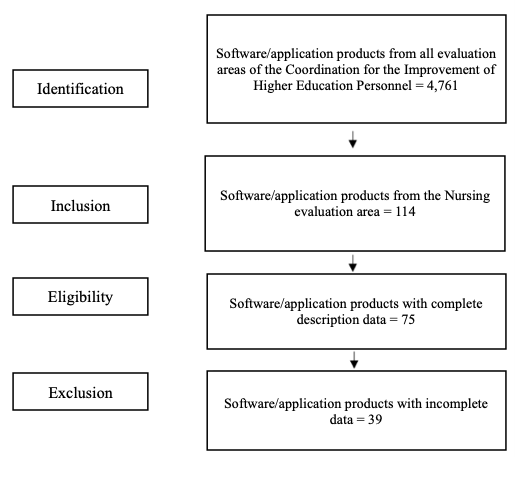
 

Figura2

Figure 1 - Flowchart of the selection and exclusion process of software/application products produced by stricto sensu Graduate Programs in the years 2021 and 2022


Based on the product description provided in the database, categorizations were performed regarding the knowledge area to which the application was directed. This process involved two judges, with a third judge deciding in cases of disagreement. The categorization was carried out based on keywords and according to knowledge areas relevant to Nursing, that is, those within the scope of Nursing practice(10).

A total of sixteen categories emerged from this process. Data were tabulated in an Excel spreadsheet and analyzed for duplication and completeness. Statistical analysis was conducted using Rcmdr version 4.3.3.

Descriptive and inferential statistical methods were applied. Fisher’s exact test was employed, with statistical significance considered for p values below 0.05.

This study uses secondary data publicly available; therefore, approval by a Research Ethics Committee was not required, in accordance with resolution number 466/2012.


RESULTS

A total of 75 software/application products produced by stricto sensu Graduate Nursing Programs were analyzed. The profile predominantly consisted of products developed in public higher education institutions (IES) in the Southeast region of Brazil and within master’s programs, with the main funding source being the universities linked to the research projects themselves. Table 1 details these findings.


Table 1 - Profile of software/application products produced by stricto sensu Graduate Nursing Programs in the years 2021-2022. Rio de Janeiro, RJ, Brazil, 2024

Variable

n (75)

%

Year of production


2021

44

58.7

2022

31

41.3

Nature of IES*


Public

67

89.3

Community

6

8.0

Private

2

2.7

Brazilian region of IES


North

2

2.7

Northeast

5

6.7

Center-West

3

4.0

Southeast

50

66.6

South

15

20.0

Graduate Program


Master’s

74

98.7

Doctorate

1

1.3

Nature of Graduate Program


Academic

39

52.0

Professional

36

48.0

Type of funding


University

32

42.6

Self-funding

27

36.0

National research funding institutions

13

17.5

Public-private partnership

1

1.3

Charitable organization

1

1.3

University and government entity

1

1.3

Availability for use


Restricted

38

50.7

Unrestricted

37

49.3

*IES – Higher Education Institution


A total of sixteen knowledge area categories to which the software was directed, nine product objective categories, and ten target audience categories were identified. Regarding the knowledge area, Pediatrics stood out, followed by Management and Primary Health Care. Concerning the target audience, patients, nurses, and the multidisciplinary team predominated. Table 2 shows these findings.


Table 2 - Themes and target audience of software/applications produced by stricto sensu Graduate Nursing Programs in the years 2021-2022. Rio de Janeiro, RJ, Brazil, 2024

Variable

n (75)

%

Knowledge area of software


Pediatrics

16

21.3

Health Management

10

13.3

Primary Health Care

9

12.0

Nursing Process/SAE*

6

8.0

Women’s Health

6

8.0

Patient Safety

5

6.7

Health Education

5

6.7

Perioperative Care

4

5.4

Mental Health

3

4.0

Emergency/Urgency

3

4.0

Gerontology

2

2.7

Home Care

2

2.7

Cardiology

1

1.3

Stomatherapy

1

1.3

Pharmacology

1

1.3

Renal Replacement Therapy

1

1.3

Target audience of software


Patients/Health service users

22

29.3

Nurses

15

20.1

Multidisciplinary Team

10

13.4

Caregivers

8

10.6

Managers

6

8.2

Patients and Caregivers

4

5.3

Patients and Health Professionals

2

2.6

Faculty

2

2.6

Students

1

1.3

Prescribers

1

1.3

Missing

4

5.3

Software objective


Health Education

26

34.7

Decision-making Support

18

24.0

Process Optimization

8

10.7

Telemonitoring

6

8.0

Health Surveillance

1

1.3

Process Computerization

7

9.3

Quality of Life Improvement

3

4.0

Treatment Adherence Improvement

1

1.3

Instructional

5

6.7

*SAE – Systematization of Nursing Assistance


CAPES has criteria for classifying technical and technological products developed in graduate programs: 1) impact; 2) innovative content; 3) complexity; and 4) applicability. Figure 2 shows the profile of software/applications according to these criteria(4). It is important to highlight that not all products presented these criteria, and the Applicability criterion was not included in the data collection instrument designed by CAPES.
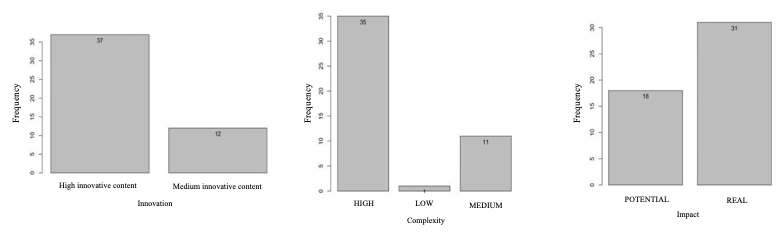
 

Figura1

Figure 2 - Criteria established by the Coordination for the Improvement of Higher Education Personnel (CAPES) for software/applications from stricto sensu Graduate Nursing Programs


Bivariate analysis did not reveal different distributions among the variables. These associations are shown below in Table 3.


Table 3 - Frequency distribution and bivariate analysis of software knowledge area and CAPES technical/technological product criteria. Rio de Janeiro, RJ, Brazil, 2024

Imagem 3

*Fisher’s exact test; †PHC: Primary Health Care; ‡SAE/PE: Systematization of Nursing Assistance and Nursing Process.

 

DISCUSSION

This study analyzed the profile of 75 software/application products created in stricto sensu graduate nursing programs during the biennium 2021-2022.

Software development by nurses has gained prominence as a production of graduate programs(8). A study conducted with Nursing PPGs in the southern region of the country showed that 19% of productions were software, a significant figure given that CAPES classifies over 20 distinct product types(4-5).

The study revealed that the majority of PPGs are located in the Southeast Region of Brazil (n=50; 66.6%) and belong to public Higher Education Institutions (IES) (n=67; 89.3%). This finding is corroborated by a study(6) on Brazilian nursing master’s and doctoral programs showing that the Southeast Region holds 65.3% of analyzed stricto sensu programs. Additionally, literature points out that public institutions are the main educational institutions for professional and academic master’s programs(11).  

In relation to the modes of stricto sensu PPGs attended by nurses, the literature shows that the academic master’s has a higher number of programs compared to the professional master’s(2). Although the professional master’s emphasizes creating a technical/technological product with practical application, this does not preclude academic master’s programs from doing so, justifying the greater representation of academic master’s in this study.

Concerning funding of these products, most received support from the IES itself (42.6%) through research scholarships and funding calls, followed by products that did not receive any form of funding (32%). An integrative review on the funding profile of Brazilian graduate research projects over ten years (2009 to 2019) indicated that most funding came from the National Council for Scientific and Technological Development (CNPq) and CAPES, contrasting with the findings of this study(12).

Technologies may have different objectives and target audiences, factors that determine the strategies adopted by their creators. This study showed that educational software represented the largest share, with 34.7% (n=26) of products. Similarly, a study on technological productions in Nursing Master’s Programs identified educational technologies as the most reported, emphasizing their relevance for nursing practice(5).

Pediatrics was the main knowledge area of the software identified in this study (n=16; 21.3%). A review on mobile applications focused on pediatrics showed that such tools can improve adherence to therapeutic proposals and quality of life. The study also highlighted Oncology as the primary area for software development(13).

The management area is inherent to Nursing practice, and several tools dedicated to this field developed by nurses are expected. Accordingly, this study showed that numerous productions were created for Health Management (n=10, 13.3%), the second largest category. This finding contrasts with a study on software production by nurses, where the majority of products had a care focus rather than management(14).

It is important to highlight that the distinct software coverage areas and product criteria defined by CAPES showed no statistically significant differences. This may be related to the small sample size, but it could also reflect a lack of specificity in CAPES’s data collection instrument. The low variability between category scores and absence of specificity for evaluating different product segments may hinder detection of these differences by statistical tests(15-16).

The software’s target audience is fundamental for planning and design. This study demonstrated that the main audiences were patients, nurses, and multidisciplinary teams. A review of mobile applications developed by various health professional classes showed that main audiences were patients (n=8, 72.7%) and multidisciplinary teams (n=3; 27.3%), demonstrating similarity with these findings(17).

This study found that the majority of analyzed products exhibited high innovative content, high complexity, and real impact. Conversely, a systematic review(8) of technological productions by nurses revealed that medium complexity prevailed, with software representing 27% of the total. Moreover, medium innovative content was most common, accounting for 57.1% of products, of which 37.5% were software.

CAPES defines the Applicability criterion as the ease of integrating the technical/technological product into daily use and its potential for replicability across different settings and audiences(4). However, this criterion is not included in CAPES’s data collection instrument, negatively impacting the analysis of products generated during the 2021-2022 biennium, as it limited in-depth understanding of their potential benefits, accessibility, and uptake by target audiences.

It is important to emphasize that this study has some limitations, such as the short temporal scope and incompleteness of information in the original database, leading to exclusion of some significant products, and the absence of a validated standard classification for these technologies, resulting in divergent approaches across studies. Therefore, further research aimed at standardizing these classifications is necessary.

Moreover, the applicability criterion was not included in CAPES’s assessment instrument, preventing its analysis in this study and limiting a fuller understanding of the analyzed technological products.


CONCLUSION

This study analyzed the profile of software and application products created in stricto sensu Graduate Nursing Programs during the biennium 2021-2022, contributing to increased visibility of products developed by nurses throughout the educational process and clarifying identified gaps and proposed solutions in Nursing practice.

The study revealed that Master’s Programs at public universities in the Southeast Region are primarily responsible for creating software products in the Nursing field. Additionally, most products were developed with a focus on meeting the needs of patients, who constituted the main target audience. Furthermore, a significant number of software solutions were intended for nurses and multidisciplinary teams. Pediatrics was identified as the most frequent knowledge area, followed by Health Management, while the main objectives of these products were to provide solutions for Health Education and to support decision-making by health professionals.


CONFLICT OF INTEREST

The authors declare that there is no conflict of interest.


REFERENCES

1. Cassiani SHB, Dias BM, Ventura CAA, Gazotti J, Rodrigues RAP, Robazzi MLCC, et al. Fortalecimiento de programas de doctorado en enfermería con base en las necesidades de salud. Rev Panam Salud Publica. 2024;48:e119. https://doi.org/10.26633/RPSP.2024.119


2. Padilha MI, Maliska IA, Costa R, Benedet SA, Gelbcke FL, Anders JC. Professional master program: preparing the nurse of the future. Rev Bras Enferm. 2020;73(suppl 5):e20200007. https://doi.org/10.1590/0034-7167-2020-0007


3. Scochi CGS, Gelbcke FL, Ferreira MDA, Alvarez ÂM. Professional Master’s Degree: potential contribution to Advanced Practice Nursing. Rev Bras Enferm. 2015;68(6):1186-1189. https://doi.org/10.1590/0034-7167.2015680626i


4. Brasil. Coordenação de Aperfeiçoamento de Pessoal de Nível Superior. Produção Técnica: Grupo de Trabalho [Internet]. Brasília: CAPES; 2019 [cited 2024 Nov 21]. Available from: https://www.gov.br/capes/pt-br/centrais-de-conteudo/10062019-producao-tecnica-pdf


5. Ferreira RE, Tavares CMDM. Analysis of the technological production of three professional master’s programs in the field of nursing. Rev Lat Am Enfermagem. 2020;28:e3276. https://doi.org/10.1590/1518-8345.3916.3276


6. Santos MMP, Araújo MS, Medeiros SM, Albuquerque JSO, Feijão AR. Professional masters and doctorates in nursing: a documentary analysis of the brazilian panorama. Rev. enferm. UFPE on line. 2023;17(1):e257379. https://doi.org/10.5205/1981-8963.2023.257379


7. Brasil. Ministério da Economia. Instituto Nacional de Propriedade Industrial. Manual do Usuário para o Registro Eletrônico de Programas de Computador [Internet]. Rio de Janeiro: INPI; 2019 [cited 2024 Nov 21]. Available from: https://www.gov.br/inpi/pt-br/assuntos/arquivos-programa-de-computador/ManualdoUsurioRPCportugusV1.8.5.pdf


8. Silva SSF, Monteiro JAS, Silva LR, Francisco MR, Brasil YZ, Paula DGD. Produções tecnológicas desenvolvidas por Enfermagem: revisão sistemática. Res Soc Dev. 2020;9(8):e224985721. https://doi.org/10.33448/rsd-v9i8.5721


9. Brasil. Coordenação de Aperfeiçoamento de Pessoal de Nível Superior. [2021 a 2024] Detalhes da Produção Intelectual Técnica de Programas de Pós-Graduação Stricto Sensu no Brasil [Internet]. Brasília: CAPES; 2024 [cited 2024 Nov 21]. Available from: https://dados.gov.br/dados/conjuntos-dados/2021-a-2024-detalhes-da-producao-intelectual-tecnica-de-programas-de-pos-graduacao-stricto-sens


10. Brasil. Conselho Federal de Enfermagem. Resolução Cofen nº 581/2018 – alterada pela Resolução Cofen nº 625/2020, Resolução Cofen nº 610/2019 e decisões Cofen nºs 065/2021, 120/2021, 263/2023, 264/2023 e 21/2024. Atualiza, no âmbito do Sistema Cofen/Conselhos Regionais de Enfermagem, os procedimentos para Registro de Títulos de Pós - Graduação Lato e Stricto Sensu concedido a Enfermeiros e aprova a lista das especialidades. Diário Oficial da União. 18 jul. 2018; Seção 1:119.


11. Vicente C, Lentz GNS, Amante LN, Tholl AD, Salum NC, Zanon J, et al. Tecnologias do cuidado de enfermagem desenvolvidas pela proposta do mestrado profissional. J Nurs Health. 2023;13(2):e1321745. https://doi.org/10.15210/jonah.v13i2.21745


12. Vasconcelos PF, Teles MF, Paiva JAC, Vilela ABA, Yarid SD. Financiamento da pesquisa no Brasil ao longo de dez anos. Braz J Dev. 2021;7(3):21258-21271. https://doi.org/10.34117/bjdv7n3-032


13. Azevedo RC, Matos SDO, Lucena ALR, Trigueiro DRSG, Toscano ITS. Contribuições dos aplicativos móveis para a prática do cuidado na saúde da criança. Rev. Eletrônica Acervo Saúde. 2024;24(5):e15388. https://doi.org/10.25248/reas.e15388.2024


14. Macedo LFR, Silva DSF, Pinto SL, Brito MLP, Lisboa KWSC. Classificação conceitual de artigos de aplicativo móvel e software para enfermagem: revisão integrativa. Rev. Interfaces (Juazeiro do Norte). 2024;12(1):3886-3893. https://doi.org/10.16891/2317-434X.v12.e1.a2024.pp3886-3893


15. Mamede W. The technical report of the CAPES’ technical production working group: a critical view. Avaliação (Campinas, Online). 2023;28:e023022. https://doi.org/10.1590/S1414-40772023000100035


16. Garrocho-Rangel A, Aranda-Romo S, Martínez-Martínez R, Zavala-Alonso V, Flores-Arriaga JC, Pozos-Guillén A. Fundamentals of Nonparametric Statistical Tests for Dental Clinical Research. Dent J (Basel). 2024;12(10):314. https://doi.org/10.3390/dj12100314


17. Oliveira LB, Vilhena BJ, Freitas RN, Bastos ZRG, Teixeira E, Menezes EG, et al. Aplicativos móveis no cuidado em saúde: uma revisão integrativa. Rev. Enferm. Atual In Derme. 2020;93(31):e-020047. https://doi.org/10.31011/reaid-2020-v.93-n.31-art.760


Submission: 29-Jan-2025

Approved: 24-Jun-2025


Editors:

Rosimere Ferreira Santana (ORCID: 0000-0002-4593-3715)

Geilsa Soraia Cavalcanti Valente (ORCID: 0000-0003-4488-4912)

Carla Argenta (ORCID: 0000-0002-9729-410X)


Corresponding author: Sara Soares Ferreira da Silva (sarasferreira@edu.unirio.br)


Publisher:

Escola de Enfermagem Aurora de Afonso Costa – UFF

Rua Dr. Celestino, 74 – Centro, CEP: 24020-091 – Niterói, RJ, Brazil

Journal email: objn.cme@id.uff.br


AUTHORSHIP CONTRIBUTIONS

Project design: Silva SSF.

Data collection: Silva SSF.

Data analysis and interpretationSilva SSF.

Writing and/or critical review of the intellectual content: Silva SSF, Paula DG, Santos IMM, Queluci GC.

Final approval of the version to be published: Silva SSF, Paula DG, Santos IMM, Queluci GC.

Responsibility for the text in ensuring the accuracy and completeness of any part of the paper: Silva SSF, Paula DG, Santos IMM, Queluci GC.


image3.png