
ORIGINAL ARTICLE
INCIDENCE AND MORTALITY OF VENTILATOR-ASSOCIATED PNEUMONIA: RETROSPECTIVE COHORT IN A UNIVERSITY HOSPITAL*
Mirella Zolner dos Santos1, Ruy de Almeida Barcellos2, Karina de Oliveira Azzolin3, Angela Enderle Candaten4, Taline Bavaresco5
1 School of Nursing and Public Health, Federal University of Rio Grande do Sul. Porto Alegre, Rio Grande do Sul, Brazil. ORCID: 0009-0008-0230-2789. E-mail: zolnermirella@gmail.com.
2 School of Nursing and Public Health, Federal University of Rio Grande do Sul. Porto Alegre, Rio Grande do Sul, Brazil. ORCID: 0000-0002-7857-2151. E-mail: rbarcellos@hcpa.edu.br.
3 School of Nursing and Public Health, Federal University of Rio Grande do Sul. Porto Alegre, Rio Grande do Sul, Brazil. ORCID: 0000-0002-2363-2858. E-mail: kazzolin@hcpa.edu.br.
4 Intensive Care Nursing Service, Hospital de Clínicas de Porto Alegre. Porto Alegre, Rio Grande do Sul, Brazil. ORCID: 0000-0002-6717-8327. E-mail: aecandaten@hcpa.edu.br.
5 School of Nursing and Public Health, Federal University of Rio Grande do Sul. Porto Alegre, Rio Grande do Sul, Brazil. ORCID: 0000-0001-5944-1941. E-mail: tbavaresco@hcpa.edu.br.
ABSTRACT
Objective: to analyze the magnitude of ventilator-associated pneumonia (VAP) and the associated outcomes in settings that adopt structured prevention strategies. Method: retrospective cohort study conducted in a high-complexity university hospital located in Porto Alegre, Rio Grande do Sul, Brazil. Adult patients of both sexes admitted to the intensive care unit between 2022 and 2024 were included, with VAP diagnosis confirmed by the hospital infection control committee. Data were obtained from this committee’s managerial reports. The study was approved by the research ethics committee (CAAE 82069124.0.0000.5327/2024). Results: during the analyzed period, 4,206 patients underwent mechanical ventilation, of whom 57 (1.36%) developed VAP. Mortality among these patients was 59.6%, with higher frequency among individuals older than 58 years and those with prolonged use of vasoactive drugs. Conclusion: the low incidence observed is compatible with the adoption of institutional prevention strategies. However, the high mortality in the context of a potentially preventable infection highlights the clinical complexity of critically ill patients and reinforces the need for continuous surveillance, sustained adherence to best care practices, and strengthening of the safety culture in intensive care.
Descriptors: Ventilator-Associated Pneumonia; Respiratory Tract Infections; Intensive Care Unit.
|
How to cite: Santos MZ, Barcellos RA, Azzolin KO, Candaten AE, Bavaresco T. Incidence and mortality of ventilator-associated pneumonia: retrospective cohort in a university hospital. Online Braz J Nurs. 2026;25(1):e20266849. http://doi.org/10.17665/1676-4285.20266849 |
What is already known:
The incidence of ventilator-associated pneumonia varies widely in literature, ranging from 6% to 52% among patients admitted to intensive care units, with mortality rates of 20%-50%, depending on the care context and the profile of the population studied.
The prevention of healthcare-associated infections is associated with reduced hospital costs, shorter length of stay, and lower risk of infectious complications, as demonstrated across different care settings.
Understanding the clinical and epidemiological profile of patients with ventilator-associated pneumonia is essential for analyzing associated factors and planning preventive and surveillance strategies in intensive care.
What this article adds:
Identifies a cumulative incidence of ventilator-associated pneumonia of 1.36% among 4,206 patients undergoing mechanical ventilation in a high-complexity university hospital during the analyzed period.
Analyzes the temporal reduction in ventilator-associated pneumonia incidence after the restructuring of an institutional prevention program in a university hospital in the post-pandemic context.
Highlights the importance of continuous surveillance, ongoing education, and strengthening the safety culture, combined with adherence to prevention bundles, to maintain low ventilator-associated pneumonia rates and mitigate the risk of operational complacency.
INTRODUCTION
Healthcare-associated infections (HAIs) represent one of the main concerns associated with prolonged hospitalization in intensive care units (ICUs). Increased length of stay is related not only to higher patient morbidity and mortality but also to increased hospital costs(1). Among such infections, ventilator-associated pneumonia (VAP) stands out as one of the most prevalent in ICUs, defined as a pulmonary infection acquired after 48 h of invasive mechanical ventilation(2).
VAP results from exposure of the airways to the external environment through the orotracheal tube, which facilitates entry and colonization by microorganisms(3). Early assessment and treatment pose important clinical challenges since premature and inappropriate antibiotic therapy may lead to adverse effects such as antimicrobial resistance and the occurrence of new infections. Conversely, delayed initiation of treatment is directly associated with increased mortality(4).
VAP rates vary according to patient profile and available diagnostic methods. Evidence indicates a higher probability of infection during the first days of mechanical ventilation, with an approximate risk of 3% in the first 5 days and 2% in subsequent days(5). Overall, incidence may range from 6% to 52% among ICU patients, with estimated mortality between 20% and 50%, reaching up to 70% in cases involving multidrug-resistant microorganisms(2,6).
Factors such as impaired immune response and prior antibiotic use are important determinants of infection severity and prolonged hospitalization(7,8). Additionally, the use of invasive devices such as nasoenteric tubes, and failures in care practices, including inadequate airway suctioning and failure to maintain head-of-bed elevation, are associated with increased risk of contamination(8).
Studies conducted in general ICUs describe a clinical and epidemiological profile of VAP characterized predominantly by male patients, age over 50 years, and the presence of prior comorbidities, often admitted in a postoperative context(9). Procedures and invasive interventions commonly performed in ICUs also increase the risk of pulmonary infection, including orotracheal reintubation, enteral nutrition, and prior dialysis(10).
The World Health Organization highlights that prevention of healthcare-associated infections contributes to reduced hospital costs and patient harm, as well as shorter length of stay and lower likelihood of subsequent infections(11). Many of these measures are low cost and low complexity and are mainly performed by the nursing staff. Among the most effective interventions, professional training for practices such as oral hygiene stands out, capable of reducing VAP incidence from 8.9% to 2.8%(12).
Despite the substantial volume of studies on VAP epidemiology, investigations that integrally describe infection incidence and clinical outcomes in critically ill patients treated in high-complexity university hospitals remain limited, especially in the Brazilian context. Furthermore, few national studies examine the temporal evolution of these indicators in scenarios of institutional reorganization in the post-COVID-19 period.
The present study therefore aims to analyze the magnitude of VAP and the associated outcomes in settings that adopt structured prevention strategies, contributing to monitoring care quality and strengthening patient safety.
METHOD
The study was developed and reported in accordance with the Strengthening the Reporting of Observational Studies in Epidemiology recommendations, which guide the conduct and reporting of observational studies(13).
Study design
This is a retrospective cohort study whose source population comprised all adult patients undergoing mechanical ventilation in the ICU between 2022 and 2024. The analytical cohort included patients who developed VAP, confirmed by the hospital infection control committee. For analysis of clinical outcomes, patients with VAP were internally compared according to progression to in-hospital death or discharge.
Study setting
The research was conducted in a 60-bed ICU of a high-complexity public university hospital located in southern Brazil and affiliated with Universidade Federal do Rio Grande do Sul.
Population and sample
All adult patients admitted to the ICU with a diagnosis of VAP between 2022 and 2024 were included. As this was a census survey, sample size calculation was not required.
(5). Exclusion criteria included incomplete medical records or VAP diagnosis not acquired in the ICU. No patients were excluded for these reasons during data collection.
Context
The study was developed within the Brazilian Ventilator-Associated Pneumonia Prevention Program (PAVPREV), a multidisciplinary institutional strategy created in 2006 to reduce respiratory infections among patients receiving mechanical ventilation. Until 2019, the program achieved an approximate cumulative reduction of 90% in VAP cases.
During the COVID-19 pandemic, a marked increase in VAP incidence and deterioration of care indicators were observed. In response, beginning in 2022 the institution initiated a structured process to reorganize and strengthen PAVPREV, including protocol updates, reactivation of VAP champions, theoretical and practical training in oral hygiene and ventilator management, and the resumption of joint audits between the hospital infection control committee and care leadership.
Multidisciplinary meetings began to incorporate systematic case analysis, identification of nonconformities, and direct feedback to teams. This phase consolidated integration among epidemiological surveillance, continuing education, and continuous improvement of care processes. The analyzed period (2022-2024) corresponds to consolidation of these actions, enabling evaluation of VAP incidence and clinical outcomes in a post-pandemic institutional reorganization scenario.
Data collection
Sociodemographic and clinical data were retrospectively obtained from institutional electronic medical records and stored on a secure cloud platform with restricted access to the research team.
The variables analyzed were: i) sociodemographic (sex, age, race/ethnicity, and origin); ii) clinical (reason for admission, comorbidities, Simplified Acute Physiology Score [SAPS] 3, duration of mechanical ventilation, continuous sedation, use of vasoactive drugs, ICU length of stay, and duration of mechanical ventilation until VAP diagnosis); and iii) outcomes (hospital discharge, death, and total hospital length of stay).
SAPS 3 is a prognostic score that incorporates demographic variables, comorbidities, diagnoses, use of invasive support, and physiological and laboratory parameters at ICU admission. Scores range from 0 to 217 points, with higher values indicating greater severity and higher probability of in-hospital death(14).
Data analysis
Data were entered into Microsoft Excel® spreadsheets and analyzed using IBM SPSS Statistics for Windows, version 27 (IBM Corp., Armonk, NY, USA) and WinPepi®, version 11.65. Initially, the Shapiro-Wilk test was applied to assess normality of continuous variables.
The cumulative incidence of VAP was calculated as the ratio between the number of patients with confirmed diagnosis and the total number of patients undergoing mechanical ventilation each year, expressed as a percentage. Incidence density was not calculated due to unavailability of total mechanical ventilation days for the ventilated population in the accessed managerial database. Available mechanical ventilation time data referred exclusively to patients who developed VAP, preventing valid estimates of the time denominator for the entire population at risk.
Quantitative variables were described using mean and standard deviation or median and interquartile range, according to distribution. Group comparisons used parametric or nonparametric tests as appropriate. Proportions were analyzed using Pearson’s chi-square test or Fisher’s exact test, adopting a significance level of 5% (p < 0.05).
Comparison of annual proportions of VAP among patients undergoing mechanical ventilation was performed using Pearson’s chi-square test, with Bonferroni correction.
Ethical considerations
This study constitutes a subproject linked to the research entitled “Multidisciplinary therapeutic plan: impact on clinical care quality indicators of critically ill patients”, approved by the human research ethics committee under CAAE 82069124.0.0000.5327 and Opinion no. 82069124.0.0000.5327/2024. Because secondary previously anonymized data were used, informed consent was waived and replaced by institutional data use authorization.
RESULTS
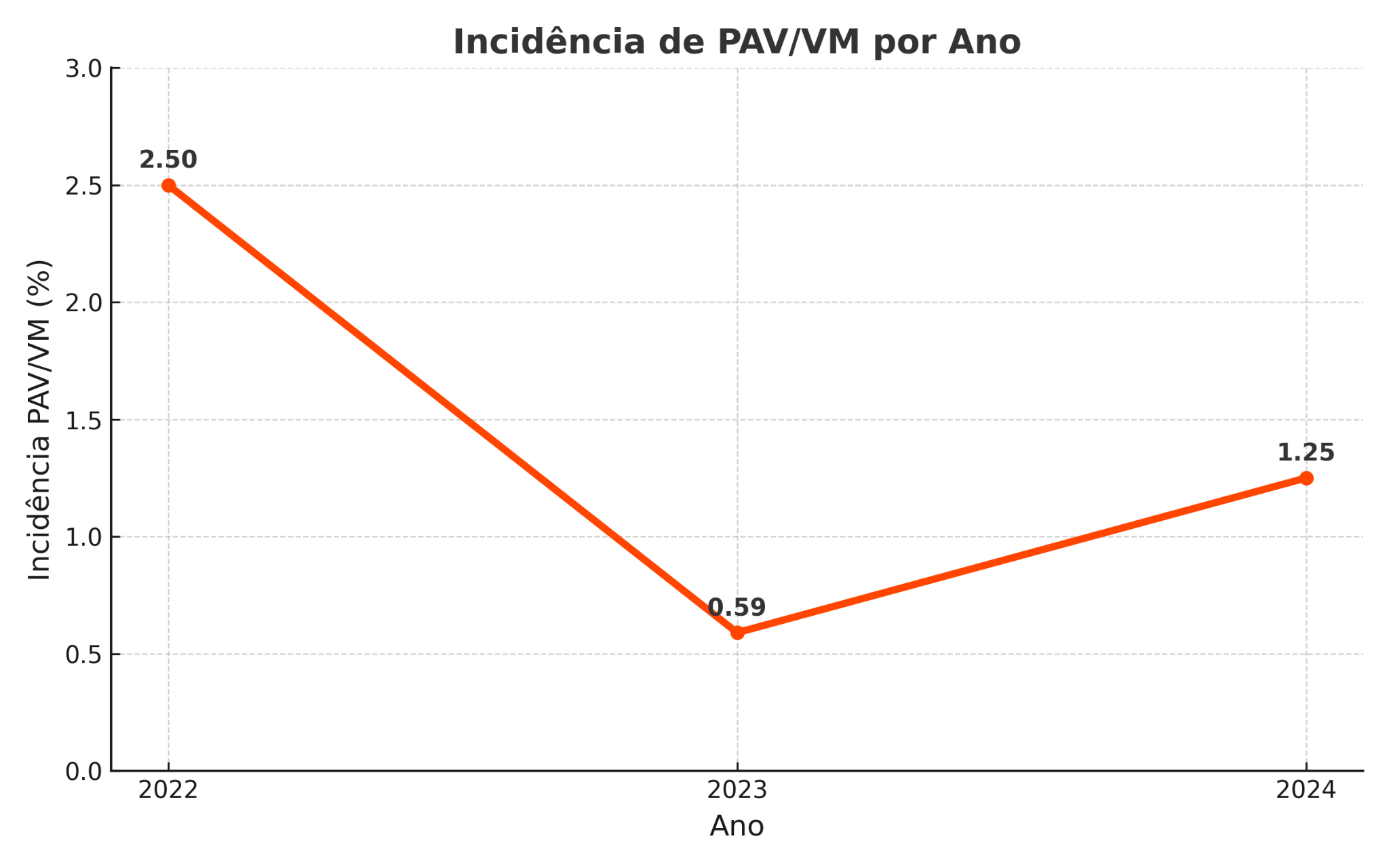
Between 2022 and 2024, 4,206 adult patients underwent mechanical ventilation in the ICU, of whom 57 developed VAP, corresponding to an overall cumulative incidence of 1.36% during the period. For temporal description, cumulative incidences were also presented by year, using the number of ventilated patients in each period as the denominator (Figure 1).
The highest cumulative incidence of VAP was observed in 2022, when 1,158 patients underwent mechanical ventilation and 29 experienced the event, corresponding to 2.5%. In subsequent years, a reduction in incidence was observed, as illustrated in Figure 1.
Statistical analysis showed a significant difference among annual incidences (p < 0.001), with a marked reduction after 2022 and no statistically significant difference between 2023 and 2024.
Figure 1 – Incidence of ventilator-associated pneumonia in the years 2022, 2023, and 2024. Porto Alegre, RS, Brazil, 2022 to 2024
Source: elaborated by the author (2025).
The sample consisted of 29 male patients (50.9%), with a mean age of 54 ± 18 years. Most participants (82.5%) self-identified as White.
Regarding admission source, 33 patients (59.6%) were admitted through the emergency department, and 38 (66.7%) had hospitalization motivated by clinical treatment. Among the main reasons for orotracheal intubation, acute respiratory failure was highlighted, present in 26 cases (45.6%), and decreased level of consciousness, observed in 14 patients (24.6%) (Table 1).
Table 1 – Sample characterization. Porto Alegre (n = 57), RS, Brazil, 2022 to 2024
|
Variables |
n |
% |
|
Sex |
|
|
|
Male |
29 |
50.9 |
|
Age (years), mean ± SD |
54.3 ± 18.8 |
|
|
Race/ethnicity |
|
|
|
White |
47 |
82.5 |
|
Black |
9 |
15.8 |
|
Brown |
1 |
1.8 |
|
Source of admission |
|
|
|
Emergency department |
34 |
59.6 |
|
Operating room |
10 |
17.5 |
|
Ward |
6 |
10.5 |
|
External ICU |
7 |
12.3 |
|
Hospitalization |
|
|
|
Clinical |
38 |
66.7 |
|
Surgical |
19 |
33.3 |
|
Comorbidities |
|
|
|
Hypertension |
26 |
45.6 |
|
DM Cardiovascular diseases Smoking COPD Cerebrovascular diseases |
18 17 15 10 9 |
31.6 29.8 26.3 17.5 15.8 |
|
Obesity |
6 |
10.5 |
|
Immunosuppression |
13 |
22.8 |
|
Reason for orotracheal intubation |
|
|
|
Respiratory failure |
26 |
45.6 |
|
Decreased level of consciousness |
14 |
24.6 |
|
Intraoperative |
16 |
28.1 |
|
Cardiorespiratory arrest |
1 |
1.8 |
|
Duration of IMV (days), median (P25-P75) |
18 (12.5-37.5) |
|
|
SAPS 3, mean ± SD |
48.6 ± 19.6 |
|
|
Neuromuscular blocking agents |
32 |
56.1 |
|
Sedation duration (days), median (P25-P75) |
14 (8-22.5) |
|
|
VAD duration (days), median (P25-P75) |
9.5 (5-22) |
|
|
Tracheostomy |
28 |
49.1 |
|
Hemodialysis |
18 |
31.6 |
|
IUC |
49 |
86 |
|
Venous/arterial catheter |
56 |
98.2 |
|
ICU length of stay (days), median (P25-P75) |
23 (14-41) |
|
|
Time to VAP (days), median (P25-P75) |
7 (4.5-12.5) |
|
|
Total hospital length of stay (days), median (P25-P75) |
40 (22.5-68) |
|
|
In-hospital death |
34 |
59.6 |
COPD: chronic obstructive pulmonary disease; DM: diabetes mellitus; ICU: intensive care unit; IMV: invasive mechanical ventilation; IUC: indwelling urinary catheter; SAPS: simplified acute physiology score; SD: standard deviation; VAD: vasoactive drugs; VAP: ventilator-associated pneumonia.
Source: elaborated by the authors, 2025.
For comparison of the clinical and epidemiological characteristics of individuals diagnosed with VAP, the sample was stratified into two groups: survivors and non-survivors.
The analysis showed a statistically significant association between death and older age (p = 0.048). Duration of vasoactive drug (VAD) use was also significantly associated with mortality, with non-survivors remaining, on average, 5 days longer on VAD (p = 0.026) compared with patients who were discharged from hospital.
Regarding length of stay, survivors presented longer hospital stay than non-survivors (p = 0.002). The remaining comparisons are presented in Table 2.
Table 2 – Comparison of clinical characteristics between surviving and non-surviving patients. Porto Alegre, RS, Brazil, 2022 to 2024
|
Variables |
Survivor (n = 23) |
Death (n = 34) |
p-value |
|
Sex |
|
|
0.516 |
|
Female |
13 (56.5) |
15 (44.1) |
|
|
Male |
10 (43.5) |
19 (55.9) |
|
|
Age (years), mean ± SD |
48.3 ± 18.2 |
58.3 ± 18.3 |
0.048 |
|
Race/ethnicity |
|
|
0.436 |
|
White |
19 (82.6) |
28 (82.4) |
|
|
Black |
3 (13.0) |
6 (17.6) |
|
|
Brown |
1 (4.3) |
0 (0.0) |
|
|
Source of admission |
|
|
0.496 |
|
Emergency department |
15 (65.2) |
19 (55.9) |
|
|
Operating room |
5 (21.7) |
5 (14.7) |
|
|
Ward |
1 (4.3) |
5 (14.7) |
|
|
External ICU |
2 (8.7) |
5 (14.7) |
|
|
Hospitalization |
|
|
1.000 |
|
Clinical |
15 (65.2) |
23 (67.6) |
|
|
Surgical |
8 (34.8) |
11 (32.4) |
|
|
Comorbidities |
|
|
|
|
Hypertension |
7 (30.4) |
19 (55.9) |
0.105 |
|
DM |
4 (17.4) |
14 (41.2) |
0.109 |
|
Obesity |
1 (4.3) |
5 (14.7) |
0.385 |
|
Cardiovascular diseases |
8 (34.8) |
9 (26.5) |
0.706 |
|
Smoking |
6 (26.1) |
9 (26.5) |
1.000 |
|
COPD |
4 (17.4) |
6 (17.6) |
1.000 |
|
Cerebrovascular diseases |
6 (26.1) |
3 (8.8) |
0.137 |
|
Immunosuppression |
4 (17.4) |
9 (26.5) |
0.631 |
|
Reason for orotracheal intubation |
|
|
0.640 |
|
Respiratory failure |
9 (39.1) |
17 (50.0) |
|
|
Decreased level of consciousness |
6 (26.1) |
8 (23.5) |
|
|
Intraoperative |
8 (34.8) |
8 (23.5) |
|
|
Cardiorespiratory arrest |
0 (0.0) |
1 (2.9) |
|
|
Duration of IMV (days), median (P25-P75) |
18 (10-36) |
17.5 (13.8-40.3) |
0.643 |
|
SAPS 3, mean ± SD |
44.0 ± 18.5 |
51.7 ± 20.0 |
0.149 |
|
Neuromuscular blocking agents |
10 (43.5) |
22 (64.7) |
0.189 |
|
Sedation duration (days), median (P25-P75) |
13 (7-23) |
14.5 (9-23) |
0.591 |
|
VAD duration (days), median (P25-P75) |
6.5 (2-17) |
11.5 (6-25.5) |
0.026 |
|
Tracheostomy |
13 (56.5) |
15 (44.1) |
0.516 |
|
Hemodialysis |
5 (23.8) |
13 (39.4) |
0.374 |
|
IUC |
19 (62.6) |
30 (88.2) |
0.702 |
|
ICU length of stay (days), median (P25-P75) |
23 (19-45) |
18.5 (12-40.5) |
0.128 |
|
Time to VAP (days), median (P25-P75) |
7 (4-13) |
7.5 (5-11.5) |
0.928 |
|
Total hospital length of stay (days), median (P25-P75) |
51 (34-95) |
25 (18-55) |
0.002 |
COPD: chronic obstructive pulmonary disease; DM: diabetes mellitus; ICU: intensive care unit; IMV: invasive mechanical ventilation; IUC: indwelling urinary catheter; SAPS: Simplified Acute Physiology Score; SD: standard deviation; VAD: vasoactive drugs; VAP: ventilator-associated pneumonia.
Source: elaborated by the authors, 2025.
DISCUSSION
The analysis of the period from 2022 to 2024 showed an overall cumulative incidence of VAP of 1.36% among 4,206 ventilated patients in the hospital. Annual incidences were 2.5% in 2022, 0.59% in 2023, and 1.25% in 2024, remaining within the institutional infection control targets. This result was considerably lower than that described in the national and international literature, in which rates range from 1.06% to 19.70%, depending on unit profile, ventilation duration, and level of adherence to preventive protocols(15-17).
A study conducted in the ICU of a general hospital in Belgium between 2007 and 2019 reported a mean VAP incidence of 2.7%(17). In a study conducted in a large hospital in the state of Goiás, Brazil, the incidence was 1.06%, with VAP being the most prevalent infection in the unit and responsible for 43.18% of recorded HAIs(18).
Research shows variations in VAP rates related to the implementation of patient safety strategies, although isolated preventive measures do not always result in consistent reductions in clinical outcomes. In the Belgian study, for example, a slight reduction in incidence over the years was observed, without robust evidence of sustained impact.
In the present study, a statistically significant reduction in VAP incidence was observed between 2022 and 2023 (p < 0.001), followed by stabilization in 2024. This trend coincides with restructuring of the institutional prevention program and adoption of a continuous improvement model based on the ANVISA prevention bundle(5). The results reinforce the positive impact of the restructuring of PAVPREV, which reintroduced systematic audits, multidisciplinary training, and immediate feedback to teams, measures recognized as essential for controlling infections related to mechanical ventilation. However, although the reduction in incidence temporally coincides with program restructuring, the study design does not allow a direct causal relationship between implemented interventions and observed outcomes to be established.
The slight increase observed in 2024 reinforces the need for continuous maintenance of preventive strategies. Factors such as staff turnover, protocol fatigue, and gaps in internal audits may compromise adherence and reduce effectiveness of measures. Sustainability of results depends on permanent integration of preventive practices into routine care and systematic monitoring of indicators.
In the analysis of clinical outcomes, patients who died were significantly older than survivors (58.3 ± 18.3 vs. 48.3 ± 18.2 years; p = 0.048), reinforcing the association between older age and worse prognosis in intensive care. Reduced physiological reserve and greater burden of comorbidities in older individuals contribute to this result by limiting response to infectious stress and invasive procedures(15,19).
Duration of VAD use was significantly longer among non-survivors (11.5 vs. 6.5 days; p = 0.026), suggesting that prolonged need for these agents reflects greater clinical instability and is associated with increased mortality risk(20). Cohort studies conducted in Argentina and South Korea identified similar findings, indicating VAD use as an independent predictor of death and a higher likelihood of developing VAP(21,22).
A shorter median hospital length of stay was also observed among non-survivors (25 vs. 51 days), indicating that more severe conditions tend to progress early to fatal outcomes. Conversely, patients who survive remain hospitalized for longer periods, possibly related to recovery and rehabilitation following the critical episode.
Brazilian studies corroborate this pattern. In a cohort of 573 patients, 148 deaths occurred within 7 days of hospitalization(23). Similarly, 53.2% of deaths occurred between the 1st and 3rd days(24). Another prospective study identified length of hospital stay as a predictor of mortality, reinforcing that fatal outcomes are associated with shorter hospital stays(25).
International evidence confirms this behavior. A retrospective study reported that approximately one-third of ICU deaths occurred within the first 24 h of admission, regardless of initial severity or admission type(26). A multicenter registry involving 53,305 hospitalizations in Nordic countries showed a median length of stay among non-survivors of 1.5 days (interquartile range: 0.5-4.2)(27).
Overall, the observed mortality of 59.6% is consistent with prior research, which describes rates above 50% among patients who develop VAP during ICU hospitalization(25). This finding reinforces the importance of permanent surveillance strategies, early diagnosis, and qualified management of complications, with special attention to monitoring VAD use and adopting individualized care, particularly in older patients.
Maintaining low VAP rates depends on strict adherence to prevention protocols and continuous investment in training care teams. In this process, the role of the multidisciplinary team, especially nursing, is highlighted in implementing preventive measures and mitigating the impact of this condition on clinical outcomes.
The findings also highlight the strategic role of nursing leadership and care management in sustaining preventive practices. Consolidation of a safety culture depends on active professional participation in bedside surveillance, critical analysis of indicators, and strengthening institutional quality improvement programs.
This study has limitations that must be considered. The retrospective design and use of secondary data may introduce information bias, underdiagnosis, and variations in the quality of clinical and epidemiological records over the analyzed period. In addition, changes in surveillance processes and care organization after the pandemic may have influenced case identification, and results should be interpreted in light of these limitations.
Although literature often uses multivariate models to investigate factors associated with mortality, adjusted regression was not considered appropriate in this study due to the small number of events (34 deaths) and the risk of unstable estimates and overfitting. Therefore, analyses should be interpreted as exploratory, with hypothesis-generating potential, without the intention of identifying independent predictors or establishing causal relationships.
Prospective studies with larger samples and more robust methodological designs are needed to deepen understanding of factors associated with mortality and improve intensive care strategies.
In this context, the findings reinforce the importance of interpreting VAP indicators not only as measures of care performance but also as indirect markers of clinical complexity and vulnerability of critically ill patients, contributing to a more qualified analysis of quality and safety of care in intensive care.
CONCLUSION
The study analyzed the magnitude of VAP and its outcomes in a high-complexity university hospital in the post-pandemic period, demonstrating cumulative incidence lower than values described in the national and international literature. These findings suggest favorable performance in a setting that adopts structured prevention strategies. Implementation of a continuous improvement model based on the ANVISA prevention bundle was associated with a significant reduction in incidence, reinforcing the importance of surveillance programs and continuing education in controlling infections related to mechanical ventilation.
Despite the low incidence, high mortality was observed among patients with VAP, particularly associated with vulnerability conditions commonly present in critically ill patients. Older age and prolonged use of vasoactive drugs indicated greater clinical severity when associated with VAP, relating to shorter length of stay and unfavorable outcomes.
These results highlight the importance of qualified interpretation of these indicators, as they allow not only evaluation of care performance but also identification of indirect markers of clinical complexity and vulnerability of critically ill patients.
*Article derived from the undergraduate nursing thesis titled “Incidence of ventilator-associated pneumonia in a public university hospital in southern Brazil,” presented to the Nursing program at the Federal University of Rio Grande do Sul, Porto Alegre, Rio Grande do Sul, Brazil, in 2025.
CONFLICT OF INTEREST
The authors declare no conflicts of interest.
REFERENCES
1. Paiva R de M, Ferreira L de L, Bezerril MDS, Chiavone FTB, Salvador PTC de O, Santos VEP. Infection factors related to nursing procedures in Intensive Care Units: a scoping review. Rev Bras Enferm. 2021;74(1):e20200731. https://doi.org/10.1590/0034-7167-2020-0731. PMID: 33886931.
2. Gomes GD, Santos JMM, Gomes BKG, Pereira VS, Dias ACA, Vieira HAL, et al. Pneumonia associada à ventilação mecânica em unidades de terapia intensiva. Res Soc Dev. 2022;11(10):e74111032422. https://doi.org/10.33448/rsd-v11i10.32422
3. Papazian L, Klompas M, Luyt CE. Ventilator-associated pneumonia in adults: a narrative review. Intensive Care Med. 2020;46(5):888-906. https://doi.org/10.1007/s00134-020-05980-0. PMID: 32157357.
4. Fernando SM, Tran A, Cheng W, Klompas M, Kyeremanteng K, Mehta S, et al. Diagnosis of ventilator-associated pneumonia in critically ill adult patients—a systematic review and meta-analysis. Intensive Care Med. 2020;46(6):1170-9. https://doi.org/10.1007/s00134-020-06036-z. PMID: 32306086.
5. Brasil. Agência Nacional de Vigilância Sanitária. Medidas de prevenção de infecção relacionada à assistência à saúde: caderno 4 [Internet]. Brasília, DF: Anvisa; 2020 [cited 2024 Aug 11]. Available from: https://www.gov.br/anvisa/pt-br/centraisdeconteudo/publicacoes/servicosdesaude/publicacoes/caderno-4-medidas-de-prevencao-de-infeccao-relacionada-a-assistencia-a-saude.pdf/view
6. Nóbrega LMB, Vasconcelos JDMB, Morais JLP de, Araújo CC de, Ramalho Neto JM, Leite AC. Pneumonia associada à ventilação mecânica em pacientes graves de uma unidade de terapia intensiva. Enferm Foco. 2021;12(4). https://doi.org/10.21675/2357-707x.2021.v12.n4.4525
7. Costa RS, Motta LC de S, Alfradique MD. O perfil epidemiológico do paciente com pneumonia associada à ventilação mecânica. Rev Fac Med Teresópolis [Internet]. 2018 [cited 2024 Aug 11];2(2). Available from: https://revista.unifeso.edu.br/index.php/faculdadedemedicinadeteresopolis/article/view/1020
8. Leite RF, Michel e Silva B. Perfil epidemiológico e análise clínica de pacientes com pneumonia associada à ventilação mecânica em um hospital de ensino. HSJ. 2018;8(3):14-8. https://doi.org/10.21876/rcsfmit.v8i3.766
9. Alvares FA, Oliveira CS de, Alves DCI, Braun G. Pneumonia associada à ventilação mecânica: incidência, etiologia microbiana e perfil de resistência aos antimicrobianos. Rev Epidemiol Control Infect. 2022;11(4). https://doi.org/10.17058/reci.v11i4.16781
10. Silva NC, Silveira VM, Keller GS, Silva GC da, Rovaris PL, Nola R. Perfil epidemiológico da pneumonia associada à ventilação mecânica. Arq Catarin Med. 2021;50(2):132-41. https://doi.org/10.63845/n9xcvq30
11. Organização Mundial da Saúde. Segurança do paciente [Internet]. 2020 [cited 2024 Aug 8]. Available from: https://www.who.int/news-room/fact-sheets/detail/patient-safety
12. Sánchez Peña M, Orozco Restrepo LA, Barrios Arroyave FA, Suárez Brochero OF. Impact of an educational intervention aimed at nursing staff on oral hygiene care on the incidence of ventilator-associated pneumonia in adults ventilated in intensive care unit. Invest Educ Enferm. 2021;39(3):e06. https://doi.org/10.17533/udea.iee.v39n3e06. PMID: 34822233.
13. Malta M, Cardoso LO, Bastos FI, Magnanini MMF, Silva CMFP da. STROBE initiative: guidelines on reporting observational studies. Rev Saude Publica. 2010;44(3):559-65. https://doi.org/10.1590/s0034-89102010000300021. PMID: 20549022.
14. Soares M, Salluh JIF. Validation of the SAPS 3 admission prognostic model in patients with cancer in need of intensive care. Intensive Care Med. 2006;32(11):1839-44. https://doi.org/10.1007/s00134-006-0374-4. PMID: 16977481.
15. Aguiar LMM, Martins G de S, Valduga R, Gerez AP, Carmo EC do, Cunha K da C, et al. Profile of adult intensive care units in Brazil: systematic review of observational studies. Rev Bras Ter Intensiva. 2021;33(4):624-34. https://doi.org/10.5935/0103-507x.20210088. PMID: 35081247.
16. Elsheikh M, Kuriyama A, Goto Y, Takahashi Y, Toyama M, Nishikawa Y, et al. Incidence and predictors of ventilator-associated pneumonia using a competing risk analysis: a single-center prospective cohort study in Egypt. BMC Infect Dis. 2024;24(1):1007. https://doi.org/10.1186/s12879-024-09909-6. PMID: 39300386.
17. Maertens B, Blot S, Huis In 't Veld D, Blot K, Koch A, Mignolet K, et al. Stepwise implementation of prevention strategies and their impact on ventilator-associated pneumonia incidence: a 13-year observational surveillance study. Intensive Crit Care Nurs. 2025;86:103769. https://doi.org/10.1016/j.iccn.2024.103769. PMID: 39043503.
18. Fagundes APFS, Alencar RP, Costa AS, Pereira DSO, Araújo CM. Indicadores de infecção relacionados à assistência à saúde em um hospital de urgência e trauma. Rev Cient Esc Estadual Saúde Pública de Goiás “Candido Santiago”. 2023;9(9c1):1-14. https://doi.org/10.22491/2447-3405.2023.V9.9c1
19. Teng G, Wang N, Nie X, Zhang L, Liu H. Analysis of risk factors for early-onset ventilator-associated pneumonia in a neurosurgical intensive care unit. BMC Infect Dis. 2022;22(1):66. https://doi.org/10.1186/s12879-022-07053-7. PMID: 35057762.
20. Oliveira CBS de, Araújo TO de, Dantas JTS, Gomes GER, Nascimento DJS do, Silva AS. Cuidados de enfermagem na administração de drogas vasoativas em Unidade de Terapia Intensiva: uma revisão integrativa. Rev Cereus. 2023;15(4):268-82. https://doi.org/10.18605/2175-7275/cereus.v15n4p268-282
21. Núñez SA, Roveda G, Zárate MS, Emmerich M, Verón MT. Ventilator-associated pneumonia in patients on prolonged mechanical ventilation: description, risk factors for mortality, and performance of the SOFA score. J Bras Pneumol. 2021;47(3):e20200569. https://doi.org/10.36416/1806-3756/e20200569. PMID: 34190861.
22. Lee JY, Sul YH, Kim SH, Ye JB, Lee JS, Choi H, et al. Risk factors for ventilator-associated pneumonia in trauma patients with torso injury: a retrospective single-center study. J Int Med Res. 2021;49(12):3000605211061029. https://doi.org/10.1177/03000605211061029. PMID: 34871529.
23. Albuquerque JM, Silva RFA, Souza RFF. Perfil epidemiológico e seguimento após alta de pacientes internados em unidade de terapia intensiva. Cogitare Enferm. 2017;22(3):e50609. https://doi.org/10.5380/ce.v22i3.50609
24. Favarin SS, Camponogara S. Perfil dos pacientes internados na unidade de terapia intensiva adulto de um hospital universitário. Rev Enferm UFSM. 2012;2(2):320-9. https://doi.org/10.5902/217976925178
25. Oliveira JC, Vasconcelos GM, Bispo LD, Magro MC, Fonseca CD, Pinheiro FG, et al. Preditores de mortalidade e tempo médio de sobrevivência dos pacientes críticos. Acta Paul Enferm. 2023;36:eAPE01192. https://doi.org/10.37689/acta-ape/2023AO01192
26. Andersen SK, Montgomery CL, Bagshaw SM. Early mortality in critical illness – a descriptive analysis of patients who died within 24 hours of ICU admission. J Crit Care. 2020;60:279-84. https://doi.org/10.1016/j.jcrc.2020.08.024. PMID: 32942163.
27. Strand K, Walther SM, Reinikainen M, Ala-Kokko T, Nolin T, Martner J, et al. Variations in the length of stay of intensive care unit nonsurvivors in three Scandinavian countries. Crit Care. 2010;14(5):R175. https://doi.org/10.1186/cc9279. PMID: 20920348.
Submission: 28-Nov-2025
Approved: 01-Feb-2026
Editors:
Rosimere Ferreira Santana (ORCID: 0000-0002-4593-3715)
Geilsa Soraia Cavalcanti Valente (ORCID: 0000-0003-4488-4912)
Luciano Marques dos Santos (ORCID: 0000-0001-7866-6353)
Corresponding author: Mirella Zolner dos Santos (zolnermirella@gmail.com)
Publisher:
Escola de Enfermagem Aurora de Afonso Costa – UFF
Rua Dr. Celestino, 74 – Centro, CEP: 24020-091 – Niterói, RJ, Brazil
Journal email: objn.cme@id.uff.br
|
AUTHORSHIP CONTRIBUTIONS |
|
Study design: Santos MZ, Barcellos RA. Data collection: Santos MZ, Barcellos RA. Data analysis: Santos MZ, Barcellos RA, Azzolin KO, Candaten AE, Bavaresco T. Data interpretation: Santos MZ, Barcellos RA, Azzolin KO, Candaten AE, Bavaresco T. All authors are responsible for the textual writing and critical review of the intellectual content, the final version published, and all ethical, legal, and scientific aspects related to the accuracy and integrity of the study. |
