
REVIEW PROTOCOL
PLAYFULNESS IN THE CARE OF CHILDREN WITH CONGENITAL CRANIOFACIAL ANOMALIES: A SCOPING REVIEW PROTOCOL
Mariana Martire Mori1, Camila Moraes Garollo Piran1, Alana Vitoria Escritori Cargnin1, Camila Siqueira Floresta Lehmkuhl1, Leslie Villarroel Yañez2, Fernanda Ribeiro Baptista Marques1, Maria de Fátima Garcia Lopes Merino1, Marcela Demitto Furtado1
1 State University of Maringá, PR, Brazil
2 University of Antofagasta, Antofagasta, Chile
RESUMO
Objective: To map the playful strategies used with children who have craniofacial anomalies. Method: This scoping review protocol developed according to the Joanna Briggs Institute (JBI) methodology (registered on the Open Science Framework under DOI 10.17605/OSF.IO/SKUV3). The guiding question of the review is: “How are playful strategies used with children who have craniofacial anomalies?” Studies with qualitative, quantitative, and mixed-method approaches, as well as systematic reviews and guidelines, will be included, with no time frame or language restrictions. Studies that do not meet the objective, are duplicates, or are not available in full text will be excluded. The search will be conducted in 14 databases. Results will be presented in a flowchart format to facilitate understanding.
Descriptors: Play Therapy; Child; Craniofacial Abnormalities.
|
How to cite: Mori MM, Piran CMG, Cargnin AVE, Lehmkuhl CSF, Yañez LV, Marques FRB, et al. Playfulness in the care of children with congenital craniofacial anomalies: a scoping review protocol. Online Braz J Nurs. 2025;24(Suppl 1):e20256842. https://doi.org/10.17665/1676-4285.20256842 |
INTRODUCTION
Congenital craniofacial anomalies result from musculoskeletal disorders that impair the proper development of the skull and facial bones and are responsible for a significant portion of infant morbidity and mortality cases(1). Around 8 million children are born with some type of congenital anomaly each year worldwide, and approximately 25,000 live births with this condition are registered annually in Brazil(2). The severity of these cases can range from mild to severe, with many requiring immediate surgical intervention. Among the most common craniofacial anomalies are cleft lip and/or cleft palate(2).
Craniofacial anomalies cause a range of impairments in children, affecting speech, dental health, hearing, and breathing, in addition to impacting mental health and self-image(3). Treatment and rehabilitation take place in specialized centers over an extended period, often continuing into adulthood. As a result, hospitalizations, medical procedures, and rehabilitation therapies become frequent during childhood and may lead to trauma and emotional issues such as anxiety, pain, fear, and fatigue due to the ongoing nature of treatment. These factors can also distance the child from age-appropriate activities that are essential to their natural developmental process(4).
In this context, the use of playful strategies becomes an important resource for the health care team, serving to welcome the child and their family, strengthen bonds, and stimulate interest and curiosity. Among these strategies are games and playful activities, which aim to provide moments of joy, relaxation, and entertainment for the patient. In addition, these activities help prepare the child for upcoming situations through appropriate language, allowing them to understand their health condition and express fears and tensions. They also help bring the child closer to their routine, contributing to alleviating suffering and supporting their coping with the illness(5).
Children with craniofacial anomalies are at greater risk of experiencing emotional and affective disorders due to prolonged stays in the hospital environment, frequent contact with unfamiliar professionals, and repeated medical interventions and handling. These impacts can be minimized using playful strategies and the involvement of the family in health care(6).
The instructional therapeutic toy (ITT) is a playful tool used to prepare and inform the child about therapeutic procedures(5). A study that applied ITT in the preoperative period of cleft lip and palate correction found that its use was beneficial in relieving tension, anxiety, and fear. It also encouraged positive behaviors in children and reactivated the memory of play as a recreational activity(7). Other playful strategies can also be used to promote well-being during the postoperative period, a time when the child’s comfort is often compromised(6).
In order to identify studies addressing this topic, a preliminary search was conducted in the main health databases, and no similar studies — either published or in progress—were found. Considering the impact of craniofacial anomalies on children’s lives and the importance of play as a child right, the present study is justified by the need to understand the playful strategies used in the care of children with craniofacial anomalies. Therefore, the objective of this study is to map the playful strategies employed with children who present craniofacial anomalies.
METHOD
Study design
This is a scoping review protocol developed according to the methodological framework of the JBI(8) following the recommendations of the Preferred Reporting Items for Systematic Reviews and Meta-Analyses – Extension for Scoping Reviews (PRISMA-ScR)(9). A scoping review is a type of study aimed at exploring the concepts related to a given topic and examining the extent and nature of scientific literature, highlighting potential gaps in knowledge on the subject(8-9).
Search strategy
The review question was developed based on the PCC mnemonic, which stands for Population, Concept, and Context. In this study, P refers to children; C, to playful strategies; and C, to craniofacial anomalies. Children are defined as individuals aged between zero and 12 years. Based on these elements, the following research question was formulated: How are playful strategies used with children who have craniofacial anomalies?
A pilot search was conducted in the PubMed and Scientific Electronic Library Online (SciELO) databases to identify, through published articles, the most frequently used descriptors related to the research topic. For the search, the following controlled descriptors will be used, drawn from the Health Sciences Descriptors (DeCS) and Medical Subject Headings (MeSH): child, preschool child, play therapy, play and playthings, cleft lip, and craniofacial abnormalities. Alternative descriptors such as toy therapy and therapeutic toy will also be used, along with the Boolean operators AND and OR.
The following databases will be used to search for scientific literature: Web of Science, ScienceDirect, Scopus, Cumulative Index to Nursing and Allied Health Literature (CINAHL), Excerpta Medica Database (Embase), Cochrane Library, PubMed/Medline, Virtual Health Library - VHL (Latin American and Caribbean Health Sciences Literature - LILACS and Nursing Database - BDENF) e SciELO. For grey literature, the Coordination for the Improvement of Higher Education Personnel (CAPES) Theses and Dissertations Catalog, OpenGrey, PeerJ Preprints, medRxiv, and bioRxiv Preprints will be consulted. The specific search strategies for each database are presented in Table 1.
Table 1 - Search strategies. Maringá, PR, Brazil, 2025.
|
Databases |
Search strategy |
|
Web of Science |
ALL= ((((((Child) OR (Child, Preschool)) AND ((Play Therapy) OR (Play and Playthings) OR (Therapeutic Toy) OR (Toy Therapy)) AND ((Craniofacial Abnormalitie) OR (Cleft Lip)))))) |
|
ScienceDirect |
("child” OR “Child, Preschool”) AND (“Play Therapy” OR “Play and Playthings” OR “Therapeutic Toy”) AND (“Craniofacial Abnormalities” OR “Cleft lip”) |
|
Scopus |
("Child" ) OR ( "Child, Preschool" ) AND ( "Play Therapy" ) OR ( "Play and Playthings" ) OR ( "Therapeutic Toy" ) OR ( "Toy Therapy" ) AND ( "Craniofacial Abnormalitie" ) OR ( "Cleft Lip" ) |
|
CINAHL |
("child” OR “Child, Preschool”) AND (“Play Therapy” OR “Play and Playthings” OR “Therapeutic Toy”) AND (“Craniofacial Abnormalities” OR “Cleft lip”) |
|
Embase |
("child” OR “Child, Preschool”) AND (“Play Therapy” OR “Play and Playthings” OR “Therapeutic Toy”) AND (“Craniofacial Abnormalities” OR “Cleft lip”) |
|
Cochrane |
(child OR Child, Preschool) AND (Play Therapy OR Play and Playthings OR Therapeutic Toy) AND (Craniofacial Abnormalities OR Cleft lip) |
|
PubMed/Medline |
("child” OR “Child, Preschool”) AND (“Play Therapy” OR “Play and Playthings” OR “Therapeutic Toy”) AND (“Craniofacial Abnormalities” OR “Cleft lip”) |
|
VHL (LILACS, BDENF) |
((child) OR (child, preschool) AND (play therapy) OR (play AND playthings) OR (therapeutic toy) OR (toy therapy) AND (craniofacial abnormalitie) OR (cleft lip)) |
|
SciELO |
("Child") OR ("Child, Preschool") AND ("Play Therapy") OR ("Play and Playthings") OR ("Therapeutic Toy") OR ("Toy Therapy") AND ("Craniofacial Abnormalitie") OR ("Cleft Lip") |
|
CAPES Theses and Dissertations Catalog |
(child) AND (Therapeutic Toy) AND (Craniofacial Abnormalities OR Cleft lip) |
|
OpenGrey |
("Child" OR "Child, Preschool") AND ("Play Therapy" OR "Play and Playthings" OR "Toy Therapy" OR "Therapeutic Toy) AND ("Craniofacial Abnormalities" OR "Cleft Lip") |
|
PeerJ Preprints |
("Child" OR "Child, Preschool") AND ("Play Therapy" OR "Play and Playthings" OR "Toy Therapy" OR "Therapeutic Toy) AND ("Craniofacial Abnormalities" OR "Cleft Lip") |
|
medRxiv |
("Child") AND ("Therapeutic Toy" OR "Toy Therapy") AND ("Craniofacial Abnormalities" OR "Cleft lip") |
|
bioRxiv Preprints |
("Child") AND ("Play Therapy" OR "Play and Playthings" OR "Toy Therapy" OR "Therapeutic Toy) AND ("Craniofacial Abnormalities") |
Eligibility criteria
Data collection will begin in September 2024. Studies with qualitative, quantitative, or mixed-method approaches, as well as systematic reviews and guidelines, will be included, with no time or language restrictions. Studies that do not meet the objective of the review, are duplicates, or are not accessible in full text — even after two attempts to contact the authors — will be excluded.
Study selection
Titles, abstracts, and descriptors of all retrieved materials will be analyzed. Those that meet the objective of the review will be read in full, and their references will also be examined in order to include all studies related to the topic(10-11). The selected materials will be imported into the Rayyan platform(12) (Intelligent Systematic Review) to assist with organization and optimize the review process. It is important to note that the selection will be conducted blindly by two independent reviewers. In case of disagreement, a third reviewer will be consulted. The results will be analyzed according to the flow diagram presented in Figure 1.
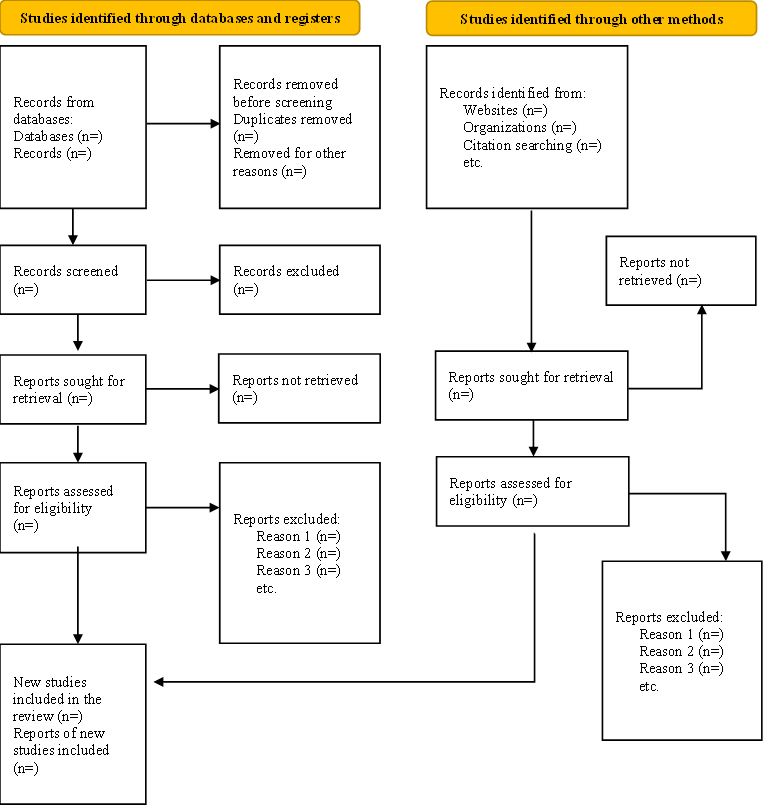
Source: PRISMA flow diagram adapted from Page et al.(11).
Figure 1 - PRISMA flow diagram model. Maringá, PR, Brasil, 2025
Data extraction and synthesis
Data from the selected materials will be extracted using a tool developed in accordance with JBI recommendations, as shown in Table 2. This tool will include the following information: author names, academic background of the first author, year of publication, country, study title and objective, study type/methodology, population, described craniofacial anomaly, sample size, type of playful strategy used, and its context(8). The results will be organized in a flowchart format to facilitate interpretation and will also be presented in tables.
Table 2 - Data extraction tool. Maringá, PR, Brazil, 2025
|
Variable |
Question |
|
Authors |
What are the names of the authors? |
|
First author |
What is the academic background of the first author? |
|
Year of publication |
In what year was the material published? |
|
Country of origin |
In which country was the study conducted? |
|
Title |
What is the title of the material? |
|
Objective |
What is the objective of the study? |
|
Study methodology |
What type of study was conducted? |
|
Population |
Who are the study participants? |
|
Craniofacial anomaly |
What craniofacial anomaly was described? |
|
Sample |
What is the sample size of the study? |
|
Playful strategy |
What playful strategy was used? |
|
Context |
In what context was the playful strategy applied? |
Ethical considerations
This study does not require approval from a Research Ethics Committee, as it involves a review of already published materials. The protocol was registered on the Open Science Framework (OSF) under DOI 10.17605/OSF.IO/SKUV3.
CONFLICTS OF INTEREST
The authors declare no conflicts of interest.
FUNDING
This study was financed in part by the CAPES – Brazil – Finance Code 001.
REFERENCES
1. Farhan TM, Al-Abdely BA, Abdullateef AN, Jubair AS. Craniofacial Anomaly Association with the Internal Malformations in the Pediatric Age Group in Al-Fallujah City-Iraq. Biomed Res Int. 2020;2020(1):4725141. https://doi.org/10.1155/2020/4725141
2. Ministério da Saúde (BR). Anomalias e infecções congênitas selecionadas: guia de consulta rápida [Internet]. Brasília: Ministério da Saúde; 2022 [cited 2024 Aug 10]. Available from: http://plataforma.saude.gov.br/anomalias-congenitas/anomalias-infeccoes-congenitas-selecionadas-guia-consulta-rapida.pdf
3. Akintoye SO, Adisa AO, Okwuosa CU, Mupparapu M. Craniofacial disorders and dysplasias: Molecular, clinical, and management perspectives. Bone Rep. 2024;20:101747. https://doi.org/10.1016/j.bonr.2024.101747
4. Kennedy M, Howlin F. Preparation of children for elective surgery and hospitalisation: A parental perspective. J Child Health Care. 2022;26(4):568-580. https://doi.org/10.1177/13674935211032804
5. Mandetta MA, Toso BRGO, Gaiva MAM, Maia EBS, Barber ROB, Ribeiro CA, organizadores. Brincar e o brinquedo terapêutico: na assistência de enfermagem à criança e família. São Paulo: SOBEP; 2023.
6. Galdino MF, Batista NT, Martinez AF, Melo CR, Zamboni CS, Bom GC, et al. Diagnósticos e intervenções de enfermagem em crianças em pós-operatório imediato de queiloplastia. Enferm. foco (Brasília). 2024;15:e-202430. https://doi.org/10.21675/2357-707X.2024.v15.e-202430
7. Fontes CMB, Sá FM, Mondini CCSD, Moraes MCAF. Therapeutic toy and child preparation for correction of cleft lip and palate surgery. Rev. enferm. UFPE on line. 2013 [cited 2024 Aug 10];7(7):4681-4688. Available from: https://periodicos.ufpe.br/revistas/revistaenfermagem/article/view/11718
8. Peters MDJ, Godfrey C, McInerney P, Munn Z, Tricco AC, Khalil, H. Scoping Reviews (2020). In: Aromataris E, Lockwood C, Porritt K, Pilla B, Jordan Z, editores. JBI Manual for Evidence Synthesis. Adelaide: JBI; 2024. https://doi.org/10.46658/JBIMES-24-09
9. Tricco AC, Lillie E, Zarin W, O’Brien KK, Colquhoun H, Levac D, et al. PRISMA Extension for Scoping Reviews (PRISMA-ScR): Checklist and Explanation. Ann Intern Med. 2018;169(7):467-473. https://doi.org/10.7326/M18-0850
10. Peters MDJ, Godfrey C, Mcinerney P, Khalil H, Larsen P, Marnie C, et al. Best practice guidance and reporting items for the development of scoping review protocols. JBI Evid Synth. 2022;20(4):953-968. https://doi.org/10.11124/JBIES-21-00242
11. Page MJ, McKenzie JE, Bossuyt PM, Boutron I, Hoffmann TC, Mulrow CD, et al. Updating guidance for reporting systematic reviews: development of the PRISMA 2020 statement. J Clin Epidemiol. 2021;134:103-112. https://doi.org/10.1016/j.jclinepi.2021.02.003
12. Ouzzani M, Hammady H, Fedorowicz Z, Elmagarmid A. Rayyan—a web and mobile app for systematic reviews. Syst Rev. 2016;5(1):210. https://doi.org/10.1186/s13643-016-0384-4
Submission: 21-Aug-2024
Approved: 26-Mar-2025
Editors:
Rosimere Ferreira Santana (ORCID: 0000-0002-4593-3715)
Geilsa Soraia Cavalcanti Valente (ORCID: 0000-0003-4488-4912)
Katerine Moraes dos Santos (ORCID: 0000-0002-2064-5207)
Corresponding author: Mariana Martire Mori (mari_mmori@hotmail.com)
Publisher:
Escola de Enfermagem Aurora de Afonso Costa – UFF
Rua Dr. Celestino, 74 – Centro, CEP: 24020-091 – Niterói, RJ, Brazil
Journal email: objn.cme@id.uff.br
|
AUTHORSHIP CONTRIBUTIONS |
|
Project design: Mori MM, Piran CMG, Cargnin AVE, Lehmkuhl CSF, Yañez LV, Marques FRB, Merino MFGL, Furtado MD. Data collection: Não se aplica. Data analysis and interpretation: Não se aplica. Writing and/or critical review of the intellectual content: Mori MM, Piran CMG, Cargnin AVE, Lehmkuhl CSF, Yañez LV, Marques FRB, Merino MFGL, Furtado MD. Final approval of the version to be published: Mori MM, Piran CMG, Cargnin AVE, Lehmkuhl CSF, Yañez LV, Marques FRB, Merino MFGL, Furtado MD. Responsibility for the text in ensuring the accuracy and completeness of any part of the paper: Mori MM, Piran CMG, Cargnin AVE, Lehmkuhl CSF, Yañez LV, Marques FRB, Merino MFGL, Furtado MD. |
